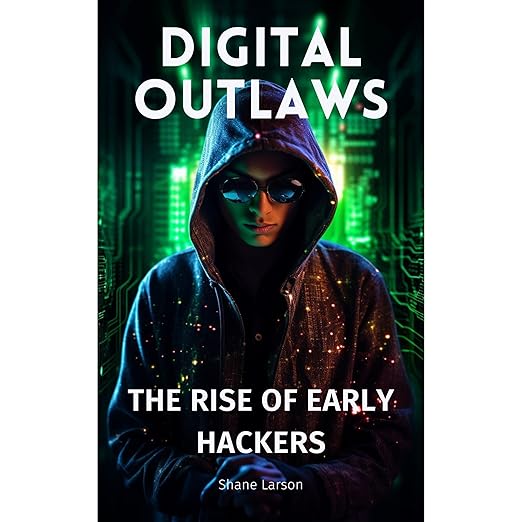
Digital Outlaws: The Rise of Early Hackers presents itself as a chronicle of the original hacker generation, the people who shaped today's internet, cybersecurity landscape, and digital culture through a combination of technical brilliance, rule-breaking curiosity, and, occasionally, genuine criminality. As an audiobook, it aims to cover figures like John Draper (Captain Crunch), Kevin Mitnick, and the creators of the Morris Worm, alongside institutional moments like the founding of the Chaos Computer Club. The subject matter is inherently compelling. The execution, unfortunately, is constrained by a significant production limitation that any potential listener needs to understand before committing to the four-hour-and-twelve-minute runtime.
This audiobook is narrated by Virtual Voice, which means the narration is AI-generated rather than performed by a human narrator. That distinction matters enormously for this particular kind of material. Hacker history is fundamentally about personality, about the specific quality of obsessive curiosity that drove people like Mitnick and Draper to do what they did. Conveying personality requires a narrator who can modulate pace, emphasis, and register to reflect the shifts between technical explanation, human drama, and ethical analysis. Virtual Voice delivers words; it does not deliver meaning in that interpretive sense.
Episodic Chapters Turn Abrupt Without a Human Narrator
The underlying text has genuine strengths. Shane Larson covers the essential historical beats of early hacker culture with reasonable accuracy: the phone phreaking era, the emergence of personal computer networks, the escalation from curious exploration to legally actionable intrusion, and the regulatory response that produced the first computer fraud legislation. The narrative arc from individual hackers operating in isolation to the formation of organized communities like the Chaos Computer Club is handled with a clear sense of historical progression. This is not a technically rigorous academic history, but it is a readable popular account of a period that shaped how we think about digital security, privacy, and the ethics of network access.
The chapter structure is episodic by design, moving from figure to figure and event to event. This works reasonably well on the page but creates challenges in audio form. With a human narrator, the transition between Kevin Mitnick's story and the Morris Worm sequence would be handled with tonal adjustment that signals the shift in register. With Virtual Voice, the transitions are abrupt in a way that can make the narrative feel assembled rather than told. Listeners who are primarily interested in the factual content rather than the storytelling experience will tolerate this better than those who come expecting the kind of immersive narrative delivery that good nonfiction audiobook narration provides.
The 2600-Hertz Whistle That Unlocked AT&T
The historical coverage has genuine value for listeners who want an accessible introduction to early hacker culture without reading Steven Levy's more demanding and detailed 'Hackers: Heroes of the Computer Revolution.' Larson writes accessibly and his ethical framing, the examination of the line between curiosity and violation, between the hacker ethos and its criminal manifestations, is thoughtful rather than preachy. The book does not simply lionize its subjects; it acknowledges the genuine harm that some of the early hackers caused and the legitimate public interest in the regulations that followed.
The section on John Draper and phone phreaking is the audiobook's strongest passage. Draper's discovery that a Captain Crunch cereal box whistle generated the precise 2600-hertz tone that unlocked AT&T's phone network is one of the genuinely mythic stories of early hacker culture, and Larson tells it with appropriate attention to both the technical ingenuity and the larger cultural significance. For listeners encountering this story for the first time, it functions as the entry point into understanding why the hacker ethos is more than simple lawbreaking.
More Nuanced Than Heroes Versus Criminals
Beyond the Virtual Voice limitation, the book's treatment of its subjects is necessarily compressed. At four hours and twelve minutes covering decades of hacker history and multiple major figures, the depth available per subject is limited. Listeners who know the Mitnick story from his own memoir or from Jonathan Littman's 'The Fugitive Game' will find Larson's treatment thinner than they might like. The book is genuinely designed for readers coming to this history for the first time rather than those seeking to deepen an existing knowledge base.
The rating of 3.0 from the single available rating reflects the combination of content quality and production limitation. It's not a hostile assessment of the material itself, but it does suggest that the audiobook format, specifically with AI narration, is not the optimal way to engage with this content. The print version would preserve the historical material without the interpretation gap that Virtual Voice creates.
The Chaos Computer Club section is another highlight, covering the German hacking collective that emerged in the early 1980s and established a philosophy that distinguished between hacking as curiosity-driven exploration and hacking as criminal exploitation. That distinction, between the hacker ethic and its criminal applications, is the ethical thread Larson follows most consistently through the book. His handling of it is more nuanced than the binary 'heroes versus criminals' framing that characterizes less careful popular histories of this period. The Chaos Computer Club's public advocacy for privacy and information freedom gives the book a historical perspective that the more individualistic American hacker stories alone cannot provide.
Content-First Listeners Are Best Suited Here
Best suited for listeners who prioritize the historical content over the listening experience and who are new to early hacker culture as a subject. Those with prior exposure to this history through Levy's 'Hackers,' the documentary 'Freedom Downtime,' or Mitnick's own writing will find the coverage too thin. Listeners who find AI narration actively distracting rather than merely suboptimal should opt for the print edition. Those for whom Virtual Voice is an acceptable tradeoff for the convenience of audio will find the underlying material worth the runtime.
Key Details
- Narration: Virtual Voice (AI-generated) delivers the text without interpretive nuance, which is a significant limitation for a history that depends on conveying personality and dramatic context.
- Themes: Origins of hacker culture, the ethics of digital curiosity and intrusion, the regulatory response to early cybercrime
- Mood: Informative and episodic, though the AI narration flattens the tonal shifts that give the best nonfiction audio its energy
- Verdict: The underlying history of early hackers is genuinely interesting, but the AI narration limits the audiobook experience enough that the print edition is a better choice for anyone who finds that distinction meaningful.
Common Questions
Is the Digital Outlaws audiobook narrated by a human or AI voice?
The narration is AI-generated (Virtual Voice). This is important to know before purchasing, as it affects the interpretive quality of the delivery, particularly for dramatic and personality-driven passages.
How does this audiobook compare to Steven Levy's Hackers for listeners interested in early computing history?
Levy's 'Hackers: Heroes of the Computer Revolution' is more detailed, more deeply researched, and more authoritative. Larson's book is more accessible and covers a slightly broader range of events. For newcomers, Larson is a reasonable starting point; for those who want depth, Levy remains the standard reference.
Is this audiobook appropriate for listeners without a technical background?
Yes. Larson writes accessibly and explains technical concepts in plain language. The book is explicitly aimed at general audiences interested in the cultural and ethical dimensions of early hacker history, not at specialists.