Key Details
- Narration: Gordon Webster holds the only credit on a seventy-minute expository file, and no listener has yet published a word about the result
- Themes: Bit rot and link rot, platform dependency, digital stewardship, memory and selfhood
- Mood: Sober, brisk, quietly unsettling
- Verdict: A short, useful alarm about everything you assume is safely stored, filed under the wrong category and reviewed by nobody.
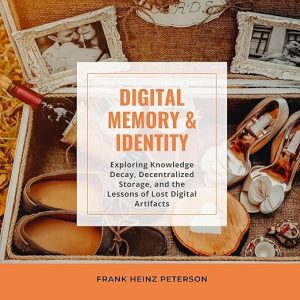
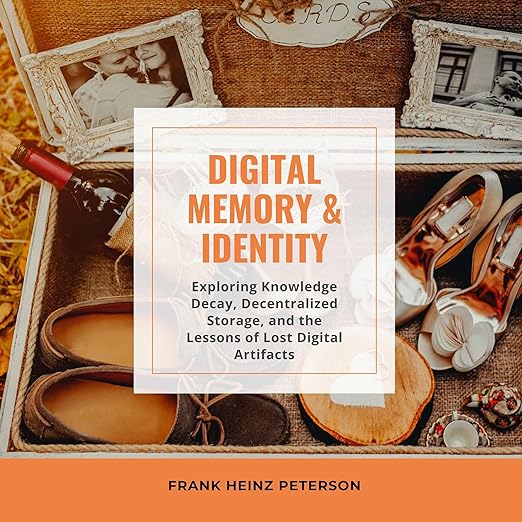
Seventy minutes is a short audiobook by any measure, and the subject is everything you have ever stored on a machine. Digital Memory and Identity argues that the permanence of the digital world is a comfortable illusion, and it makes that case at essay length rather than book length. Gordon Webster reads it. Nobody has said anything about how, because months after release this record still carries no score and no written responses of any kind.
Seventy Minutes Names Four Failure Mechanisms
The argument opens where most people's intuitions sit: what gets uploaded stays uploaded, and the cloud remembers longer than paper. Peterson takes that apart with four named mechanisms. Bit rot, where the physical substrate degrades underneath intact-looking files. Link rot, where the address survives and the destination does not. Platform dependency, where somebody else's business decision removes your archive. Knowledge decay, where formats outlive the software that opens them. Four ordinary failure modes, none of them exotic, all of them running right now.
Where the book gets interesting is in refusing to treat any of that as an IT problem. Losing a decade of photographs, or a community's entire forum history, or a body of creative work stored in a format nobody can open, is framed here as a cultural and psychological event rather than a technical failure. That reframe is the reason a general listener should care, and it is also the reason the record's own shelving looks wrong.
The back half turns constructive, which not every book of this kind bothers to do. Active digital stewardship is the umbrella term, and underneath it come redundancy, open formats, metadata enrichment, cold storage and the three-two-one backup philosophy, all explained in language that assumes no professional background. Practical enough to act on, general enough not to date immediately.
Scope reaches further than the title suggests. Personal histories are only the first of four categories named in the description; cultural artifacts, creative works and collective knowledge get the same treatment, which pushes the argument out from the family photo library to institutions and the shared record. Whether seventy minutes can carry that reach is a fair question, and the copy does not attempt to answer it.
Real Payoff Comes From Changing Behavior
Length is the first argument. Seventy minutes is a briefing rather than a course, and the subject genuinely fits that shape: four failure modes, one reframe, five countermeasures. A three-hundred-page treatment of the same material would spend two hundred of those pages on case studies you could have guessed. Compression suits a topic whose central point can be stated in a sentence and then has to be made to feel real.
The copy also appears to have been written for this format specifically, describing what the book introduces listeners to rather than readers. That is rarer than it ought to be. Most short nonfiction arriving in audio carries print copy translated badly, and the small courtesy of addressing the actual audience suggests somebody thought about the edition rather than merely producing it.
Payoff is the third argument and the strongest. Anyone who follows through on the three-two-one principle after finishing has recovered the price and the seventy minutes several times over, and the same is true of a single decision to move an archive into an open format. Books that change one behavior are worth more than books that change one opinion, and this one is aimed squarely at behavior.
One further point in its favor: the book is not selling anything. No service, no subscription and no proprietary tool appears anywhere in the description, which is unusual on this subject, where most writing about personal archiving arrives attached to something you are meant to purchase. Format-level, vendor-neutral advice is the kind that will still hold in ten years.
Digital Artifacts Vanish, and So Might This File
Nothing on this record tells you what the recording is like. No rating, no written responses, no listener commentary of any sort, which leaves Gordon Webster credited and entirely unassessed. Expository nonfiction places real demands on a reader, since technical vocabulary has to stay clear at pace and seventy minutes offers no room to recover from a slow opening, and the page gives you no way to judge whether those demands were met.
Classification is the second issue and the more misleading one. The record tags this under programming and software development, and nothing in the description suggests code, tooling or engineering practice. This is a book about cultural memory that happens to mention file formats. A developer arriving through that tag will feel misled, and the general listener who would actually want it is unlikely to look there.
Production signals deserve a glance too. The byline is set in capital letters and the publisher field repeats the author's name, so this is self-published, with no house standing behind the editing. No chapter list, no sources and no supporting document appear on the record. And for a book arguing that digital artifacts vanish, it is worth noticing that the only way to own this one is as a digital file with no durable fallback of its own.
Everybody Else Is This Book's Audience
Nobody comes to a seventy-minute file for a comprehensive treatment, and expecting one guarantees disappointment. Archivists, digital preservation professionals and anyone who works with institutional repositories already know every term in this book and will find nothing new in it.
Everybody else is the audience, particularly people carrying twenty years of accumulated personal data with no plan for any of it. Parents with a decade of photographs on one phone. Writers with drafts across four dead services. Anyone who has clicked a bookmark from 2015 and found a parking page. The book turns a vague unease into four named problems and five specific responses, which is exactly what a short book should do.
Listeners who want the philosophy rather than the checklist will also find something here, since the connection between what we can retrieve and who we understand ourselves to be is treated seriously rather than as decoration. Just do not expect the record itself to reassure you about anything, because after months on the shelf it has collected no verdict at all.
Before You Listen
How technical is the Digital Memory and Identity audiobook?
Not very. The description promises accessible language throughout and no professional background is assumed. Terms like bit rot, cold storage and metadata enrichment are introduced and explained rather than used as shorthand. Despite the programming tag on the record, nothing in the material involves code or engineering work.
What practical advice does it actually give?
Five named strategies. Keep more than one copy, prefer open file formats to proprietary ones, describe files well enough that future software can find them, keep something offline, and follow the three-two-one rule. All are aimed at individuals rather than institutions, and all are actionable in an afternoon.
Is seventy minutes long enough for the subject?
For orientation, yes. The book states four failure modes, reframes them as a cultural rather than technical problem, and closes with countermeasures. Anyone wanting case studies, standards documentation or a survey of preservation research will need a much longer book after this one.
Why are there no ratings on this audiobook?
It is self-published and recent, released in March 2026 with the author's own name in the publisher field. Both the score and the response column sit empty, so no independent assessment of the writing or the reading exists on the record at all. Judge it on the description alone.