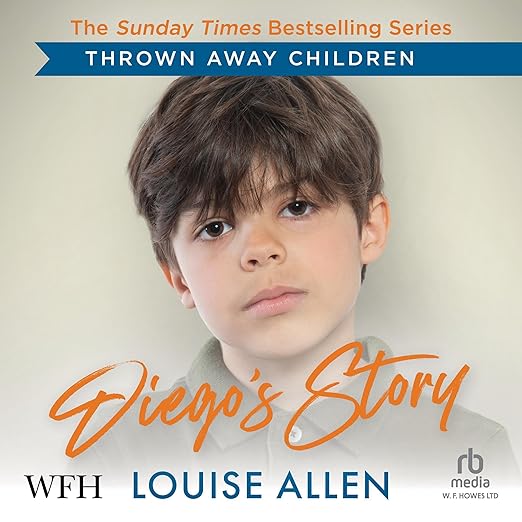
- Narration: Melanie Crawley reads all six hours and forty minutes, with no second voice credited, standing between a foster carer's own account and the listener.
- Themes: county lines exploitation, foster care, childhood poverty, witnessing violence
- Mood: Plain and unsparing, closer to a case record than to a thriller
- Verdict: Self-contained, unsparing, and thirteenth in a sequence this listing never names.
Halfway through the description, a sentence arrives that does not follow from the one before it. The copy explains that Diego and his siblings are close to starving, "scouring food banks to survive," and that nobody seems to notice or care. Then comes the turn: "But he’s wrong." Wrong about what? No belief has been attributed to him anywhere in the paragraph. A sentence went missing between those two, and the product page for this audiobook is where it went missing. Errors of that kind are common enough on retail listings; this one sits in the middle of the only paragraph a buyer actually has to go on.
Nobody in This Story Is Being Investigated
By its own account this is the thirteenth book in a sequence. The description says so in its opening line: "Diego's Story is the thirteenth instalment in the popular Thrown Away Children series." The listing carries no series entry, no position number, and no title on the cover beyond those two words. A listener arriving here is therefore told they have twelve books behind them and handed no way to identify a single one of them. For a thirteen-volume sequence, that is a strange thing for a retail page to do.
Three genre categories are attached to this record and they pull in three directions. It sits in biographies and memoirs, in mystery, thriller and suspense, and in relationships and parenting, with a true crime tag on top of all of that. All four labels are defensible, and no single one of them describes the book. What the description promises is a placement: a fourteen-year-old arrives carrying a history, and an experienced carer has to work out whether he can be kept safe. The true crime tag is the one doing most of the work in search results, and also the one likeliest to set a wrong expectation, since nobody in this story is being investigated by anyone.
None of the surrounding detail is softened. Diego has "an absent father, alcoholic mother and dependent young siblings," which the copy offers flatly as the reason he is "the perfect mark" for County Lines gang members who "can see his vulnerability." He is entrapped, used and abused, he witnesses terrible crimes, he escapes a murder scene and runs. All of that is given away in one paragraph, which tells you the book is not built on suspense about what happened to him.
A Performance Reaching for Pathos Can Undo It
Half of what makes this kind of book work is the position its narrator occupies, and here the author occupies it from inside the story. Louise Allen is the name on the byline and also a figure in the description, the "Experienced foster carer" who takes Diego in when he is placed with her. The last question the copy asks concerns her own household: what happens if the gang finds him "with Louise and her family?" The person writing is the person at risk, so the account is first-hand by construction.
The reading goes to Melanie Crawley, and no second voice is credited across six hours and forty minutes. That puts a third voice between the carer who lived this and the person listening to it, which is standard practice and still worth naming for this genre, because the whole appeal of a foster-care account is its plainness. A performance reaching for pathos can undo a book like this inside a chapter. No sample or description of the reading appears anywhere here, which for a release this recent is unremarkable.
A series that has reached thirteen volumes has a working method, and this one is legible in the title itself: a child's name and the word story. Each book takes one placement. That structure lets a newcomer start anywhere, which is fortunate given the total absence of any route to the earlier twelve, and it also keeps the emotional arc bounded by a single case, not by a whole career. Six hours and forty minutes is the right length for that: long enough to follow a placement through, short enough to avoid sprawl. The naming convention carries a cost, though. Two words on a cover give a browsing listener no sense of period, place or subject, and the description is left to carry every bit of it.
One Line Would Cost the Publisher Nothing
That description was not written for an American listing. It calls this the thirteenth "instalment," spelled with a single L, which is not the American form, and the publisher is given as W. F. Howes Ltd. Neither detail is a defect. Both are useful, because they tell you the register was set for a different market, and anybody who cares how a social-services vocabulary lands in audio, County Lines among the terms in play, now knows which side of the Atlantic the phrasing came from.
Nothing on this page prepares a listener for the content. A book taking in child exploitation, drug running, abuse and a murder scene arrives with no content note of any kind. Two people have rated it and neither wrote anything, which is hardly surprising for a March 2026 release, so no reader warning exists to fall back on either. The description does its own warning by being explicit about the premise, and that explicitness is the only advance notice on offer. One line naming the hardest material would cost the publisher nothing and would serve a listener a great deal.
This Listing Will Not Point You to Them
What this offers, and what the twelve books before it presumably offered, is the view from inside a system most people meet only through headlines. Listeners who follow social-care writing, or who work anywhere near it, are the natural audience for it. So are readers of the wider true crime shelf who want the aftermath instead of the investigation, since the crime here is background and the placement is the actual story being told. Carers and parents reading around a placement of their own make up a third group, and the practical detail is the part that will land hardest for them: food banks, an absent parent, a gang reading a child's vulnerability with complete accuracy.
Listeners who need a mystery will be disappointed by design, because the copy tells you what happened before you press play. Listeners who need something gentle should know that a fourteen-year-old escaping a murder scene is the premise here, never the climax. Everybody else gets six and a half hours on one placement, told by the person who made it and read by somebody the page says nothing else about. Look elsewhere if you need the twelve books that came first, because this listing will not point you toward any of them.
Before You Listen
Does this audiobook work if I have not heard the earlier books in the series?
Each entry in the sequence covers one placement, so the case here is self-contained and the description assumes no prior reading. The awkwardness is practical, not narrative: no field here numbers the book or names the sequence it belongs to, so identifying the twelve titles that came before means looking them up somewhere else entirely.
Why is the audiobook filed under true crime, thriller and parenting all at once?
Because the material touches all three. County Lines exploitation and a murder scene supply the crime, the escape supplies the tension, and the second half concerns a foster carer trying to settle a traumatized teenager. No single category covers it, and the listing simply applies every one that partly fits.