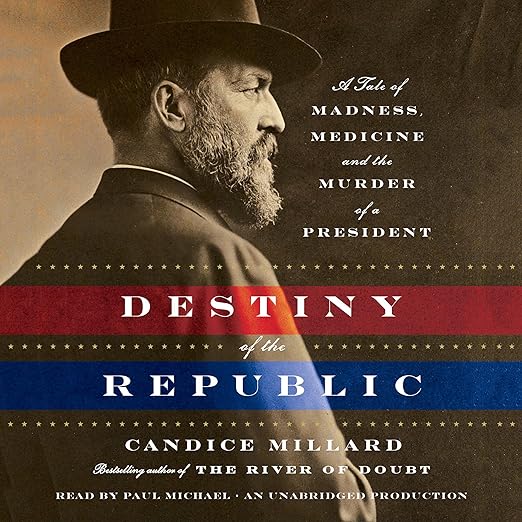
How does a president survive being shot, only to die months later from the treatment meant to save him? Candice Millard's Destiny of the Republic answers that question through the story of James A. Garfield, a man born into poverty who became a Civil War hero, a respected congressman, and, reluctantly, president, before a deranged office seeker shot him four months into his term. The synopsis promises this audiobook will "stand alongside The Devil in the White City and The Professor and the Madman as a classic of narrative history," and reviewer Bryan Carey backs that ambition up, calling Garfield's assassination "one of the lesser-known events in American history" that this book brings fully into focus, narrated by Paul Michael.
Garfield's path to the presidency, per the synopsis, was unlikely enough to read like fiction: born into "abject poverty," he became a "wunderkind scholar," then a Civil War hero, then an "admired reformist congressman" who fought "a fierce battle with the corrupt political establishment," all before being "nominated for president against his will." That reluctance matters to the story Millard is telling, since it reframes Garfield's death four months into office not as the fall of an ambitious politician but as the loss of someone who did not particularly want the job in the first place, a detail that gives the assassination a different weight than a more conventional political-thriller framing would.
Rating Math That Actually Checks Out, for Once
Reviewer Scott, who credits Shelby Foote's Civil War trilogy with reviving public appetite for narrative history decades ago, singles out three things Millard does well here: rigorous research, attention to an underexamined corner of presidential history, and what Scott calls "a terrific narrative arc." Reviewer CCatherine goes further, calling the book "an absolute page-turner" and adding a rare admission for nonfiction: "I've never read a non-fiction book so quickly." That pairing, meticulous research plus genuine narrative momentum, is the balancing act Millard is attempting across Garfield's rise, his shooting, and the medical crisis that follows it.
Rating math on this listing checks out cleanly, for once: a 4.6 average from eight counted votes requires those eight scores to sum to exactly thirty-seven out of a possible forty, three short of a flawless run of perfect fives. That is consistent with the five written reviews visible: four rate it a full five stars, and one lone four-star review comes from a reader who, writing in Japanese, still calls the biography compelling even while finding the era's medical practices genuinely disturbing by modern standards.
Michael's Reading Goes Unmentioned by All Five
Paul Michael's narration goes unmentioned across all five reviews on this page, which is worth naming plainly rather than working around: the written feedback here is entirely about Millard's research and prose, not the audio performance delivering it. That is common enough for narrative nonfiction that listeners should not read too much into the silence, but it does mean this review, like the source reviews it draws from, can speak to what the book covers and how the writing lands rather than to specific choices in Michael's reading.
Medical drama is where this book earns its comparison to The Devil in the White City and The Professor and the Madman: Garfield's team of physicians administered what the synopsis calls "shockingly archaic treatments, to disastrous effect," while Alexander Graham Bell, fresh off inventing the telephone, worked around the clock trying to build a device capable of locating the bullet still in Garfield's body. That collision of cutting-edge invention and medical incompetence, happening simultaneously around one dying president, is the kind of specific historical irony narrative nonfiction is built to capture.
Bryan Carey's review points to the book's attention to detail and thorough research as its "strongest points," noting that the citations cover facts most readers are unfamiliar with going in. That density of research, combined with Millard's narrative pacing, is presumably what lets a book about nineteenth-century political assassination and archaic medicine move quickly enough for CCatherine to call it a page-turner rather than a dutiful history lecture, a balance narrative nonfiction rarely strikes this cleanly.
Random House Audio published this edition, a major publisher signal consistent with the scale of ambition the synopsis lays claim to, comparing itself to two well-established narrative-history touchstones rather than positioning itself as a niche or regional release. For listeners weighing production value as part of a purchase decision, that publisher backing is one of the few concrete signals available before actually starting the audiobook, alongside the concentration of five-star ratings among the visible reviews.
An Italian Reader Praises the English Prose
One small inconsistency worth flagging: the synopsis itself states a "Total Run Time: 10 hours," while this listing's duration field lists nine hours and forty-seven minutes. That is a thirteen-minute gap, likely just rounding between two different points in the production or listing process rather than a meaningful discrepancy, but worth knowing if you are timing a commute or a specific listening window around this audiobook.
Reviews in three different languages, English, Italian, and Japanese, also sit on this listing. The Italian review, from Teresa, praises the book's English prose specifically, calling it rich in vocabulary and genuinely enjoyable to read, a notable thing for a non-native reader to single out. The Japanese review, from arcangelo1854, is the lone four-star rating among the five visible and focuses on how alien the era's medical practices look from a modern vantage point, a theme that lines up with the synopsis's own framing of Garfield's treatment as archaic.
Biography as Tragedy Rather Than Triumph
This audiobook suits listeners who enjoy narrative history with genuine forward momentum rather than a purely academic pace, readers drawn to stories where scientific ambition and human failure collide, per the Bell subplot, and anyone who appreciates presidential history that goes deeper than the assassination itself into the political and medical systems surrounding it. Fans of The Devil in the White City or The Professor and the Madman, the two books this synopsis directly invokes, have a clear built-in reason to try this one. Listeners looking for a brisk single-sitting listen should note the runtime discrepancy above and plan for closer to ten hours than nine and three-quarters. Given the reluctant-president framing running through the whole account, this also rewards listeners drawn to biography as tragedy rather than triumph, where the subject's death is less a plot twist than the destination the entire narrative has been building toward from Garfield's poverty-stricken childhood onward.
How long is the Destiny of the Republic audiobook, and who narrates it?
The listing's duration field lists nine hours and forty-seven minutes, though the synopsis itself states a total run time of ten hours, a small discrepancy worth noting before planning a listening window. Paul Michael narrates the full audiobook solo, start to finish.
Does this audiobook focus mainly on the assassination itself or on Garfield's full life?
Both, with real weight on each. It covers Garfield's rise from poverty to a reluctant presidency, the shooting itself, and the months-long medical crisis that followed, including Alexander Graham Bell's effort to build a device capable of locating the bullet still in his body.
Is this audiobook comparable to other popular narrative-history titles?
The synopsis itself makes that comparison directly, stating the book will stand alongside The Devil in the White City and The Professor and the Madman as a classic of narrative history, citing shared strengths in research depth and narrative pacing.