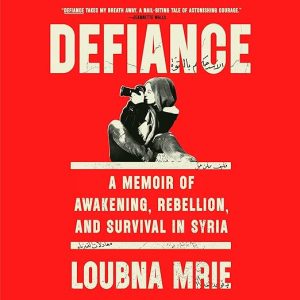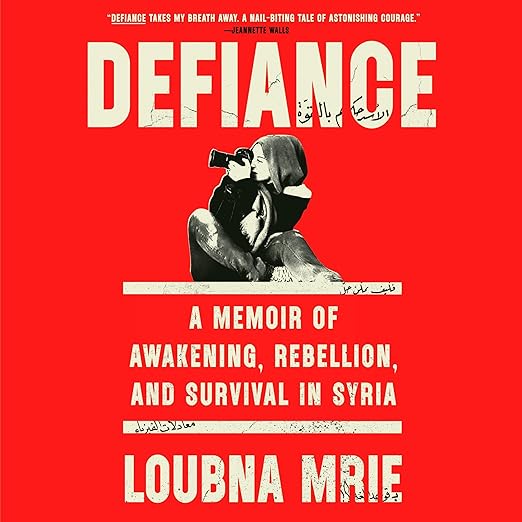
Loubna Mrie is credited as both author and narrator of this audiobook, and for a memoir that opens on a schoolgirl made to recite a president's speeches aloud, that doubling is not a scheduling convenience. Defiance runs fifteen hours and twenty-one minutes under the Penguin Audio imprint, released on February 24, 2026, and the whole book turns on what a voice is permitted to say and who gets to decide. Reading it yourself is the one production choice that answers that question before the first chapter starts.
Loyalty as Insurance, Never as Enthusiasm
Penguin Audio's listing already carries ten ratings behind a displayed 5.0, and that figure is not a rounding artifact. Ten votes averaging exactly five must total fifty out of a possible fifty, which means every person who graded the book gave it full marks and not one of them held anything back. Only two of those ten wrote a word, so the unanimity is genuine but sparsely furnished: ten hands raised, two voices explaining the raising. I would treat it as an early signal rather than a settled verdict.
Hafez al-Assad appears in the first descriptive line as the figure a child pledges allegiance to every morning at school, and the account of Alawite loyalty that follows is the part I found hardest to look away from. It refuses the flattening that Syrian coverage usually applies. The family logic is spelled out precisely in the copy: without the president, the Alawites would be persecuted by the Sunni majority, as they had been for centuries before the Assads came to power. Loyalty as insurance rather than as enthusiasm is a considerably more uncomfortable thing to sit with for fifteen hours.
Aleppo and New York City bookend the arc, with the pro-democracy uprisings of the Arab Spring reaching Syria in 2011 as the hinge. The description promises ground level rather than analysis: one person attending one anti-government protest, then joining a resistance, then documenting the war for Reuters and other outlets while openly proclaiming an Alawite heritage that made her a target twice over. The cost is stated without softening, the loss of loved ones, of community, and ultimately of country, so nobody arrives here expecting a recovery narrative with a gentle landing.
A Photojournalist's Trained Eye for What to Exclude
Reuters is the credential that changes the book's shape for me. A memoirist who spent years as a photojournalist carries a trained relationship to framing, to composition, to what a picture is deliberately made to exclude, and fifteen hours is room enough for that habit to surface in the prose. Whether it does is not something a product page can settle. Both written responses on this listing address the person on the page rather than the sentences she built, which is ordinary for memoir and still a limitation worth naming out loud.
HistoryNerdsUnited opens the longer of the two responses with a personal rule about the form: a writer who casts themselves as the hero of their own story is thereby not one. Applied to Defiance, the verdict is that Mrie is no hero by her own accounting, which the reviewer plainly intends as the highest compliment available. That response then stops dead partway through a sentence, at the words I think she defines herself, so where it was heading stays genuinely unknown, and inventing an ending for it would serve nobody.
Jeannette Walls and Lawrence Wright supply two blurbs that occupy the description before a single line of actual summary appears. Walls calls it a nail-biting tale of astonishing courage. Wright, who won a Pulitzer for The Looming Tower, calls it a heartbreaking account of a young woman's struggle for freedom and lands on Unforgettable. Blurbs are marketing and I weigh them accordingly, but the pairing does tell you which shelf the publisher wants this on: literary memoir with reportorial credentials bolted to the side.
A Line Break Splits the Word Survival in Two
Ten ratings is a very small column for a title from a major imprint, and the second written response, signed kristine, is disarmingly candid about its own limits: not a literary critic, but certain that the story matters and that no country or people is a monolith. That is an endorsement of subject rather than of craft, and the distinction is worth holding onto. If you want to know how the prose behaves across a full fifteen hours, this page cannot tell you, and the perfect score reflects ten early enthusiasts.
Fifteen hours and twenty-one minutes is a serious commitment for a first-person account of war, exile and paternal control, and nothing in the copy suggests the material thins toward the end. The description closes on becoming rather than on arriving, which points to a final stretch that is interior work instead of incident. Listeners who need forward momentum to stay attached to a book should understand that shape going in rather than discovering it somewhere around hour eleven, when the streets of Aleppo are already behind them.
Syria's political history is the backdrop here, not the subject, and the copy is honest about that much. One oddity does deserve flagging: the description on this audio listing contains the word survival broken across a line as sur-vival, a hyphenation artifact that belongs to a typeset print page and has no business in an audio product description. Cosmetic, certainly, but it tells you the copy was lifted out of a book file rather than written for this format, which is worth knowing before you trust its precision.
Mrie Narrates Her Own Slow Political Awakening
Memoirs of political awakening are a crowded shelf and most of them arrive with the conversion already complete, the narrator safely on the correct side by page ten. What this description offers instead is the slow part, the years of believing exactly what you were raised to believe, which is harder to write and considerably harder to say aloud without flinching. Listeners drawn to authoritarianism described from inside the class it was built to protect, rather than from the opposition, will find the vantage point genuinely unusual.
For anyone weighing the commitment, the shape is simple: fifteen hours, one voice, no supporting cast, and a narrator credit identical to the byline. Penguin Audio has aimed this at the literary memoir audience and the blurb pairing confirms the target. Anyone who needs a structured account of the Syrian conflict will not find one here, because this is a single life set against a regime and a father, and it flatly declines to become a survey.
Before You Press Play
- Performance: Loubna Mrie takes the reading herself, so one name fills both the author slot and the narrator slot, which matters unusually much for a book about a voice trained to obey.
- What it covers: Alawite loyalty and inherited belief, the 2011 Arab Spring, paternal authority, exile and wartime photojournalism.
- Feel: Controlled fury, closer to testimony than to lament.
- Our call: Worth the fifteen hours if you want authoritarianism described from inside the class it protected, though ten ratings and two written responses make the perfect score a thin guide.
Does Loubna Mrie narrate the Defiance audiobook herself?
Yes. The listing gives the same name in the author slot and in the narrator slot, so the account reaches you in the voice that lived it. For a book whose first scene involves a child reciting a president's speeches on command, that single production decision carries more weight than it normally would.
How long is the Defiance audiobook and how demanding is that runtime?
Fifteen hours and twenty-one minutes, issued by Penguin Audio in February 2026. The copy suggests the final stretch turns interior rather than eventful, moving from Aleppo toward exile in New York City, so listeners who rely on incident to stay engaged should understand that trajectory before committing to it.
What do the ten ratings on this listing actually prove?
Only that ten people graded it and all ten chose five stars, because an average of exactly five across ten votes admits of nothing else. Two of the ten wrote anything at all, and both discuss the subject rather than the writing, so the verdict is unanimous and evidentially thin.
Is Defiance a history of the Syrian war?
No. The description frames it as one life measured against a father, a dictator and inherited belief, with the pro-democracy uprisings of 2011 as the turning point and photojournalism for Reuters as the later career. Political history sits in the background rather than in the foreground.