The Short Version
- Performance: Dan Bittner brings a track record of restraint to dense, name-heavy material, though no listener review here confirms his specific performance.
- What it covers: Mueller investigation, insider political memoir, contested recent history
- Feel: Tense and openly partisan
- Our call: A firsthand advocacy account best suited to listeners already invested in Papadopoulos's version of events, not a neutral investigation.
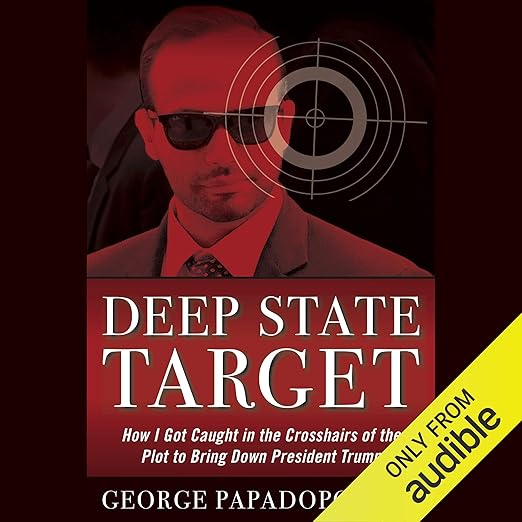
George Papadopoulos became a nationally recognized name for a few frantic news cycles in the fall of 2017, but how many listeners actually know his own account of those events rather than the version filtered through cable news chyrons and congressional hearings? Deep State Target, a six-hour-and-twenty-minute audiobook narrated by Dan Bittner, is Papadopoulos's attempt to answer that question directly: a first-person account from the former Trump campaign foreign policy advisor who became, by his own telling, the opening target of the investigation that would consume the following two years of American politics.
The book positions itself explicitly as a firsthand corrective, built around Papadopoulos's own meetings, phone calls, and eventual guilty plea, naming specific figures, Joseph Mifsud, Sergei Millian, Alexander Downer, Stefan Halper, as participants in what he describes as a coordinated effort by American and allied intelligence services to entrap him before the 2016 campaign was even over. A pull quote from Representative Mark Meadows included in the product description, calling Papadopoulos 'the whole reason for the Trump Russia investigation,' signals plainly which side of a still-contested public argument this book is written from.
That framing matters for how to approach the listen. This is advocacy nonfiction from one participant's perspective on a genuinely disputed episode of recent political history, not a multi-source journalistic investigation weighing competing accounts against each other. The three reviews attached to this title, all strongly favorable and all aligned with the book's own framing of events, reflect an audience already sympathetic to that perspective rather than a broader cross-section of listener reaction.
The book's structure follows Papadopoulos chronologically through his own advisory role, the meetings he says were engineered to draw him out, and the eventual legal proceedings that followed, giving the six-hour runtime a clear narrative shape even though the underlying material is dense with names, dates, and overlapping intelligence-adjacent relationships. That chronological approach makes dense political material more trackable in audio than a more thematically organized book might have been.
Papadopoulos pled guilty in 2017 to lying to federal investigators, a fact the book addresses directly as part of its own narrative rather than omitting, framing the plea itself as a consequence of the alleged entrapment rather than a straightforward admission of separate wrongdoing. How persuasive that framing lands will depend heavily on what a listener already believes about the broader investigation before pressing play.
Why Listen to Deep State Target
Dan Bittner has built a reputation elsewhere for restraint, resisting the urge to add dramatic weight to material that does not need it, an instinct that suits dense, name-heavy political material where over-narrating could tip an already-charged account into something closer to a thriller performance than a firsthand memoir. None of the three reviews on this listing comment specifically on the narration itself, so this reads as a reasonable expectation based on his broader track record rather than a confirmed result for this particular title, at least not yet.
For listeners who followed the original Mueller investigation news cycle in real time, hearing the sequence of events reconstructed by the person at its center, rather than by reporters or congressional staff, offers a genuinely different vantage point on a story most people only know secondhand. The genre tags applied to this title, spanning both memoir and thriller-suspense, reflect the book's own choice to frame real political events with the pacing and stakes of a spy narrative.
Beyond factual detail, the book also carries an emotional register secondhand coverage rarely attempts: what it felt like, by Papadopoulos's account, to realize retroactively which conversations may have been engineered, a specific kind of unease that only a first-person narrator recounting his own unraveling can really convey.
Campaign-adjacent political memoirs from figures who became unexpectedly central to a larger investigation are a recognizable subgenre in their own right, distinct from a principal's own memoir, and their appeal typically rests on exactly the kind of granular, insider-detail promise this book is built around rather than broader political analysis.
What to Watch For in Deep State Target
Approach this one knowing exactly what it is: a first-person, openly partisan account of a contested chapter in recent American political history, not a neutral or adversarial investigation of the same events. Listeners wanting a more skeptical or multi-perspective treatment of the same underlying story will need to look elsewhere, since nothing in this book's structure is built to represent an opposing view fairly.
Review volume is thin and uniform in perspective, three reviews on record at the time of this review, each written by a reader already persuaded by Papadopoulos's account, so treat listener sentiment here as a signal of an engaged existing audience rather than a broad or balanced sample of reaction.
Genre-blending real political events with thriller pacing is a rhetorical choice with real effects on how neutrally the material reads, tense chapter breaks and dramatic framing tend to heighten a sense of conspiracy and danger regardless of how the underlying facts might otherwise be reported. Listeners should factor that presentational choice into how they weigh the book's persuasive power separately from its factual claims.
Following a cast of real names, dates, and overlapping meetings across six hours asks more of a listener's attention than a straightforward narrative memoir would, and Bittner's pacing choices around where to slow down for a new name versus where to keep momentum moving will likely matter more to comprehension here than in a less densely populated account.
Chapter breaks in the audio edition give listeners natural stopping points for a dense nonfiction narrative like this one, useful for anyone wanting to research a specific named figure or meeting before continuing rather than listening straight through in one sitting.
Who Should Listen to Deep State Target
Listeners already interested in or sympathetic to Papadopoulos's account of the Mueller investigation, true-crime and political-thriller fans drawn to real-world insider narratives, and anyone who followed the original 2017 news cycle and wants the participant's own version of events, are this book's clearest audience.
Skip it if you want a dispassionate, multi-source journalistic account of the same events, or if spending six-plus hours inside one side of a still-contested political argument, with the Deep State framing taken as this book's premise rather than something the listener gets to weigh independently, is not how you want to spend a listen.
Questions Listeners Ask
How long is the Deep State Target audiobook?
About six hours and twenty minutes, narrated by Dan Bittner rather than by Papadopoulos himself.
Does this audiobook name the people Papadopoulos says were involved?
Yes, it names specific figures directly, including Joseph Mifsud, Sergei Millian, Alexander Downer, and Stefan Halper, as part of his account.
Who narrates the Deep State Target audiobook if not the author?
Dan Bittner narrates. He has a broader track record for measured, restrained delivery on other titles, though this particular performance hasn't been addressed by any reviewer yet.