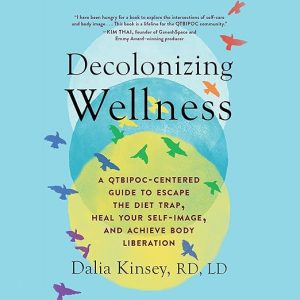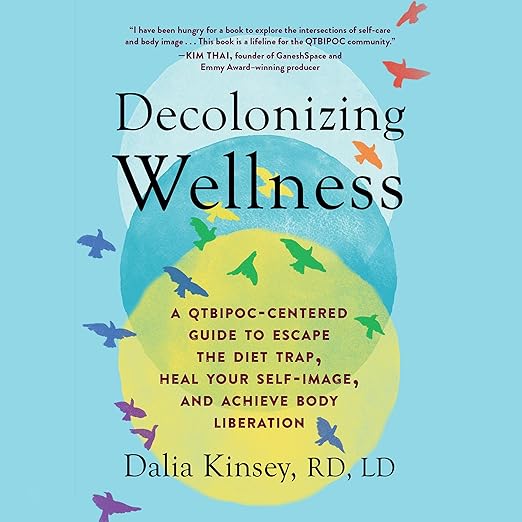
Body-positivity resources usually assume a body the industry already recognizes, and this audiobook opens by naming who that leaves standing outside: queer people of color, addressed by a movement that keeps measuring everyone against cisgender, heteronormative and Eurocentric standards of beauty. Dalia Kinsey, a registered dietitian and nutritionist, wrote it. LaNecia Edmonds reads it. Four hours and two minutes is all it takes to travel from that diagnosis to a working set of practices.
Naming Food Trauma a Reader Didn't Know Was There
October 21, 2022 produced the response that explains the book's reach. Kinsey puts into words something that writer had been feeling for years inside wellness and diet culture, it reports, and then goes on to describe healing body and food trauma it had not known was there. That second clause carries the real weight, because a book this short which surfaces something buried is doing considerably more than restating a familiar position.
Practitioners get named directly in that same verdict: anybody working as a trauma-informed health coach, dietitian or fitness instructor is instructed to read it immediately. Professional readership is where the leverage sits, since the argument concerns how an entire field treats the people who walk into it rather than what any individual ought to eat tonight. Kinsey is writing to clients and to the practitioners who see them, simultaneously.
Edmonds Reads Prompts With No Page to Fill
March 8, 2022 delivered the only grade on this page below the top mark, and it is a warm one. Accessibility is what that four-star praises: action-based journaling prompts and guides that come through as inclusive, easy to follow, and never pretentious, too schmaltzy or hard to understand. It also names an audience with unusual precision, people who follow The Maintenance Phase and want to dig further into what the dieting industry has been selling them.
Method matters here at least as much as position. Nobody gets argued into body acceptance; instead the book hands over practical eating practices, journal prompts, affirmations and mindfulness tools, and asks you to trade external food rules for internal cues. That structure is precisely why it works for people who already accept the analysis and have no idea what to actually do with it once the reading stops.
LaNecia Edmonds reads a book that keeps asking you to write things down, and the tension runs the whole length of the recording. Journal prompts arrive as spoken questions with no page waiting to receive an answer. Affirmations arrive in a voice that is not yours, which is an odd grammatical position to be placed in. Nothing on this record mentions a companion document, so every exercise depends on a notebook you supply.
Declining to Rate, Yet Filed as Five Stars
April 30, 2023 carries the strangest entry on the page. It opens by declining to rate the book at all, on the stated grounds that the writer is not the intended audience and came only to see what the material offers the queer Black and Indigenous community. The listing files it as five stars regardless. A declared non-rating is sitting inside this average as a top mark.
Usefully, that same entry is also the most descriptive one available. It identifies the journaling prompts as the substance, separates the things a person can notice in themselves from the things that follow from the historical position of Black and Indigenous people of color in the United States, and reports a stretch of historical context about white supremacy in the wellness industry. Somebody outside the target readership found the whole structure legible.
Grades diverge sharply from the crowd on this entry. Every written response sits at four stars or five, averaging 4.8 between them, against the 4.4 displayed across forty-six ratings. People who wrote paragraphs came away considerably warmer than people who only clicked, and at least two of those written fives are not verdicts on the content in the first place. Weight the star line with all of that in mind.
Specificity Travels Further Than Universality Here
Queer and trans people of color are the stated audience and the book never pretends otherwise, which is exactly what makes the February 21, 2022 five-star instructive. Written from outside that community by somebody highly aware of internalized beauty standards and close to despairing of ever escaping them, it reports the exercises for processing relentless minority stress working anyway. Specificity travels further than universality, and this is the evidence.
Dietitians, coaches and fitness professionals should treat the whole thing as continuing education. The critique lands on a field that has produced racist and unscientific biases while claiming to serve the people it harms, and the practical half leaves you with something to hand a client rather than a position to defend. Four hours is a single afternoon of professional reading, which is a favorable exchange rate.
Anybody currently mid-argument with their own eating will get the most immediate use. What gets promised is improvement without restriction, food as a source of pleasure instead of shame, and mealtime reframed as celebration and healing rather than compliance. Whether that lands depends on how much you want permission versus a plan, and this book is firmly and deliberately in the permission business.
Steer clear if you want macros, meal plans or anything resembling a protocol, because refusing that genre is the entire project. None of it works for you either if the vocabulary of decolonization and intersectionality reads as an obstacle rather than as precision, since it runs throughout and never gets softened for comfort. A notebook is close to mandatory, and arriving without one wastes half of what you paid for.