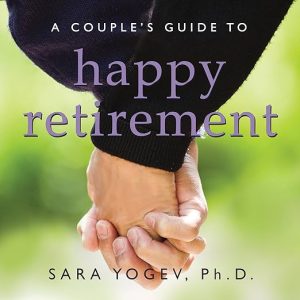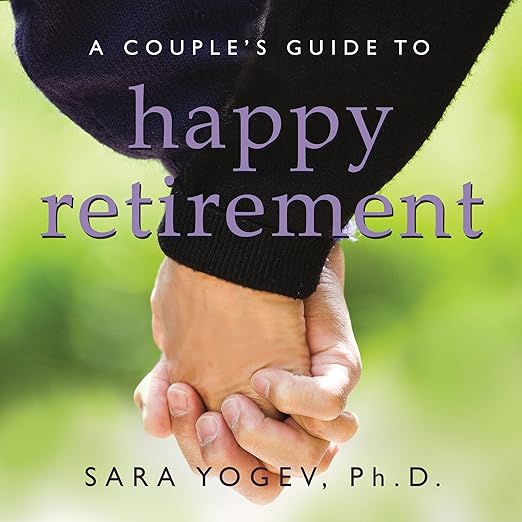
Retirement arrives as a relationship problem long before it arrives as a financial one, and this audiobook is built entirely on that premise. Sara Yogev takes no interest in your portfolio. What occupies nine and a half hours here is what happens to two people who have spent forty years organizing their lives around work and now face what the copy calls a quarter of their lives spent largely in one another's company. The money books are on a different shelf. This one is about the marriage.
Real Friction Points Instead of General Advice
Sara Yogev is a psychologist specializing in work and family issues, and the material draws on accounts from couples who have already made the transition. That sourcing shows in the structure. Instead of general principles, the book works through specific friction points: disagreements about money, about time together set against time apart, about housework, about how much of the new schedule belongs to grown children and grandchildren. Each is treated as a negotiation rather than as a personality flaw.
Ophira Benarieh's five-star note from October 2012 describes reading the first edition and then welcoming the second, which is a useful indicator of how this book actually gets used. People come back to it. That response calls the writing easy to take in and easy to apply, and the second half of the pairing is what matters, because a great deal of relationship writing is perfectly comprehensible and entirely unusable. Yogev keeps the advice small enough to act on.
Money is the one subject the book refuses, and the refusal is stated up front rather than discovered halfway through. That will disappoint part of the audience, since financial anxiety is what drives most people toward a retirement shelf in the first place. The implicit argument is that the money question has been answered a thousand times over and the psychological question almost never, which is defensible and also narrower than the title promises.
Debbie Feldman Switches Between Two Registers
Two people can listen to a recording at once. That sounds trivial and is not, on a book whose entire method depends on both partners engaging with the same material and then talking about it. A shared paperback gets read by one person who reports back, which is precisely the dynamic the advice is trying to correct. A recording in the car, over dinner preparation or on a walk puts both parties in front of the same sentence at the same moment.
Debbie Feldman has a specific task here. The book alternates between the author's analysis and case accounts drawn from real couples, and print separates those two registers using typography a recording cannot borrow. A reader has to signal the switch by voice alone, dozens of times, without dramatizing testimony that was never written to be performed. Sample a passage containing a case account rather than an introductory chapter, because that is where the difficulty actually lives.
Both partners are the intended audience, and one response says so outright. Four stars in October 2015, filed by likescifi, calls the insights valuable and the information worth considering for anyone approaching retirement or recently arrived in it, then closes by insisting both partners should take it on. That instruction is the most practical line the whole pool of responses contains, and it matches how the chapters are built.
Three Reviews Predate This Audio Edition
October 2012 is when three of these five responses were written, more than a year before the recording appeared in November 2013. All three discuss print: a reissue being welcomed, an original being updated, a first edition compared against a second. They are verdicts on a book that existed in another form, pooled onto an audio entry, and the average travels with them. None of the three can be read as a comment on this edition of anything.
Twenty-one stars across the five written verdicts average out at 4.2, while the page displays 3.9 across forty-seven ratings. The written record is friendlier than the pool standing behind it, which is the reverse of the usual arrangement. Three of those five enthusiastic responses came from people who had already read an earlier edition, so the visible warmth belongs disproportionately to returning readers rather than to anyone arriving new.
Titles drift on this entry. The copy opens with A Couple's Guide to Happy Retirement and closes by referring to A Couple's Guide to Retirement, dropping the adjective the title depends on. The same copy has had the word audiobook substituted into sentences plainly written about a printed book, describing itself as the most comprehensive audiobook devoted to the subject. The genre tag is stranger still, filing a marriage guide under sexual and reproductive health.
Laura Smith Expected Comedy, Found Self-Help
Couples within five years of retiring are the obvious buyers, and the ones who stand to gain most are those who have not yet had the conversation at all. The book is organized around anticipating friction rather than repairing it, and it is measurably more useful before two schedules collapse into each other than afterward. Both members of the couple have to engage with it for any of the method to work.
Comedy shoppers should keep walking, and one response documents exactly that mistake. Two stars in June 2021 from Laura Smith records a recommendation received as a funny book about retirement and a discovery that it is a self-help book, a point made twice inside three sentences, which is what disappointment sounds like when the product was fine and the expectation was wrong. Nothing here is played for laughs.
Therapists and counselors working with older clients form the other natural audience, and the case-account structure serves them well. For everybody else the honest framing runs like this: nine hours and twenty-six minutes on the psychology of a transition most people plan for financially and not at all emotionally. The advice is unglamorous and specific. Whether it lands depends far less on the recording than on whether both people agree to hear it.
Does this audiobook cover the financial side of retirement?
No, and it says so in its opening lines. Yogev treats money only as a source of friction between partners, alongside housework and time apart, rather than as a planning problem to solve. If you want portfolio strategy or withdrawal rates, this is the wrong shelf entirely. The subject here is the marriage.
Is the audiobook suitable for people already retired, or only for those approaching it?
Both, with one caveat. The structure anticipates friction rather than repairing it, so the value peaks before a daily schedule collapses. Listeners already a few years in will still find the sections on purpose, intimacy and time apart worthwhile, but a portion of the preparatory material will land as retrospective.