The Short Version
- Read by: Riley Ellis narrates his own guide with the kind of self-aware humor and lived-in authority that makes the parenting anecdotes land, and his delivery keeps the two and a half hours moving without ever becoming a lecture.
- At its heart: ADHD subtypes and hormonal factors, communication systems for parents and children, preparing ADHD boys for adult independence
- Vibe: Warm, direct, and genuinely funny without softening the practical substance
- Short version: A practical, humor-laced guide to raising boys with ADHD that actually delivers the strategies it promises, made more credible by Ellis narrating from personal experience.
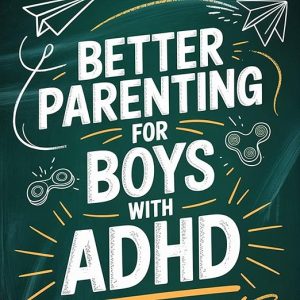
Riley Ellis opens Better Parenting for Boys with ADHD with an image that parents will recognize immediately: the moment you think you are managing the day, then step outside to find your vinyl fence pock-marked like a WWI battlefield, the neighbor kids fled, and your son wearing an expression that mixes defiance with genuine bewilderment about what went wrong. Ellis writes this audiobook from inside that experience rather than above it, and the narration, performed by Ellis himself, carries that authenticity throughout the two hours and twenty-seven minutes of the Real Life with ADHD series. This is practical, humor-forward guidance grounded in the specific chaos of raising boys whose brains operate outside most standard parenting frameworks.
The book's craft is its balance between humor and specificity. Ellis is funny in a way that acknowledges the real difficulty of what he is describing rather than minimizing it. The comparison of an ADHD boy's energy to a nuclear reactor is a joke, but it also accurately describes the management problem the book is trying to address. That combination, acknowledging the genuine difficulty while refusing to collapse into either despair or toxic positivity, is what distinguishes Better Parenting for Boys with ADHD from more clinical ADHD guides that tend toward either diagnostic gravity or cheerful optimism without the substance to back it up.
ADHD Brains Do Not Like Vague Instructions
The framework for understanding which specific type of ADHD a child presents is one of the book's more practically valuable sections. Ellis avoids treating ADHD as a monolithic condition and instead asks parents to identify their child's particular expression of it before applying any strategy. The section on hormonal factors, a dimension that is often underemphasized in parenting guides focused on behavior modification techniques, is where the book adds something genuinely useful to the existing literature. Reviewer Lauran, who notes that ADHD brains do not like vague as the book's most memorable formulation, captures Ellis's practical orientation well: concrete systems, checklists, and environmental design rather than vague encouragement.
The ADHD-proof environment chapter is where the book's philosophy becomes most practical. Ellis's argument that ADHD brains do not like vague extends from verbal communication to physical space: systems, visual cues, and structured routines are not accommodations but the actual architecture of a functional environment for these children. That chapter rewards close listening rather than passive background audio, as the specific design principles are dense enough that they benefit from active engagement and note-taking.
Ellis's Narration Fits a Two-Hour Playbook
Self-narrated audiobooks on parenting work best when the author's voice conveys the experience behind the advice rather than simply delivering information, and Ellis achieves that here. Reviewer Karen describes the book as easy to follow and filled with real-life situations that parents can relate to, which translates directly to the audio experience: the anecdotes are recognizable enough that parents will find themselves nodding even at the more exaggerated examples. Reviewer MissK notes that Ellis mixes humor with real insight, making parents feel understood while giving them tools that genuinely help, which is an accurate description of the audiobook's emotional register throughout.
At two hours and twenty-seven minutes, this is a book designed for the time-constrained reality of parents who are already managing a great deal. The runtime means the book does not attempt to cover every possible ADHD scenario but instead focuses on the highest-leverage interventions: communication frameworks, environmental design, and the longer-horizon work of preparing a child for independence. The brevity is a feature rather than a limitation if you know what you are getting, and Ellis is clear about his scope from the opening chapters.
Turning Hyperarousal Into Hyperfocus Over Time
The book's final vision, of ADHD children growing into emotionally articulate adults capable of channeling their hyperarousal into hyper-focus on meaningful problems, is present throughout but most explicit in the later chapters. Ellis is careful not to oversell this; the vision is aspirational but grounded in specific developmental work that begins now, not a promise about the future. That honesty is one of the book's more important qualities, distinguishing it from self-help guides that offer inspiration without the practical scaffolding needed to pursue it.
The communication skills chapter deserves particular attention for parents who feel the behavioral strategies are already familiar from other resources. Ellis's framework for improving communication across the child's full orbit, not only parent-child but teacher-parent and peer relationships, is the section most likely to contain genuinely new material for parents who have already done significant reading on ADHD management. The interpersonal network approach treats the child's environment as a system to be designed rather than a series of individual relationships to be managed, which is a practically useful reframe.
Even a Non-Parent Reviewer Found This Useful
Parents of boys diagnosed with ADHD or boys currently being evaluated for it are the primary audience, and the book will also resonate with teachers, school counselors, and anyone in regular contact with ADHD children who wants a practical, humor-grounded framework for thinking about their needs. The series connection to Real Life with ADHD suggests there is more material available for parents who find this volume useful. Reviewer Lauran notes that even as a non-parent she found herself engaged, suggesting the book's insights about how ADHD brains process information and structure are relevant to anyone working with or caring for children in this demographic. Adults with ADHD who want to understand their own childhood patterns may also find the book unexpectedly useful.
Does the Better Parenting for Boys with ADHD audiobook cover different subtypes of ADHD, or does it treat ADHD as a single condition?
Ellis specifically addresses the different subtypes and argues that effective parenting strategies must be calibrated to a child's particular expression of ADHD. The section on identifying which type you are dealing with is one of the book's more practically useful contributions.
Does Riley Ellis narrating his own audiobook add credibility to the practical advice?
It does, meaningfully. Ellis writes from lived experience as a parent of an ADHD child, and his self-narration carries the kind of wry, been-there authority that distinguishes personal experience from theoretical guidance. Multiple reviewers specifically mention feeling understood by the material, which is at least partly a function of the narration's authenticity.
Is the Better Parenting for Boys with ADHD audiobook comprehensive enough to replace a therapist or specialist consultation?
No, and the book does not position itself as such. It is a practical parenting guide focused on high-leverage strategies for daily management and communication, not a clinical intervention. For children with complex or severe presentations, professional consultation remains essential. The book works well as a complement to professional support rather than a replacement.