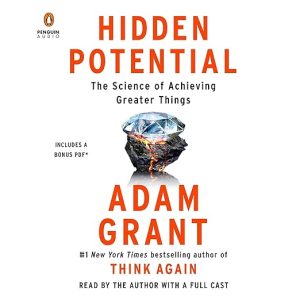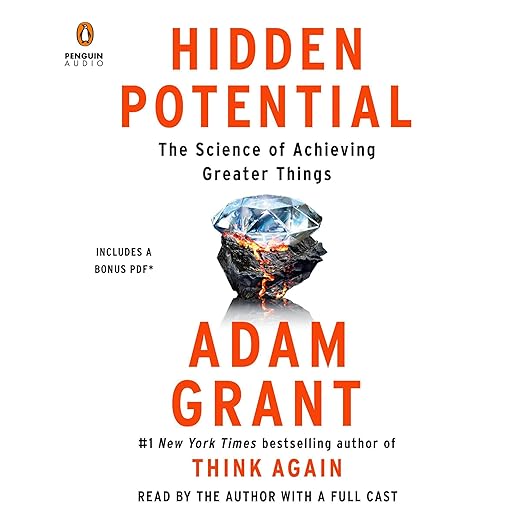
Adam Grant's body of work has consistently challenged the frameworks people use to evaluate capacity and success, from Give and Take's rethinking of professional relationships to Think Again's argument for intellectual humility. Hidden Potential arrives as the audiobook of his most personal argument: that what we measure and celebrate, natural talent, innate ability, prodigious early achievement, actively prevents us from recognizing and developing the capacity that most people carry. Grant narrates his own work, as he has before, and the audio production is substantially richer than a standard author reading, with TED podcast clips, archival audio from historical figures, and original music embedded throughout the seven hours and twenty-one minutes.
The central framework is direct and clearly stated. Grant argues that progress depends less on how hard you work than on how well you learn. Growth is not a function of the genius you possess but of the character you develop. He distinguishes between character as moral virtue and character as cognitive and motivational disposition: proactive curiosity, tolerance for discomfort, the willingness to be bad at something in order to become good at it. These are trainable qualities rather than fixed traits, and the book is organized around the evidence that they can be systematically developed.
A Deaf Percussionist Challenges What Performance Requires
What separates Hidden Potential from the broader positive psychology literature is Grant's commitment to the structural dimension of potential. He does not simply argue that individuals can grow if they try hard enough with the right mindset. He also asks who gets the opportunity to grow in the first place, and how systems can be designed to give overlooked people a door when opportunity does not knock. The second half of the book is as much about organizational and institutional design as it is about personal development, which gives the argument a scope that avoids the usual self-help myopia.
One reviewer described wanting to be the sponge Grant describes in the book, absorbing more and becoming a better version of themselves. Another noted the expert weaving of story and lesson content. The book uses a wide range of case studies, from a Finnish music teacher who builds exceptional performers without selecting for natural talent, to the Golden 13, the first Black officers commissioned in the US Navy, to a deaf percussionist whose career challenges assumptions about what musical performance requires. Each story earns its place in the argument rather than serving as decoration.
Leonard Cohen and the Golden 13 Arrive as Clips
The audio format significantly enhances the experience of this specific book. Grant includes clips from his TED podcast series WorkLife and ReThinking, which add voice and texture to the case studies in ways that a print reading cannot replicate. The inclusion of Leonard Cohen's Anthem, Evelyn Glennie's drum improvisation, and interviews from the US Naval Institute with members of the Golden 13 means that certain pivotal moments in the argument arrive with their primary sources attached. You hear what Grant is describing rather than just reading about it, which suits an argument about how experience shapes learning.
Grant's narration is practiced and clear. He has narrated his own audiobooks consistently enough that his delivery has developed into a recognizable style: measured without being dry, enthusiastic without overselling. He reads the text as someone who has thought about these ideas for a long time rather than as someone performing enthusiasm for a product. For a book this dependent on the credibility of its evidence and the warmth of its storytelling, that quality of voice matters.
Research Visualizations Work Better in Original Form
A PDF companion is included with the audiobook, containing charts, graphs, images, and actions for impact. Listeners who want the visual reference materials referenced in the text should download it before beginning. The audiobook is fully comprehensible without it, but some of the research visualizations are easier to engage with in their original form.
Listeners who are already deeply familiar with the organizational psychology and learning science literature may find some of the frameworks here recognizable rather than novel. Grant is synthesizing and communicating a broad body of research rather than presenting entirely original findings, and readers who have spent significant time with Anders Ericsson's work on deliberate practice or Carol Dweck's growth mindset research will recognize the intellectual territory. What Grant adds is his particular gift for case study selection and argumentative structure, which has its own value even when the underlying evidence is familiar.
Organizational Leaders Get Concrete Questions to Ask
This audiobook suits listeners who want evidence-grounded nonfiction that moves at a good pace and trusts them to draw connections across case studies. The embedded audio clips make it particularly rewarding for people who respond well to documentary-style nonfiction that includes primary sources. Those who have responded to Grant's previous books will find Hidden Potential a natural continuation of his concerns.
Grant's synthesis extends beyond the individual to the institutional in ways that distinguish this book from the majority of self-improvement audiobooks. The sections on designing systems that create opportunities for overlooked people are among the most practically useful, because they give organizational leaders a set of concrete questions to ask about the structures they are operating within or responsible for. The audio clips embedded in those sections, particularly the Golden 13 interviews from the Naval Institute, give the structural arguments the same emotional grounding that the personal development sections carry.
Readers looking for a structured how-to guide with specific daily practices may find the book more inspirational than operational. Grant argues for a set of dispositions and designs rather than a numbered system, and the book rewards a more reflective engagement than readers who want step-by-step action plans typically prefer. The audiobook's best use is probably as the beginning of a longer conversation with yourself about what you are actually building toward.
Before You Listen
How does the Hidden Potential audiobook differ from the print version?
The audiobook includes embedded audio clips from Grant's TED podcasts WorkLife and ReThinking, archival recordings from US Naval Institute interviews, a Leonard Cohen song, and a drum improvisation by Evelyn Glennie. These additions make certain case studies more vivid in audio form than they can be on the page.
Does Adam Grant narrate Hidden Potential himself, and how is his narration style?
Yes, Grant narrates his own audiobook, as he has for his previous titles. His delivery is practiced and clear, measured but engaged. He reads like someone who has lived with these ideas rather than someone performing familiarity, which suits the personal nature of this book's central argument.
Is there a PDF companion for the Hidden Potential audiobook, and is it necessary?
Yes, a downloadable PDF containing charts, graphs, images, and actions is included. The audiobook is fully comprehensible without it, but listeners who want to engage with the research visualizations Grant references will find the companion useful to download before beginning.
Does Hidden Potential audiobook work for listeners who are not in corporate or professional settings?
Yes. While Grant includes organizational and institutional design as part of his argument, the core case studies range from music education to athletic comeback to military history. The book's central claims about character development, learning quality, and systemic opportunity are broadly applicable across life contexts, not just professional ones.