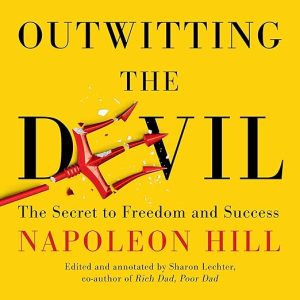
Napoleon Hill wrote this in 1938, the year after Think and Grow Rich made his name, and the description calls it long-suppressed and once considered too controversial to publish. The audiobook runs five hours and fifty-one minutes for Brilliance Audio, read by Dan John Miller, and what sits inside it is not a self-help manual. It is a parable staged as an interview, in which Hill puts the questions and the Devil answers them at length.
No Warning That a Second Author Is Here
Hill's device is why the book still gets argued over. Instead of laying out principles, he stages a cross-examination with an adversary who explains precisely how people get captured, and the seven principles of good the description promises emerge from that exchange rather than from a numbered list. Fear, procrastination, anger and jealousy are named as the mechanisms that stop people reaching their goals, and the Devil is handed the job of explaining why they work so reliably.
No hero, no villain, no happy ending. That is how the response filed at the end of December 2011 sets expectations, at five stars: this does not read like a classic novel about good and evil or success and failure, anyone waiting for a good guy in a white hat to ride to the rescue will be disappointed, and the thing behaves more like a choose-your-own-adventure than a story. That account also warns that a reader has to pony up intellectually, which is a fair description of the deal on offer.
Sharon Lechter is the name the byline leaves off. The description credits Lechter with annotating and editing the text for a contemporary audience, which means a real portion of what you hear was written some seventy years after Hill wrote his half. In print an annotation layer announces itself typographically and you can see where it starts. In audio it does not, and the credit on this page gives a listener no warning that a second author is in the room.
Hill Believed He Could Not Print This Argument
Drifter is the term this book contributed to the genre, and the January 2013 five-star shows what it does to a reader. That account found the format odd, an actual interview with the Devil, then got caught by the concept and recognized a family member inside the description of it: total lack of a major purpose in life, conspicuous absence of self-confidence, and a list that keeps going. Recognizing somebody you know in Hill's taxonomy is the experience most of these responses are circling.
Seven principles of good are the payload, and they arrive at the end of an argument rather than the top of a chapter, which is why the parable structure earns its keep. Steve Forbes is quoted above the description calling Hill one of America's great influential thinkers who continues to have enormous impact, and the historical claim is the real one: this is the argument Hill believed he could not print.
One Narrator, the Same Voice for Both Speakers
One narrator is credited for a text built as a dialogue between two speakers, and that is the production question worth holding in mind. Every turn arrives in the same voice unless the reading separates them, and a book whose entire structure is question and answer depends on a listener always knowing which of the two is talking. Five hours and fifty-one minutes covers Hill's parable and the modern annotation together, so the runtime is doing double duty.
Four Votes Cannot Make a 4.7 Average
Annotations are the practical problem, and the July 2018 response filed from the India store puts it in a line: the comments by Sharon are optional reading, and Hill's writing is clear enough without them. That is advice you can act on in print, where the commentary is visibly separate. In audio you cannot act on it at all without stopping to work out whose sentence you are inside. The same account preferred this book to Think and Grow Rich, which is not a small thing for a Hill reader to say.
Marketplaces are pooled on this page. Three of the five signed responses were filed outside the United States, from the Mexico, France and India stores, and the one from Mexico is written in Spanish. None of that is a fault, and it does tell you something real: the enthusiasm for this title is international and long-running, and the star column mixes buyers who did not necessarily hold the same edition, let alone this recording.
Four ratings sit beneath five written responses, and the average fits neither figure. A 4.7 cannot be built from four whole-star votes at all, since four votes can average 4.5, 4.75 or 5.0 and nothing between them. Add that all five written verdicts are fives, and what you have is a counter lagging behind a page that has been collecting enthusiasm since 2011 without ever updating the number on top.
Explained by the Thing Setting the Trap
Self-help readers who have exhausted the modern shelf are the natural buyers, because a great deal of that shelf descends from here and the tone is nothing like the current register. No data, no studies, no program, just an adversary explaining the trap from inside it. The December 2017 response from the France store describes being stunned by the authenticity of the ideas and identifying with them completely, which is the reaction the structure is engineered to produce.
Managers, coaches and anyone whose work touches other people's motivation will get use out of the drifter taxonomy even if the theology leaves them cold, since the characteristics are behavioral and the diagnosis is unsparing. Under six hours is a short commitment for a foundational text, brief enough to hear twice before deciding whether the framing counts as insight or as period costume.
Literalists should stay well away. A book in which the Devil answers questions for hours becomes intolerable for anyone unable to hold the frame as a device, and the religious vocabulary is not incidental decoration. Listeners who want Hill's material without the staging have other options in his catalog. Listeners who want to know why the trap works, explained by the thing setting it, have essentially this one.
Key Details
- Read by: Dan John Miller credited alone on a 2011 Brilliance Audio production, carrying a two-speaker interview text and a modern annotation layer in one voice.
- At its heart: Fear and procrastination as capture mechanisms, drifting against definite purpose, success argued from the opposition's side
- Vibe: Strange, confrontational and unexpectedly practical
- Short version: The oddest book in the Hill catalog and the most revealing, provided the interview conceit does not lose you in the first hour.
Questions Listeners Ask
Is the audiobook really structured as a conversation with the Devil?
Yes, as a device. Hill stages the book as an interview in which he asks and an adversary answers, and the seven principles of good the description promises come out of that exchange rather than from a numbered list. One narrator handles both sides across five hours and fifty-one minutes.
What is Sharon Lechter's role in this edition?
The description credits Lechter with annotating and editing the text for a contemporary audience, so some of what you hear is commentary written decades after Hill finished his manuscript. The byline lists Hill alone. A listener who wants only the 1938 material has no way to tell from this page how much of the runtime is annotation.
Do you need Think and Grow Rich before this audiobook?
No. The description places this as what Hill wrote in 1938 immediately after that bestseller, but the parable does not build on it and nothing in the copy assumes prior reading. Starting here means meeting Hill at his least polished and most candid, which a number of readers prefer.