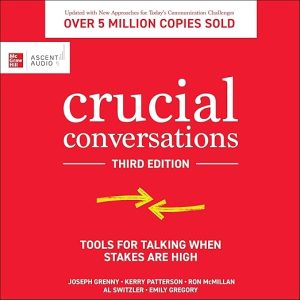
Three options are on the table whenever the stakes rise and the emotions run hot: dodge the conversation and live with what follows, hold it badly and live with that instead, or acquire a method. This audiobook exists to sell you the third option, and the third edition has been retooled for a workplace that now argues over messaging apps as often as across a desk. Seven hours and forty-five minutes is a compact container for a system this widely taught.
One Voice Plays Every Side, Twice Over
The reason this book keeps getting reissued is that its unit of analysis is right. Most communication advice operates at the level of personality, telling you to be assertive or empathetic; this one operates at the level of the individual exchange, and treats a conversation as something with observable failure modes. People blow up or clam up, dialogue stops, and the method is a set of moves for restoring it. A December 2025 response captures the effect precisely: easy and engaging to read, yet immediately applicable, with scenarios relatable enough that you start mapping them onto your own week.
Buyers should know what the third edition adds, because the copy is specific about it. Three updates are named: how to respond when somebody else opens a crucial conversation with you, how to notice and close the lag between spotting a problem and raising it, and how to handle all of this across digital channels. That last one is the genuine addition, and it is also the piece most likely to date fastest.
Emily Gregory reads for McGraw Hill-Ascent Audio, and the assignment has a specific difficulty. A book built on demonstration dialogues asks one voice to play both sides of every sample exchange, and, harder still, to perform the same exchange twice, once handled badly and once handled well. The difference between those two versions is the entire lesson, and in audio it has to be carried by delivery rather than by a labeled box on a page.
A Review Reproduces the Subtitle the Listing Omits
Portability is the honest answer. This is a skills manual, and skills manuals reward repetition more than they reward attention, which makes audio the format that fits how people actually use them. A July 2023 response, which reproduces the full subtitle the listing itself omits, sums up the pitch as practical tools for navigating difficult and important conversations with confidence, then organizes its own verdict into a list of top takeaways. That is how the material wants to be consumed.
Procedure rather than inspiration is why the framework holds up. Nothing here depends on you becoming a different kind of person by next week. The moves are observable, sequenced and rehearsable, and they work as well on a supplier dispute as on a conversation with a family member, which is why the book has escaped the business shelf into schools, development programs and households.
Length is a real virtue. Under eight hours for a system with this much institutional adoption means you can hear the whole thing in a working week of commutes and then return to specific sections, and the structure supports that: each skill is introduced, illustrated, and then stress-tested against a harder case. Business audio routinely runs longer while carrying a quarter of the content.
Four Ratings Only Divide Into Quarter-Star Steps
Two things will limit what you get out of a single pass. The first is repetition: a September 2025 response at four stars makes the case bluntly, saying the core points have been repeated by other authors since, and that reading this one earlier in a self-improvement sequence would have made it feel far more life-changing. Priority matters with this genre, and a lot of what feels familiar here is familiar because this book got there first.
Second, the book expects to be worked rather than heard. Annotation language runs right through the written pool: marked passages, revisited notes, concepts that need more than one pass before they settle. Audio makes the first pass effortless and every pass after that harder, so pair the listen with a printed edition if you intend to deploy the method rather than simply understand it.
Finally, two problems with the page itself. The title appears without the subtitle the book is universally known by, so a search for that phrase may never reach this listing. And the average is broken: 4.7 is posted over exactly four ratings, yet four votes divide only into quarter-star steps, so no arrangement of four ratings averages 4.7 at all, and five written responses sit beneath a counter that admits to four.
Institutional Distribution Followed by Individual Re-Use
Anybody responsible for other people's work is the core audience, and organizations have noticed. A response filed on January 26, 2026 describes receiving the book as part of a professional development program run by a school superintendent, notes that it is a secular text despite the institutional setting, and reports returning to the annotated copy regularly. That pattern, institutional distribution followed by individual re-use, is the clearest evidence of what the method is worth.
This method travels well outside management. Anyone who avoids a specific recurring conversation, at work or at home, will find the diagnostic sections uncomfortably accurate, and the digital-channel material in this edition speaks directly to people whose hardest exchanges now happen in writing. No prior reading in the genre is assumed and no organizational authority is required.
Managers who already own the second edition should think carefully, since the copy names only three substantive additions and the page gives you no further detail about what changed. Skip it entirely if you want reassurance rather than instruction, because the method asks you to hold the conversation, not to feel better about having avoided it. Anyone who has never worked through a communication framework before will get real value from a single pass.
Before You Press Play
- Performance: Emily Gregory for McGraw Hill-Ascent Audio, one voice playing both sides of every demonstration exchange, including the versions that go wrong
- What it covers: high-stakes dialogue, psychological safety, conflict avoidance, communicating across digital channels
- Feel: Brisk, procedural and unusually practical
- Our call: Take the audio for the first pass and buy the print if you actually intend to use the method.
Common Questions
What is new in the third edition of this audiobook?
The copy names three additions: how to respond when somebody else opens a crucial conversation with you, how to shorten the lag between spotting a problem and raising it, and how to hold these exchanges over digital channels. Beyond those three, the page offers no detail on what else changed.
Does the method work if you are not a manager?
Yes, and that is much of its reach. The framework operates on individual exchanges rather than on organizational authority, so it applies equally to a supplier dispute, a performance review or a conversation at home. Written responses on the page come from education, professional development and general readers alike.
Is one listen enough, or do I need to go through it repeatedly?
One pass gives you the concepts; it will not give you the habits. A response filed on January 29, 2026 is explicit about needing two or three passes before the ideas stick, and several others describe annotating and revisiting. Treat the audio as the introduction and plan a second visit before your next difficult conversation.
Should I get this audiobook or the print edition?
Audio suits the first pass and the refreshers, since the material is conversational and the runtime fits a week of commutes. Print suits deployment, because the exercises, checklists and dialogue comparisons are designed to be marked up. Listeners who intend to actively use the method usually end up owning both.