Quick Take
- Voice: Author-read and unbroken, delivered at one steady pitch, with no second voice and no chapter furniture across a running time short enough for a single sitting.
- Big ideas: Personality disorders, biological accounts of abuse, survivor validation, the limits of trauma-only explanations.
- Atmosphere: Clinical and uncompromising, closer to a legal brief than to a comfort.
- Worth it?: A forceful one-sided case worth hearing if you want the biology argued; look elsewhere for balance or for recovery steps.
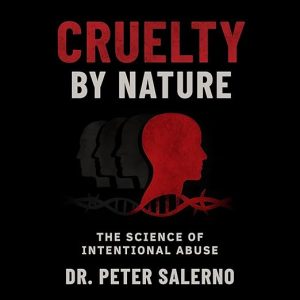
Compression is the first thing you notice about this audiobook. A book that sets out to rewrite how we talk about abuse finishes the job in two and a half hours, which is short by any standard in this corner of psychology. Dr. Peter Salerno reads his own work, and the same name fills the author, narrator and publisher slots on the listing. That combination is worth naming at the outset: nobody stood between the argument and the microphone, and you can hear it in how directly the material arrives.
Four Personality Patterns Salerno Frames as Biological
Neuroscience, genetics and clinical psychology are the three sources the description names, and the claim they are marshaled to support is blunt. Personality pathology, it argues, sits in stable biological systems that bias individuals toward exploitation. Salerno, a retired licensed psychotherapist who specialized in personality disorders, sets that against what the copy calls the comforting myths, that abuse is merely the product of trauma, bad parenting or social wounds. Narcissistic, psychopathic, borderline and histrionic patterns are the four he works through.
Beth filed five stars in December 2025 and gave the clearest account of what the thesis does for a reader who has lived it. The book, that verdict says, confirms what the gut already knew: these people are intentionally cruel and manipulative, and the natural human tendency to offer compassion, plus the belief that everyone has some good in them, are exactly the traps a cluster B personality needs in order to gain power. That is the emotional engine of the whole thing, and it is not subtle.
Salerno does not hedge anywhere. The description calls the book a manifesto and uses the word uncompromising, and the writing lives up to both. Whether that reads as bracing or as reductive depends on how much room you think biology deserves in an account of harm, and this book gives it a great deal. Survivors will find their experience validated in nearly every chapter, which the copy states as an aim rather than treating as a side effect.
Salerno's Own Narration of Cold Clinical Logic
Salerno reads his own book, and on this subject that shifts the register more than usual. Clinical vocabulary spoken by the clinician who assembled it carries an authority a hired voice would have to simulate, and the tradeoff is that you get no distance from the argument at all. Alicia Rader filed five stars in March 2026 and described being helped to understand and overcome a great deal, which is precisely the response an author's own delivery is built to produce.
Brevity is the second argument for the audio. Books in this corner of psychology usually run long and recycle their case studies until the point is unmissable. This one gets through altered brain networks, neurotransmitter imbalances and what the copy calls the cold logic of instrumental cruelty inside a single afternoon, and density on that scale survives a first listen far better than a sprawling version would. Nothing has to be re-found, because nothing has been buried.
The argument also builds toward something practical rather than diagnostic. The last movement of the description is a call for a cultural shift, away from trauma-only narratives and toward protecting victims, holding perpetrators accountable and advancing psychology as a true science. Whether or not you accept the biology underneath it, that is a coherent destination, and hearing it argued in a clinician's own cadence makes the stakes plainer than a summary on a page would.
March 2026 Arrived After Most of the Reviews
Four of the five written verdicts on this listing were filed before the recording existed. This recording reached the store on March 2, 2026; the verdicts run from December 2025 through March 2026, and a single one of them postdates that date. What the 4.8 average across forty-seven ratings grades, then, is the writing rather than the reading. That is not a flaw in the file, but it does mean the number above the reviews is answering a different question than the one you are asking.
Johana filed five stars in February 2026 and attached a condition to them: you have to read all of his previous books to fully comprehend and recognize the value of this one. The listing carries no series field, no reading order and no mention of a backlist anywhere in the description. If that condition is real, this is not a standalone purchase, and nothing on the page tells you so before you buy.
Balance is the other thing to weigh. The book argues that abuse is often intentional, calculated and biologically sustained, which is a strong position in a genuinely contested area, and the description presents it as a corrective rather than as one account among several. Listeners who want the trauma-informed case represented fairly alongside it will not find that here. The book makes the choice openly, in the copy as well as in the text, but it remains a choice.
Cluster B Survivors Are the Book's Real Audience
Survivors of relationships with cluster B personalities are who this book was written for, and the file knows it. Kimberly filed four stars in December 2025 from both a personal and a professional chair, as someone with lived experience of people with personality disorders who also treats them clinically, and called the book easy to follow, succinct enough to finish in a day, and a good introduction to a somewhat controversial perspective. That is a fair statement of both the ceiling and the floor.
Steer clear as well if you came looking for treatment guidance or a recovery program. The description promises frameworks for treatment, prevention and justice aimed at professionals, not exercises for the person in the middle of it, and the running time leaves no room for a workbook structure. Anyone currently inside an active situation should also weigh how bluntly the material describes perpetrators before pressing play.
Clinicians form a second audience, and the description addresses them directly with new frameworks for treatment, prevention and justice. Neither group is asked for much time, which keeps the cost low of finding out whether the biological account holds up against what you already know from the inside. Short, blunt, and read by its own author, this one states its case, defends it, and stops while a rival volume would still be clearing its throat.
Does the audiobook cover all four cluster B personality types or focus on narcissism?
The description names narcissistic, psychopathic, borderline and histrionic abuse as its subjects, in that order, and treats them as variations on one underlying mechanism rather than as separate chapters of a survey. Expect the shared biology to get more time than any single diagnosis, which is the book's central argument rather than an omission.
Is the audiobook suitable for someone still in an abusive relationship?
Approach it carefully. The material describes deliberate, calculated cruelty in detail and argues that perpetrators do not change, which some listeners find clarifying and others find destabilizing mid-situation. Nothing on the listing carries a content warning. If you want validation rather than a plan, it delivers; if you need next steps, this is not that book.
How current is the science the book relies on?
The copy cites neuroscience, genetics and clinical psychology without naming studies or dates, and the audio was published in March 2026. Salerno is described as a retired licensed psychotherapist and an expert in personality disorders, so the framing is clinical experience plus research summary rather than a literature review you can follow up.