Before You Press Play
- Voice: Ron McLarty brings a prolific narrator's tonal control to a memoir that swings between geopolitical crisis and personal confession.
- Big ideas: Presidential decision-making, personal accountability, faith and sobriety alongside national crisis.
- Atmosphere: Candid, reflective, unevenly paced across a wide historical sweep.
- Worth it?: A worthwhile listen for readers wanting Bush's own account of his hardest calls, best approached with an awareness of one's own political priors.
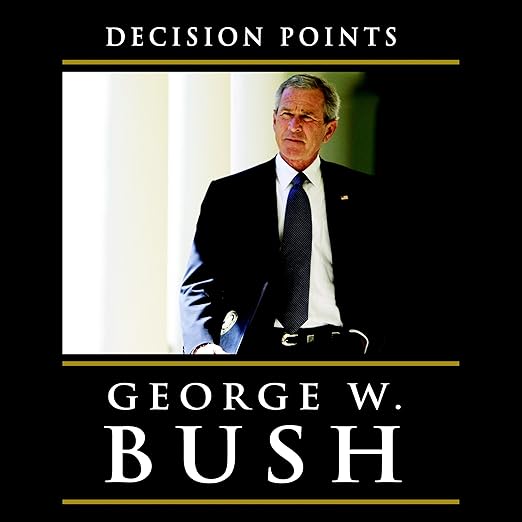
Air Force One banking away from Washington on the morning of September 11, 2001 is one of the scenes this audiobook returns to directly, not as background noise but as one of the defining 'decision points' the title promises. George W. Bush's memoir skips the standard cradle-to-present structure of most presidential autobiographies and instead organizes itself around roughly a dozen major crossroads: the contested 2000 election night in the Texas Governor's Mansion, the September 11 attacks, the decision to invade Iraq from inside the Situation Room, Hurricane Katrina, the 2008 financial crisis, and his own decision to quit drinking.
That structural choice is the book's real distinguishing feature. Reviewer Turin wrestled openly with what a five-star rating even means for a book this politically loaded before landing on a definition worth quoting: 'a book that I'd generally recommend without hesitation.' Reviewer Big Chucko took a different but equally candid approach, disclosing upfront that he voted for Bush twice while remaining unconvinced by parts of his presidential record, and still walked away impressed by the memoir's candor.
Katrina and the 2008 financial crisis get the same decision-point treatment as the more heavily covered war and election chapters, and that inclusion matters: the synopsis frames the book around moments Bush himself considers defining, not simply the ones most likely to generate headlines, which gives the memoir a slightly different shape than the media narrative around his presidency often did.
Decision Points became a best seller on release in 2010, drawing both strong sales and the mixed critical reception any sitting or former president's memoir tends to generate, and that commercial reach suggests the book found readers well beyond those already committed to Bush's politics one way or the other.
The title itself functions as more than branding: each chapter is explicitly built around a single named decision, giving the book a repeatable internal rhythm, context, choice, consequence, reflection, that a listener can settle into even while the subject matter swings from deeply personal to globally consequential from one chapter to the next.
The Best Parts of Decision Points
The synopsis promises Bush 'writes honestly and directly about his flaws and mistakes,' and the structure backs that claim up by forcing him to sit inside each individual failure rather than letting one bad chapter get buried under twenty good ones. The personal material, quitting drinking, discovering faith, the strain the Anita Hill-adjacent political battles of his era put on his family, gets equal narrative weight alongside Iraq, Katrina, and the financial crisis, which keeps the book from reading as pure policy defense.
Narrator Ron McLarty is a prolific audiobook narrator and stage and screen actor with decades of literary fiction and nonfiction credits behind him, and that general reputation, not confirmed by this specific title's reviews but well established across his broader career, suggests a steady hand for a book that swings between geopolitical crisis and quiet personal confession within the same chapter. A twenty-hour memoir demands exactly that kind of tonal control to avoid either register overwhelming the other.
Ron McLarty's own background adds a layer worth knowing: beyond his narration work, he is a veteran stage and television actor and a published novelist in his own right, which means he brings a working writer's ear for sentence rhythm and pacing to a text built from short, declarative chapters rather than sprawling continuous narrative.
Twenty hours puts this memoir on the longer end for the genre, roughly on par with other single-term-plus retrospective political memoirs rather than the shorter, more tightly focused books some ex-officials release; the decision-point structure is partly what allows that length to stay purposeful rather than padded.
Before You Commit to Decision Points
Only two ratings back the 4.6 average despite three substantive written reviews attached to the listing, a mismatch worth flagging honestly as a data quirk rather than reading too much into the raw number itself; the written reviews are the more informative signal here. Reader bias is also worth naming directly, since Big Chucko's own framing, that any review of a politically controversial figure's memoir should disclose the reviewer's biases upfront, is sound advice for anyone approaching this book.
At twenty hours and six minutes, this is a real time commitment for anyone not already invested in the subject, and the decision-by-decision structure, while its biggest strength, also means the book jumps between eras rather than building a single continuous narrative arc. Listeners expecting a strict chronological march through two presidential terms should recalibrate that expectation before starting.
The sobriety chapter carries its own weight independent of the political material: Bush describes quitting drinking at forty as a turning point that reshaped his family life and, by his own account, his capacity to later handle the presidency's worst days without it, a personal-stakes throughline the more headline-grabbing chapters build directly on.
Should You Listen to Decision Points?
Presidential history readers, listeners who lived through the Bush years and want his side of specific, contested moments, and anyone curious how a sitting president frames his own worst calls in his own words are the clear audience here. The book's candor about mistakes, not just accomplishments, sets it apart from more defensive political memoirs in the same genre.
Listeners looking for a purely chronological biography, or for a neutral third-party account rather than the subject's own framing, should look to a biographer's treatment instead. For readers willing to sit with one man's account of his own hardest calls, delivered with the self-awareness the synopsis promises, this audiobook earns the time it asks for.
Listeners of other presidents' own memoirs, read in their own voices rather than a hired narrator's, will find a natural point of comparison here, since the genre convention of self-narrated presidential memoir carries the same basic argument every time: hearing the actual decision-maker's own inflection on his hardest calls is the whole reason to choose audio over print.
Frequently Asked Questions
Who narrates the Decision Points audiobook?
Ron McLarty, a prolific audiobook narrator and actor, reads the full twenty-hour memoir.
Is the Decision Points audiobook primarily political analysis or personal memoir?
It blends both: geopolitical chapters on Iraq, Katrina, and the financial crisis sit alongside intensely personal chapters on his decision to quit drinking and his discovery of faith.