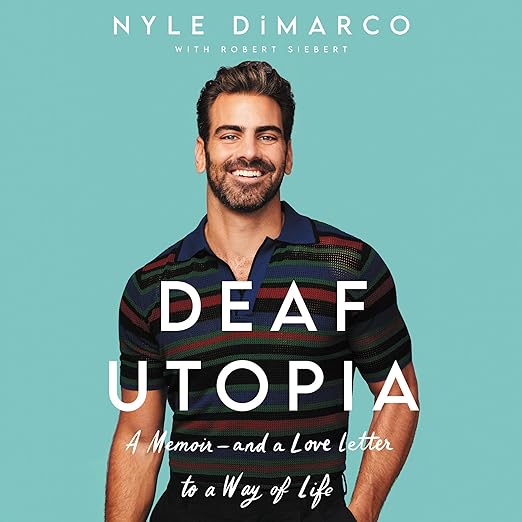
Deaf Utopia landed on my list because I wanted to hear an actor I only knew from reality competition shows talk about the childhood that actually shaped him, and this audiobook turned out to be a far more layered listen than that description suggests. Nyle DiMarco was born into a multi-generational Deaf family in Queens, one half of a pair of Deaf twins, and the hospital hearing test he "failed" on his first day becomes both the framing joke and the emotional anchor of everything that follows across ten hours and forty-nine minutes.
The Generational Gap Between Oral and ASL
What makes the book work is DiMarco's refusal to let one thread stand in for the whole story. He spends real time on the mechanics of ASL versus Signed English, on Gallaudet as the university that shaped his sense of possibility as a math major and athlete there, and on the reality-show run that took him through both America's Next Top Model and Dancing with the Stars. One review lays out a generational contrast plainly: DiMarco's account of his own father's education under an older, oral-first system that left graduates reading at a second-grade level by graduation sits right next to the ASL-first approach that raised Nyle himself. That contrast, more than the celebrity angle, is what gives Deaf Utopia its weight, and it is also why the review signed only "I sign Bohemian Rhapsody and force the Hearing to watch" calls the book a fascinating account of Deaf education history rather than a straightforward celebrity memoir. A shorter review from Susan Burns lands on the same point from a different direction, calling the insight "unique" precisely because it can only come from someone who lived the split between Deaf and hearing worlds firsthand. The review titled "Against All Odds" goes further still, walking through the difference between ASL and Signed English as distinct systems with different histories, not interchangeable labels for the same thing, which is a distinction plenty of hearing readers arrive at this book not knowing exists.
Bittner's Credit Shows No Connection to ASL
This is billed as more than a standard memoir. The synopsis calls it a cultural anthem for Deaf culture and a love letter to American Sign Language, and the audiobook edition ships with a supplemental enhancement PDF, which matters more here than it would in a typical memoir since so much of DiMarco's world runs through a visual, physical language that audio alone cannot fully carry on its own. Dan Bittner narrates, and the credit gives no indication of any personal connection to Deaf culture or ASL, which is a strange gap to sit with in a book this specific about who gets to tell Deaf stories and how. What comes through regardless is the range of setting: a loud, loving Italian-American household in Queens, the academic pressure of Gallaudet, the famed university for the Deaf in Washington, DC, and the glossy, high-stakes world of America's Next Top Model and Dancing with the Stars, all carried at the pace of one continuous story rather than three disconnected chapters of a public life. Publisher William Morrow released this one in April 2022, and a reviewer called OC Artist frames it as required listening for parents of Deaf children specifically, arguing that learning ASL alongside a child, then learning to sign well enough to actually use it, matters more than most hearing parents realize going in.
A Different Review Drifts Into a Pitch
The star count is worth a pause before you commit to this one. The listing shows 4.7 built from a single counted vote, yet five written reviews sit underneath that count, and four of those five hand out a perfect 5.0. The fifth, from a reviewer signed amls, gives 4.0 and explains why in detail: they loved the material on Deaf culture, ASL, and language acquisition but wanted the chapters on sexual identity separated into a book of their own, arguing the two subjects serve different readers and different purposes and that not everyone drawn to the Deaf-culture material is looking for the other. That is a real editorial critique, not a complaint about pacing or performance, and it is worth knowing before you press play expecting a single throughline. A separate review, from Marie Anne Scofield, drifts away from Deaf Utopia entirely into a pitch for a manuscript titled only "The Vision I couldn’t hear," which tells you something about how loosely that review section gets moderated but nothing at all about DiMarco's actual audiobook. Between a mismatched star count, a reviewer arguing for a different structure, and one review that is not really about this book at all, the surrounding commentary asks for more sorting than most memoirs require. None of the five written reviews mention the audiobook edition specifically, the narrator, or the pacing of the recording, so anything said here about the listening experience itself rests on the production credit rather than firsthand listener reaction.
Asking One Narrative Arc to Carry It All
Parents raising a Deaf child, or anyone who wants a concrete sense of what ASL-first education looks like set against the oral-first alternative, will find real substance here, and so will listeners who only know DiMarco from competition television and want the fuller story behind the wins. Go in with adjusted expectations if you were hoping for a single-issue memoir: DiMarco covers Deaf identity, sexual identity, family history, and reality-show fame inside one book, and amls's review is fair to point out that the combination asks a great deal of one narrative arc to carry at once. Readers who want their memoirs tightly themed around a single question might find the pivots between chapters on ASL history and chapters on identity and romance a little abrupt, and that is a fair thing to know going in rather than discovering it three hours into a ten-hour commitment. Listeners drawn specifically to the American Sign Language material, DiMarco's primary language according to the synopsis, will still get plenty even if the identity chapters are not their main interest, since the ASL and Deaf-education content is threaded through nearly every part of the book rather than confined to one section. If that kind of range sounds like a feature rather than a flaw, Deaf Utopia earns the two-time reality show winner reputation DiMarco brought into writing it, and it earns the "cultural icon" label the synopsis gives him well before the closing chapter reflects on what Deaf Utopia, the idea, might actually look like.
Common Questions
Does the Deaf Utopia audiobook include the supplemental PDF mentioned in the listing?
Yes, the listing specifies that a supplemental enhancement PDF accompanies the audiobook edition. Given how much of DiMarco's story runs through ASL and visual communication, that companion document is worth downloading before you start listening rather than searching for it partway through.
Why does one review under this audiobook talk about a completely different book?
One reviewer, Marie Anne Scofield, uses the space to promote an unrelated manuscript instead of discussing DiMarco's memoir at all. It is worth knowing before you weigh the review section too heavily, since not every entry listed there actually addresses Deaf Utopia.
Does the narrator identify as Deaf or hearing anywhere in this audiobook's credits?
No. Dan Bittner is credited as narrator, but nothing in the listing states any connection, one way or the other, to Deaf culture or ASL. For a memoir this focused on who gets to tell Deaf stories, that is a detail some listeners will want going in.