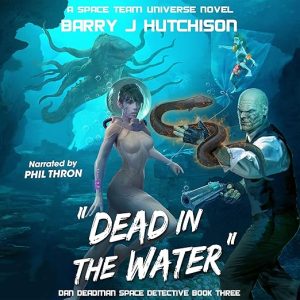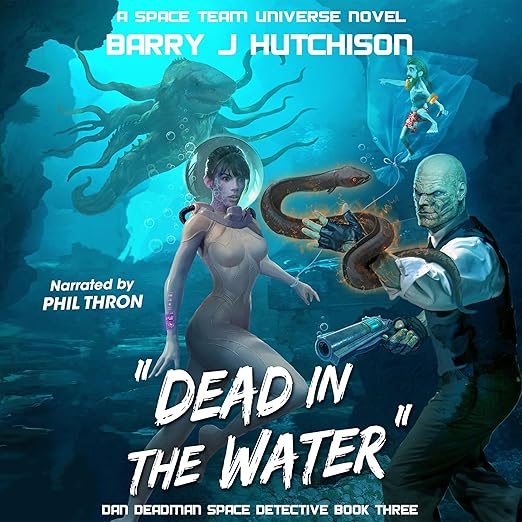
Killer toilets, an intergalactic despot, and a cartoon mascot built to haunt your nightmares: that's just the opening act of Dan Deadman's third case, and somehow none of it is the strangest part of his afterlife. What kind of audiobook makes a suspect exploding mid-interrogation barely register as unusual for its detective? Barry J. Hutchison's answer is Dead in the Water, and this third entry in the Dan Deadman Space Detective series spends nine hours proving that an undead noir investigator can survive an intergalactic despot's takeover of his office, banishment to an underground hostel network, and a mass-murder case that threatens two entire civilizations, without the book ever losing its footing between actual dread and outright silliness.
Genuinely Twisty Plotting Underneath the Absurdist Jokes
The plot mechanics are genuinely twisty for a comedy: Dan gets banished to a dangerous underground hostel network called Down Here, gets pulled into a mass-murder investigation, and follows the clues from underground tunnels to the depths of the ocean before uncovering a plot that could plunge the planet of Parloo into an endless war. Hutchison keeps the mystery structure intact even while stacking absurdist set pieces, sea monsters, killer toilets, that nightmare cartoon mascot, on top of it, which is a harder balancing act than it sounds.
Dan Deadman is a spinoff of Hutchison's larger, well-known Space Team universe, and this series carries over that universe's specific comic register: fast, profane-adjacent, willing to go for a gross-out gag in one paragraph and a genuinely tense confrontation in the next. New listeners should know they're stepping into an established world with its own internal rules about what 'Down Here' is and how Dan's undead physiology works, even though the plot of this specific book is self-contained enough to follow.
What impressed me most is how the humor never undercuts the actual stakes of the mystery. A lot of comedic science fiction treats plot as a clothesline for jokes; Hutchison writes toward a real resolution with real consequences for Parloo, and the comedy sits inside that structure rather than replacing it.
Self-Published Confidence Behind a Literal Title Pun
Hutchison built the wider Space Team universe as a self-published project that found its audience directly through readers rather than a traditional publishing launch, and that origin shows in how unapologetically the series leans into big, absurd premises, killer toilets included, without the more cautious tonal hedging a traditionally acquired book might carry. Dan Deadman inherits that same confidence: a willingness to commit fully to a ridiculous premise rather than constantly winking at the listener about how silly it is, which paradoxically makes the jokes land harder.
The title itself works as a small piece of genre wordplay: 'dead in the water' is a familiar nautical idiom for something stalled or doomed, and Hutchison applies it literally to a plot that moves between underground tunnels and actual ocean depths, while Dan himself, already dead, spends the entire book proving that being technically deceased hasn't slowed him down in the slightest. It's the kind of pun-as-structure choice that rewards readers already fluent in the series' specific sense of humor.
Selling Absurd Material With a Straight Deadpan Voice
Phil Thron has no track record in this file yet, so I'm assessing the performance purely on what the role demands: comedic noir requires a deadpan register that sells absurd material completely straight, since a narrator who winks at the jokes usually undercuts them. That's a real technical challenge specific to this genre, distinct from either straight comedy or straight science fiction narration.
Reader reaction backs up the tonal balance working in practice. One longtime fan called this Hutchison's best entry in the series, praising how the characters 'develop more and more' across the run, and said they 'laughed out loud more than once.' Another reviewer, who prefers the flagship Space Team books, still called this spinoff series 'a great laugh,' which is a meaningful concession from someone comparing it to Hutchison's most beloved work.
At just over nine hours, the runtime leaves enough room for both the noir mystery plot and the comedic set pieces to breathe without the book feeling padded or rushed toward its ending.
The comedy here works primarily through dialogue and character voice rather than slapstick description, which is exactly the register that translates best to audio; a narrator with sharp comic timing can land a deadpan line reading in a way that's genuinely harder to convey on the page, where a reader has to supply their own timing.
Exploding Suspects and Load-Bearing Gross-Out Jokes
This is explicitly book three, and at least one longtime reader's advice is blunt: read the series in order of publication. The running gags, Dan's relationship to his afterlife circumstances, and the escalating scope of the Space Team universe all build cumulatively, so starting here means missing setup that the book assumes you already have.
The humor is broad and gross-out by design, killer toilets and an anatomically unsettling cartoon mascot are not incidental details, they're load-bearing jokes, so listeners who want straight science fiction without comic exaggeration should look elsewhere in the genre.
The gross-out elements are frequent and specific: exploding suspects, monstrous sea creatures, and body-horror-adjacent gags appear regularly enough that listeners with a low tolerance for that particular comedic register, however much they enjoy dark humor generally, should know upfront exactly how far Hutchison is willing to push it before committing to the full nine hours.
One more practical note for newcomers weighing whether to jump in anyway: the emotional throughline involving Dan's afterlife circumstances and his relationships with recurring supporting characters carries real weight built up across the first two books, so even though the mystery plot here resolves on its own, some of the character beats will land with less force without that earlier context.
Better Started From Book One of the Series
This is a strong pick for existing Space Team readers, fans of detective fiction crossed with science fiction absurdism, and anyone who enjoys the specific Dresden Files-adjacent mashup of noir plotting and supernatural chaos that the synopsis itself invokes.
This also suits listeners who specifically enjoy genre-mashup fiction, comedy stitched to mystery stitched to science fiction, over books that commit to a single genre's conventions throughout; Hutchison never lets any one of those three modes dominate for too long before pulling in one of the others.
Skip this one if you're new to the universe and want a clean starting point; begin with Space Team book one or the first Dan Deadman novel instead, and save this for once you're already invested in Dan's specific brand of afterlife.