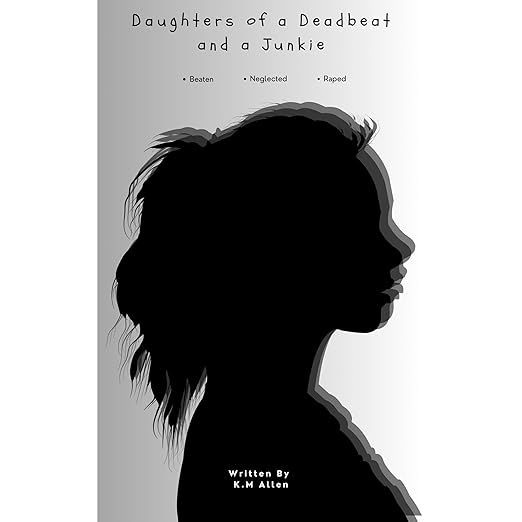
Trigger warnings open the description before a single line of the story does, five of them, itemized: drug addiction, physical abuse, emotional abuse, sexual abuse, and one memory of animal abuse the author marks as mild. Most memoirs bury that information or leave it for a reviewer to supply. K.M Allen puts it at the very top of the page, and the choice says something true about the audiobook underneath it, which is that somebody has thought carefully about what this will do to the person receiving it.
Between a Stepfather's Fists and a Mother's Body
Allen writes in the first person and in the present tense of memory, which is a harder register to sustain than it looks. The excerpt in the description puts a twelve-year-old between a stepfather's fists and a mother's body, on purpose, more times than the writer can count. That is not scene-setting. It is the thesis. The book is about what a child does with a situation no child should be managing, and the deliberateness is the part that stays with you afterward.
Cowering is where the excerpt begins, with a sister clinging to a side and screaming coming through a wall, and the prose reaches for no literary distance at all. Allen states outright that the book will not be perfect and that every editing pass meant reliving the material. A listener can take that as a disclaimer or as the terms of the deal. I take it as the terms. Memoirs of this kind are routinely over-shaped until the pain reads as craft, and this one has not been.
Diary is the word the description chooses, and it accurately names the form. The book is organized by what surfaces rather than by chapter logic, and that will strike some listeners as raw and others as shapeless. Just under six hours is a long stretch to spend inside somebody's most defended memories with no narrative scaffolding to hold. The description does promise a happy ending somewhere past the abandonment and the neglect, and having that fact in advance genuinely helps.
The Child's Perspective Over the Addict's Own
Children of addicts are the readership Allen names, and one five-star response identifies the same thing from the other direction. That entry observes that most books on this subject supply the perspective of the person who caused the harm, and that here the account belongs to the child living through it. Nobody else on the page names the value of the book so precisely. Writing about addiction is dominated by recovery told from inside the addiction, and the household tends to appear as scenery.
Healing is stated as a motive rather than claimed as an outcome, and the description is honest about the order of events: writing the book started the journey and did not conclude it. Anyone who has read widely in survivor memoir will recognize how unusual that admission is. The genre's commercial shape demands resolution, a chapter where the past gets filed. Allen declines to supply one, and the book is more trustworthy for the refusal.
Sisters run through the entire account, from the child pulled away from a bedroom door in the opening excerpt to the plural standing in the title, and one August 13 response is already asking for the next volume. That comment wants Morgan's story, naming somebody the description never mentions. Whether a second book exists is not something this listing will tell you, since the series fields sit empty, so a listener who finishes wanting more has nowhere on the page to go.
A Voice That Cannot Hesitate or Tighten
Synthetic narration is the fact that will decide this purchase for most people, and the narrator field states it plainly: Virtual Voice. A machine reading is a defensible choice for an independently published memoir with no audio budget, and it puts the book in front of people who would otherwise never have it. On this particular material it is much harder to defend. A voice that cannot hesitate, cannot tighten, and cannot decide to slow down before a sentence about a twelve-year-old is a strange instrument for a text whose whole power sits in restraint.
Dates on this page refuse to line up. All three written responses were filed in August 2024, while the edition itself carries a release date of November 2025, more than a year afterward. That gap almost certainly means the responses attach to an earlier print or digital release and have been carried across to the audio page. Nothing dishonest is happening, but a buyer reading them as verdicts on this recording is reading them wrong, because none of those people could have heard it.
Survival is doing peculiar work in the catalog. The genre fields place the book under sports and outdoors, and the tag reads Adventurers, Explorers and Survival, a category built for expeditions and shipwrecks. This is a childhood memoir about domestic violence and addiction. The classification looks like keyword matching rather than a human decision, and the practical result is that the book surfaces for the wrong browsers and stays invisible to the right ones.
Caution Is the Whole Recommendation Here
Survivors are the audience Allen writes toward, and one short August entry frames the book that way exactly, as an account of overcoming abuse and neglect rather than merely enduring it. If you belong to that group, the closing instruction in the description is the important sentence on the page: be mindful of your own mental health before starting. Take it literally. The material is specific, and the itemized warnings at the top are not decoration.
Readers who want craft above testimony are in the wrong place, as is anybody who needs a human voice in their ear for difficult material. The prose is plain, the structure is associative, and the machine reading strips out the one resource that could have carried the plainness. What remains is a first-hand account of what addiction does to the children in the house, told by one of them, with the warnings printed where you can see them. Caution is the whole recommendation here, since the book is worth your time and will cost you something to give it.
Questions Listeners Ask
Who narrates the Daughters of a Deadbeat and a Junkie audiobook?
The narrator field reads Virtual Voice, which means a synthetic reading rather than a human performer. That is what keeps an independently published memoir in audio at all, and it also means no pause, emphasis or change of pace was chosen by somebody who had read the book first.
What content warnings does the book carry?
The description lists them ahead of everything else: drug addiction, physical abuse, emotional abuse, sexual abuse, and one memory of animal abuse the author marks as mild and not graphic. It closes by asking readers to be mindful of their own mental health before beginning.
How long is the audiobook, and is it a continuous narrative?
Just under six hours. The author calls the book a diary, so it moves by memory rather than by chapter logic, and the description promises abandonment, neglect and love alongside a happy ending. Expect an associative account rather than a straight chronological one.