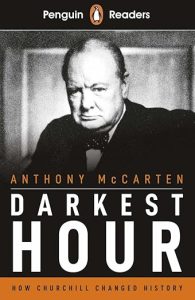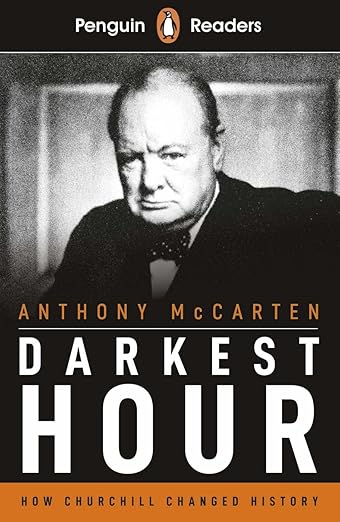
May 1940 finds Winston Churchill barely a week into the job of prime minister, already facing a skeptical king and a party actively plotting against him, and the Darkest Hour audiobook drops listeners straight into that exposed, uncertain moment rather than easing in with background first. Anthony McCarten, who also wrote the screenplay for the Oscar-winning 2017 film of the same name starring Gary Oldman, builds this companion account hour by hour across the weeks when European democracies were collapsing and Britain's own public had little sense of how dangerous their position had become. McCarten's stated goal is a more rounded portrait than the familiar iconic-Churchill story, one where doubt, and even a real, considered peace overture toward Nazi Germany, sit alongside the defiance history remembers best.
The Review
What makes this account distinct from a standard Churchill biography is its narrow window: rather than covering a full career spanning decades, McCarten stays inside a matter of weeks, tracking the day-by-day, sometimes hour-by-hour decisions that turned an unlikely, initially unpopular new prime minister into the wartime leader history remembers. That tight focus lets McCarten dig into specifics a broader biography would need to compress or skip entirely, the exact arguments happening inside the war cabinet, the real pressure from a king who did not want him in the job, the seriousness with which a negotiated peace with Germany was actually considered.
The synopsis calls this a scarier, more human account than the familiar version of the story, and that framing is the book's real thesis: Churchill's greatness is not diminished by showing the doubt underneath it, if anything, McCarten argues, the uncertainty makes the eventual defiance more impressive rather than less. Listeners who know Churchill mainly through the confident wartime speeches will find a more anxious, more politically vulnerable figure here, someone whose iconic status was still very much undecided in May 1940.
McCarten has built a distinct career pattern of finding the tightly scoped, character-driven human moment inside major historical events, the same approach he brought to Freddie Mercury's story in Bohemian Rhapsody and to the two popes' relationship in The Two Popes, and Darkest Hour applies that same instinct to Churchill's specific crisis of confidence in May 1940 rather than his full biography.
The war cabinet debates McCarten reconstructs, particularly the real disagreement over whether to explore terms with Germany through Italian intermediaries, remain some of the most consequential and, until relatively recently, under-examined decisions of the entire war, since the outcome we now know makes it easy to forget how genuinely undecided the question felt to the people arguing it in real time.
John Lee narrates, and while no reviews are currently attached to this specific listing to confirm his performance here, he has built a broad reputation across historical nonfiction narration more generally, which supports real confidence in his handling of McCarten's dense, day-by-day material even without a title-specific quote to point to. A book built around escalating, hour-by-hour tension needs a narrator who can control pace tightly, building real momentum toward the famous wartime speeches without rushing past the smaller procedural details that make the crisis feel genuinely uncertain in the moment.
The connection to McCarten's own Oscar-winning screenplay gives this audiobook a useful entry point for listeners who saw the film and want the deeper, less compressed nonfiction account of the same six weeks. A screenplay has to compress a complicated political crisis into roughly two hours of dramatized scenes; this audiobook, running six and a half hours, has room to include the cabinet-room nuance and archival detail a film adaptation necessarily leaves out.
The hour-by-hour structure also suits continuous audio listening particularly well, since the mounting pressure across a single sustained sitting reproduces something closer to how the crisis actually felt in real time than a print reader flipping between chapters at their own pace would experience.
What to Watch For in Darkest Hour
No listener reviews are attached to this title yet, leaving only the listing's own rating of 5.0 from three ratings as a signal, itself a small enough sample to treat cautiously rather than as a settled verdict. Listeners should weigh the strength of McCarten's source material and reputation heavily here, since less crowd-sourced signal exists to lean on than usual.
Listeners wanting a comprehensive Churchill biography covering his full life and career should look elsewhere; this stays deliberately narrow, covering only the weeks surrounding his ascension to prime minister rather than his earlier political career or the years of war that followed. That narrowness is a genuine strength for the specific story McCarten is telling, but a real limitation for anyone wanting the complete picture in a single listen.
The book's central revisionist claim, that Churchill seriously explored a peace treaty with Nazi Germany before committing to war, is likely to surprise listeners who only know the more triumphant popular version of this story, and McCarten treats that detail as historically significant rather than a minor aside, so it is worth going in prepared for a genuinely more complicated Churchill than the myth allows.
Listeners drawn to this specific slice of history might also want to compare it against other single-episode WWII narrative histories to see how McCarten's screenwriter's instinct for scene and dialogue shapes the account differently than a more traditionally academic historian's version of the same six weeks would.
Who It's For
WWII history fans, Churchill biography readers, and anyone who watched the film and wants the fuller nonfiction account behind it are the clearest audience, alongside listeners who specifically enjoy tightly scoped, single-episode narrative history in the vein of Erik Larson's work, one dramatic, bounded moment examined in real depth rather than a sprawling multi-decade survey.
Skip this if a complete Churchill biography, cradle to grave, is the goal; McCarten's focus stays fixed on a matter of weeks in 1940. For listeners drawn to a single, high-stakes historical moment told with real narrative propulsion, six and a half hours makes for a genuinely efficient, tension-filled listen.
It also works well as a compact companion listen for book clubs or history discussion groups working through WWII-era leadership more broadly, since its tight six-and-a-half-hour scope makes it far more approachable than a doorstop-length full biography would be for a single group discussion.
Frequently Asked Questions
Are there any listener reviews for the Darkest Hour audiobook yet?
None are attached to this listing at the time of this review, so the 5.0 rating from three ratings should be weighed as an early, limited signal rather than a broad consensus.
Who narrates the Darkest Hour audiobook?
John Lee narrates. No reviews confirm his specific performance on this title yet, but he carries a strong general reputation across historical nonfiction narration.