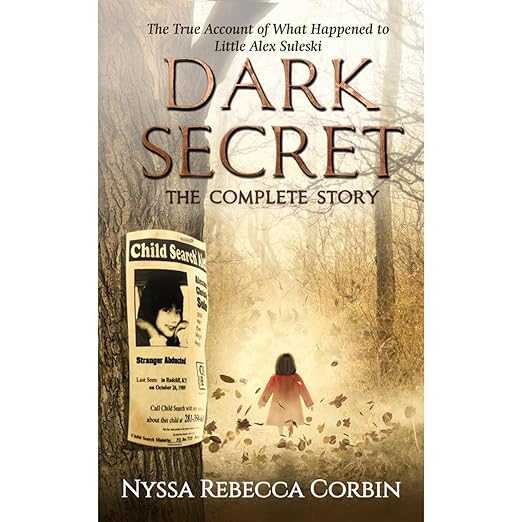
Before You Press Play
- Read by: Virtual Voice handles this seventeen-hour true crime account, and the synthetic delivery is worth real scrutiny given how emotionally heavy and personal the source material is.
- At its heart: missing child investigation, community trauma, firsthand testimony
- Vibe: Heavy and sustained
- Short version: A thorough, source-grounded true crime account best approached by listeners already comfortable with difficult subject matter.
Alex Suleski vanished from her Kentucky neighborhood, close enough to a military base that soldiers themselves joined the search, alongside local police and civilians who had never even met the girl or her family. This audiobook runs just over seventeen hours and follows that search from its earliest hours through an FBI investigation that fundamentally changed the shape of the case.
Only three people ever knew what actually happened to her, and the book's central tension is whether any of them would ever talk. Nyssa Corbin builds the account around a first-hand witness to the entire case, supplemented with court transcripts and wire tap transcriptions, an updated 2018 edition that folds in the latest developments since the case first broke.
Crying Through Much of the Book, by Design
This is difficult listening by design, and the reviews attached to it reflect that directly. Pondfrog62 writes about crying through much of the book and shaking their head in disgust at points, which is not a complaint, it is an accurate description of what sustained true crime about a child victim actually does to an engaged listener. R. Waldon's review adds a layer of real proximity: the crime took place less than a mile from where they grew up, and the author attended the same school, details that turn this from abstract true crime into something closer to community memory.
Ceriola's review captures the tension the book sits inside honestly: heartbreaking, praised as well-written, with prayers extended toward 'these girls,' plural, hinting the case involves more than one victim's story woven through the investigation. That kind of emotional directness from reviewers, rather than genre-standard true crime enthusiasm, suggests the book earns its difficulty rather than exploiting it.
A Self-Published Account That One Reviewer Corroborates
Worth naming plainly too: little independent verification exists beyond the book's own claimed sourcing and the personal reviews attached to it, since this is a self-published account rather than a work vetted by a major true crime publisher's editorial and legal process. That does not mean the reporting is unreliable, the reviewer with direct community ties to the case corroborates its accuracy, but it is a different kind of trust relationship than a traditionally published investigative book asks a listener to extend.
The title itself, 'The Complete Story,' suggests this edition consolidates material that may have appeared across earlier, more fragmented releases, a common pattern in self-published true crime where a case develops in real time and earlier editions capture only partial information. Corbin's choice to fold everything into one comprehensive account, rather than leaving listeners to track down multiple older versions, is a genuine service to anyone trying to understand the full case in one sitting.
Wire Tap Transcriptions Are a Rare Inclusion
The first-hand witness account at the center of the book is the strongest reason to choose this over a more distant, journalist-assembled true crime narrative. Combined with actual court transcripts and wire tap material, the book has access to primary source detail that most true crime writing has to reconstruct secondhand, and that access shows in how specific and grounded the account reportedly is.
At seventeen hours, updated as recently as 2018 with the latest case information, this is a genuinely comprehensive account rather than a quick true crime overview, closer in scope to a full investigative book than a single-sitting listen. Anyone who wants the complete arc of the case, search through investigation through whatever resolution the courts eventually reached, gets real depth here.
The book's structure as an 'updated version,' explicitly dated to 2018, also matters practically: true crime cases evolve, appeals happen, new information surfaces, and a book willing to revise itself rather than freeze at its original publication date is doing something genuinely useful for listeners who want the most current understanding available of how the case was ultimately resolved.
Wire tap transcriptions specifically are a relatively rare inclusion in true crime writing generally, since they usually require court authorization to access and publish, and their presence here signals a level of legal access beyond what a typical true crime author working purely from public records and interviews would have. That detail alone is worth knowing if primary-source rigor is what draws you to true crime in the first place.
Synthetic Narration Meets a Child's Death
The narrator is Virtual Voice, and given how emotionally loaded this material is, a missing child, a first-hand witness account, courtroom material involving real trauma, that synthetic narration deserves real scrutiny before committing seventeen hours to it. AI narration tends to work reasonably well for flatter, list-driven nonfiction; a first-hand emotional testimony about a child's death is closer to the opposite end of that spectrum, where a human narrator's judgment about pacing and restraint genuinely matters.
The emotional weight here is sustained rather than occasional, closer to a slow accumulation of dread than a single shocking reveal. R. Waldon's review notes the story is 'a lot' to sit with given personal proximity to the case, and that is a fair general warning: this is not a casual true crime listen, and pacing yourself across multiple sessions rather than a single long sitting is a reasonable way to approach seventeen hours of this specific material.
Runtime is also worth flagging on its own terms: seventeen hours is long even by true crime standards, and Virtual Voice narration sustained across that length asks more patience of a listener's ear than it would across a shorter book, since the AI voice's limitations become more noticeable the longer a single narration register has to carry the material.
Given the seventeen-hour runtime and the case's connection to a nearby military installation, listeners with any personal or family connection to military communities may find an additional layer of unease here, since the search effort itself drew directly from that base's personnel and resources.
The Most Complete, Source-Grounded Account Available
This audiobook is built for listeners deeply committed to true crime as a genre, particularly cases involving primary source material like court transcripts and firsthand witness testimony rather than secondhand journalistic reconstruction. Kentucky residents and anyone with a personal or geographic connection to the case, per R. Waldon's review, will find an added layer of resonance here.
Skip it if child-victim true crime is a hard line for you regardless of how respectfully it is handled, or if AI narration on emotionally difficult material is a genuine dealbreaker. For listeners who can sit with heavy, sustained true crime and want the most complete, source-grounded account available on this specific case, the updated Complete Story edition delivers exactly that.
Frequently Asked Questions
Who was Alex Suleski, and what does this audiobook cover?
Alex Suleski was a young girl who went missing in Kentucky near a military base; the book follows the massive search, the FBI investigation, and the difficult path toward answers using court transcripts and a firsthand witness account.
What additional material does the Complete Story updated edition of this audiobook include?
The 2018 update folds in the latest information available on the case at that time, on top of the original firsthand witness account, court transcripts, and wire tap transcriptions.
Is this audiobook based on a firsthand account?
Yes. The book centers on a firsthand witness to the entire case, supplemented with court records and wire tap transcriptions rather than secondhand journalistic reconstruction.