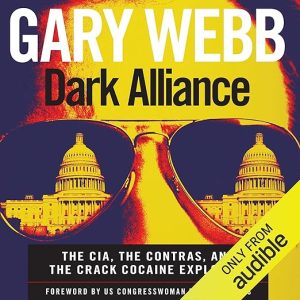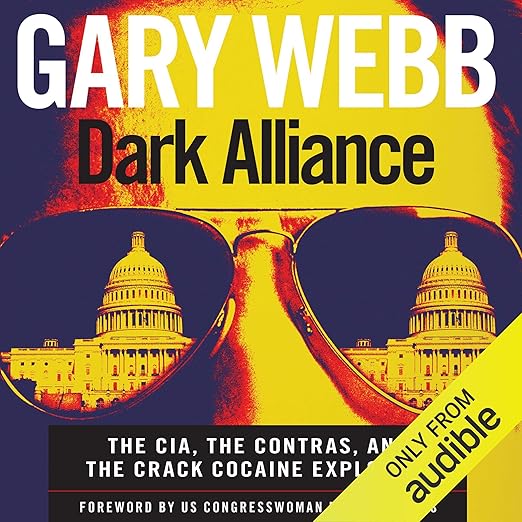
A single unexpected phone call about a routine drug trial is not usually how the biggest story of a journalist's career begins, but that is exactly how Gary Webb stumbled into what became Dark Alliance. This audiobook traces what happened after: thousands of tons of cocaine, Nicaraguan Contra rebels funding a counterrevolution, and evidence of the CIA's own tolerance for the operation bankrolling them.
Webb was a San Jose Mercury-News reporter with no particular reason to expect the story would consume the rest of his career, and the twenty-plus hours that follow trace both the investigation itself and everything it cost him to publish it.
For several years during the 1980s, Webb found, Contra elements moved thousands of tons of cocaine into the United States, with the resulting profits funneled back toward funding the counterrevolution against Nicaragua's Sandinista government. That is the scale of operation this audiobook reconstructs, piece by documented piece.
The reporting is exhaustive in the most literal sense: names, dates, places, and dollar amounts accumulate steadily until they form what the synopsis rightly calls a towering wall of evidence. Webb isn't asking listeners to take his conclusions on faith; he's laying out the paper trail piece by piece and letting the accumulated weight of it make the argument.
Christian Rummel narrates with precise, gravity-appropriate delivery suited to twenty-plus hours of forensic journalism, never reaching for drama the material doesn't need. That restraint matters for a story this dense with names and figures; a narrator chasing artificial peaks would exhaust a listener long before the evidence finishes accumulating.
Webb doesn't merely allege CIA awareness of the trafficking; he documents what he characterizes as implicit approval and, at points, outright support from the very agency tasked with keeping illegal drugs out of the country. The audiobook lets that specific, carefully sourced claim sit at the center of the whole investigation rather than treating it as one accusation among many.
The synopsis frames this audiobook as serving two functions simultaneously: a memoir of Webb's own time reporting on the Contras, and a broader indictment of the state of American press credibility. Most investigative journalism books pick one lane; Dark Alliance's willingness to hold both accounts responsible, the CIA's and the media's, is part of what makes it distinctive.
Webb's own prose style, precise and unshowy, mirrors the just-the-facts approach of the evidence he presents: short, declarative sentences carrying enormous factual weight rather than reaching for rhetorical flourish to manufacture outrage the material already generates on its own.
Vindicated Later by the CIA's Own Report
This book operates on two levels at once, and that dual structure is genuinely distinctive: it's an account of the Contra-era cocaine operation itself, and separately, an indictment of how Webb's own profession treated him once he published it. Major outlets criticized the reporting, his own paper backed away from standing behind the series, and Webb quit in disgust in November 1997, a professional cost the book documents as carefully as it documents the original crime.
History has been kinder to Webb's core reporting than his contemporaries were: a CIA Inspector General report released years later substantiated significant elements of what he'd found, and the 2014 film Kill the Messenger brought his story to a wider audience who'd missed the original controversy. Listening to the book with that vindication in mind changes how the press-backlash chapters land.
The book's second half functions almost as its own separate story: a working journalist watching his own profession turn against him, as competing major papers ran pieces disputing his reporting and his own newspaper quietly declined to keep standing behind the series it had published. Few investigative works document that particular betrayal as directly as this one does.
Webb's method throughout relies on primary documentation, court records, financial transfers, and firsthand testimony rather than anonymous sourcing alone, which is part of why the reporting held up as well as it eventually did once outside investigators returned to the underlying material years later.
Patient Listening Rewards Twenty-Plus Dense Hours
At over twenty hours, this is a major time commitment, and the density of named figures, dates, and financial detail means it rewards patient, attentive listening rather than background use. One reviewer noted the narrative structure jumps around chronologically rather than proceeding in a straight line, which tracks with how Webb builds his case thematically as much as sequentially.
This is heavy, disturbing subject matter: government complicity, drug trafficking, and a fair amount of Cold War-era Central American political violence sit underneath the domestic crime story. Listeners wanting a lighter true-crime pace should know upfront what they're getting into.
Decades after its original publication, the specific dollar figures, dates, and named operatives Webb catalogued still read as remarkably precise rather than dated, a testament to how much verifiable documentation underlies claims that were, at the time, dismissed by much of the mainstream press as conspiracy-minded overreach.
Listeners new to this story should know going in that the backlash Webb faced came substantially from other major newspapers, not just government officials, a detail that reframes the press-freedom angle: this is as much a story about journalism turning on itself as it is about government secrecy.
Listeners drawn to this book specifically for the CIA angle should know the agency's own internal reviews, released years after publication, focused narrowly on specific factual claims about awareness and support rather than validating every interpretive conclusion Webb drew, a nuance worth understanding before treating the book's most dramatic claims as uniformly confirmed.
Press-Freedom Readers Get the Most Reward
Readers of serious investigative journalism, press-freedom and media-criticism audiences, and anyone interested in Cold War-era Central American policy will find this rewards the time it demands. It holds up well as history, not just as a period piece about a specific scandal.
Anyone who has read other accounts of journalism colliding head-on with institutional power will find a genuine kinship here, though Dark Alliance's ending is considerably less redemptive for its central reporter than most of those stories manage.
This audiobook rewards a highlighter-and-notes approach as much as passive listening, given how much specific evidentiary detail accumulates across the runtime.
Skip this if you want a breezy true-crime pace or a quick single-sitting listen; Dark Alliance is dense, evidence-heavy reporting closer to a legal case file read aloud than a thriller, and it asks real patience of its audience.
- Narrator: Christian Rummel brings precise, unhurried gravity to twenty-plus hours of forensic journalism without melodrama.
- Subjects: CIA complicity, Contra-era cocaine trafficking, press freedom and retaliation
- Tone: Heavy, meticulous, and quietly furious
- Bottom line: A dense, thoroughly reported indictment that rewards patient listening and holds up well over time.
Common Questions
How long is the Dark Alliance audiobook, and how demanding a listen is it?
It runs just over twenty hours and is dense with named figures, dates, and financial detail. It rewards patient, attentive listening rather than background use.
Does the Dark Alliance audiobook tell the same story dramatized in the film Kill the Messenger?
Yes, the 2014 film covers the same investigation and its professional fallout for Gary Webb, though the book carries far more of the underlying documentary evidence than any film adaptation could include.
Does the Dark Alliance audiobook require prior knowledge of the Contra conflict to follow?
No, though a basic familiarity with 1980s Central American politics helps. Webb builds the necessary context into the reporting itself as the investigation unfolds.