In Brief
- Voice: Kevin Pierce reads; two reviewers name him directly as the reason they chose this collection.
- Big ideas: true crime compilation, Ted Bundy case studies, breadth over depth
- Atmosphere: Grim and steady, built for long stretches of listening
- Worth it?: Kevin Pierce's narration carries this collection further than the case selection does on its own, worth choosing for his voice alone if breadth appeals to you more than depth.
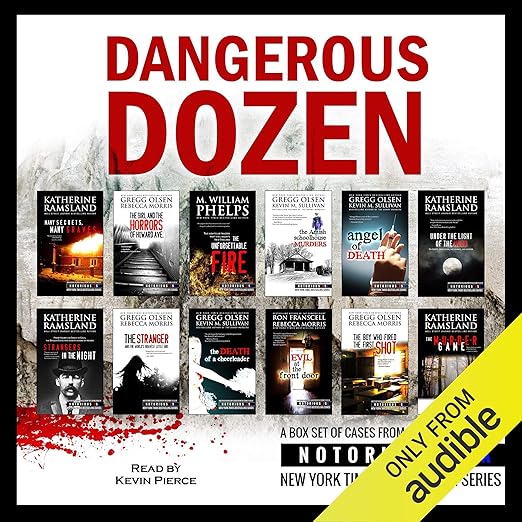
The synopsis for this audiobook is a single sentence: a true-crime collection culled from the crime files of the New York Times best-selling series, Notorious USA. That is genuinely all the listing offers by way of description, so everything else worth knowing about Dangerous Dozen, Gregg Olsen's entry in that franchise, comes from the five listener reviews attached to it, and from Kevin Pierce's narration, which two of those five reviews single out by name as the actual reason to press play.
Laurie Miller's review opens with a genuine admission: compilations are not usually a favorite format, yet this one worked, turning up 'many, many cases' never encountered before and worth investigating further afterward. That same review is also the first to name a real quality concern, flagging 'poor editing, which seems to be the case in many books these days,' as something to look past rather than ignore entirely if in-depth coverage of any single case is not the priority.
Reactions to tone diverge sharply elsewhere. Susan's three-star review describes the listening experience as 'depressing and exhausting,' bad enough to prompt locking doors and keeping a baseball bat by the bed while working through it, and argues the shorter format leaves many of these stories 'lacking' the fuller sense of the people involved that true crime fans usually get from a single-case book. Dia D.'s five-star review reads almost as a direct answer to that complaint, praising the same bite-sized structure for giving 'the important parts and conclusion' without every case dragging on past the point of interest.
The publisher credit itself, Crime Rant Classics and Notorious USA listed together, confirms what the synopsis implies: this is a spin-off collection pulling from an established franchise's back catalog of cases rather than a standalone project built from scratch. That is useful context for calibrating expectations, this functions closer to a highlight reel of a larger true-crime operation's back files than a single author's original investigative work start to finish.
The Best Parts of Dangerous Dozen
Kevin Pierce's narration is the most consistently named draw across the five reviews, not the case selection itself. Miss V's review puts it bluntly: 'I could listen to Kevin Pierce read the phonebook, when there were phonebooks,' and Dia D. separately calls him 'my favorite narrator,' unprompted and in a review otherwise focused on the collection's structure. Two independent five-star reviews naming the same narrator as the specific reason to choose this over another true-crime anthology is a stronger signal than either review alone.
Cyn's four-star review adds real texture on the case selection itself: several stories were genuinely new information, at least two separate entries cover Ted Bundy alongside passing mentions of him elsewhere in the collection, and more than one case is 'interesting' enough to make you 'hold your breath and shake your head.' That same review notes the collection skips individual character voices for the narration, adding plainly that 'in this type of book it isn't needed,' true-crime narration generally works better staying out of the way than performing each case like a drama.
Miss V's review offers a specific, practical way to approach the runtime: it suggests treating this as rainy-day listening rather than a single sitting, pairing it with something comforting on the side rather than trying to power through twenty-five-plus hours of true crime in one stretch. That framing matches the collection format well, since the case-by-case structure offers a natural stopping point roughly every hour or so, unlike a single continuous narrative you might feel pressure to finish once started.
Before You Commit to Dangerous Dozen
Two separate reviews flag real production issues worth knowing before buying. Laurie Miller's 'poor editing' comment is one; Cyn's is more specific, noting two places where Kevin Pierce repeats words and observing that he delivers the material without showing much emotion, though that same review argues flat delivery actually suits true crime's factual register rather than undercutting it. Worth reading both as data points about the same recording rather than contradictory opinions, since a listener can reasonably read 'unemotional' as either a flaw or exactly the right choice depending on what they want from the genre.
The Ted Bundy overlap Cyn's review describes, at least two dedicated entries plus additional passing references, is also worth knowing if you have already read extensively on Bundy specifically and are hoping for twelve genuinely distinct, lesser-known cases rather than a collection that returns to one of true crime's most-covered subjects more than once.
Should You Listen to Dangerous Dozen?
It is worth adding one more honest note about the source material itself: with a synopsis this thin, a single sentence pointing back to a franchise rather than describing this specific collection's contents, a listener genuinely has to rely on the five attached reviews to know what they are buying before pressing play. That is not a criticism of the book so much as a description of the listing, and it is exactly why the reviews get this much attention here rather than a plot-style rundown of what is inside.
Range over depth is the actual selling point, so true crime listeners chasing breadth stand to get the most here, newcomers to the genre included; Miss V's review specifically recommends newcomers 'take it slowly' rather than binge the whole runtime at once. Fans of Kevin Pierce specifically, or listeners who already enjoy the broader Notorious USA franchise this collection draws from, should also feel confident going in based on how consistently his narration gets credited as the standout element.
Listeners drawn specifically to the Bundy case should also temper expectations: with the material already split across at least two dedicated entries and further passing references elsewhere in the same collection, this is not the place for a single, sustained deep-dive into that one case; a book built entirely around Bundy would serve that specific interest better.
Listeners who want deep, single-case true crime with full psychological and investigative detail should look elsewhere; Susan's review is a clear warning that this format trades depth for range. Anyone sensitive to sustained, back-to-back disturbing content should also weigh that review's account of the emotional toll before committing to a twenty-five-hour, forty-three-minute runtime covering case after case with little relief between them.