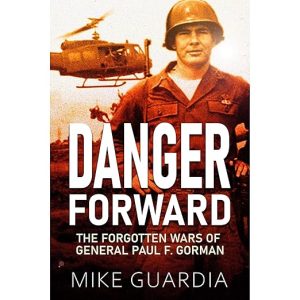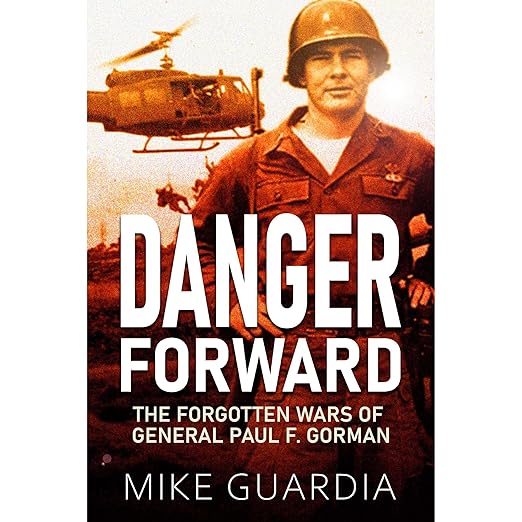
In Brief
- What it covers: Cold War military biography, Army training reform, forgotten institutional leadership
- Feel: Substantive and methodical, with the cumulative weight of a career reconstructed from archival research
- Our call: A persuasive restoration of General Paul Gorman's place in American military history, grounded in primary research and structured around one of the twentieth century's most consequential unsung careers.
Military biography occupies a strange corner of the nonfiction audiobook space: it demands both the rigor of serious historical research and the narrative pull of a compelling life story, and most entries in the genre deliver only one of those at a time. Mike Guardia's account of General Paul F. Gorman, narrated by Virtual Voice across seven and a half hours, manages both. The book opens with a specific scene: August 27, 1966, and the men of 1st Battalion, 26th Infantry holding their positions under relentless assault, with their badly burned battalion commander still calling for fire support rather than evacuating. That opening is not rhetorical; it is representative of the kind of evidence Guardia marshals throughout to argue that Gorman belongs in the front rank of twentieth-century American military leaders, despite his near-total absence from popular historical memory.
A note on the narration: this audiobook uses Virtual Voice, Audible's AI-generated narrator. The production quality is functional and clear, but listeners sensitive to AI narration should know that in advance. The biography's strength lies in Guardia's research and narrative construction, not in a human performance.
Reviewer Rebekah Kerr, who described herself as someone who has read almost every military history book she could access, admitted she knew almost nothing about General Paul Gorman before this book and came away wondering why that was. That response captures the book's central argument: Gorman spent five decades at the intersection of the most consequential decisions in American military policy, from Korea to Vietnam to the Cold War restructuring of the Army to the proxy conflicts of the 1980s in Latin America, and yet his name is not taught in schools, not featured in popular histories, and not part of the cultural memory of the period. Guardia's biography is explicitly a corrective project.
Reviewer Dremel22, who posed the same question about why Gorman was not spoken of more widely, noted that the book answered it. Gorman's career is not obscure because his contributions were minor; it is obscure partly because the domains where he excelled, institutional reform, training methodology, and strategic advisory work, do not generate the battlefield headline moments that drive popular memory. His principal authorship of the Pentagon Papers is one example: a document of enormous historical significance whose central figure has been largely erased by the drama surrounding its leak. Guardia restores that context without turning the biography into advocacy.
Training Reform Chapters Are the Most Substantive
Guardia is methodical and thorough in a way that serves biography well. He covers Gorman's 1950 West Point graduation, his Korean War service with the 32nd Infantry Regiment in the hilltop battles of 1952, his NATO command in West Germany, his two Vietnam tours, and his final assignment as Commander-in-Chief of US Southern Command during Operation Urgent Fury in Grenada and the Contra support operations in Nicaragua. Each phase receives sufficient depth to establish what Gorman actually did, what decisions he made, and why they mattered, without the compressed, glossing treatment that often reduces a long career to a highlight reel.
The training reform chapters, covering Gorman's work in revitalizing Army training methodology during the post-Vietnam period when the institution was transitioning to an all-volunteer force, are among the most substantive sections in the book. This is where Gorman's institutional impact was perhaps most durable: the transformation of Army training culture in the 1970s and 1980s had downstream effects on American military effectiveness for decades. Reviewer pellepelle23 called the book "excellent, exciting and informative" and noted it provides "a great deal of helpful information about the subject matter," which understates the depth of the research Guardia built this on.
AI Narration Handles Names With Variable Consistency
Virtual Voice narration does present some limitations that are worth noting for a biography of this length and complexity. AI narration handles proper names, military unit designations, and tactical terminology with variable consistency, and listeners attuned to those qualities may find moments where the narration's rendering of specialized vocabulary requires a second pass to parse correctly. The content itself remains authoritative; the issue is purely a narration quality matter that some listeners will find inconsequential and others will find genuinely distracting.
The book's focus on Gorman also means that some of the larger historical events he participated in, particularly the debates around Vietnam strategy and the 1980s Central American proxy conflicts, are viewed entirely through the lens of his role in them. Listeners wanting a broader context for Operation Urgent Fury or the Contra operations will find this account illuminating for Gorman's specific perspective and actions but will need additional reading for the full political and historical picture surrounding those events.
Battle-Focused Readers May Find the Advisory Sections Slower
Military history readers with an interest in the Cold War era, particularly those drawn to institutional biography rather than pure battlefield narrative, will find this audiobook rewarding and substantive. Listeners who appreciate the kind of biography that restores genuine significance to someone history has largely overlooked, in the tradition of books about unsung architects of major institutions, will find Guardia's project both convincing and well-executed. Those who come to military biography for the action of specific battles rather than the intellectual history of military reform may find the training methodology and advisory sections slower than the Korean and Vietnam combat chapters. Listeners particularly sensitive to AI narration should factor that in when deciding whether the seven-and-a-half-hour format works for them.