The Short Version
- Read by: Tom Brooks brings his established measured, note-taking-paced delivery to a new technical certification domain, and it suits the material well.
- At its heart: welding inspection judgment, code-based acceptance and rejection decisions, exam time management.
- Vibe: focused and procedural, built for study rather than entertainment.
- Short version: solid audio reinforcement for CWI Part B terminology and reasoning, but not a substitute for the visual and hands-on practice the actual exam demands.
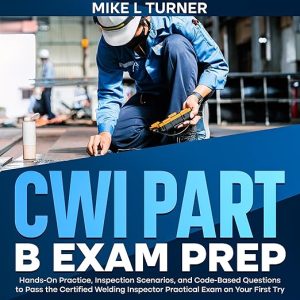
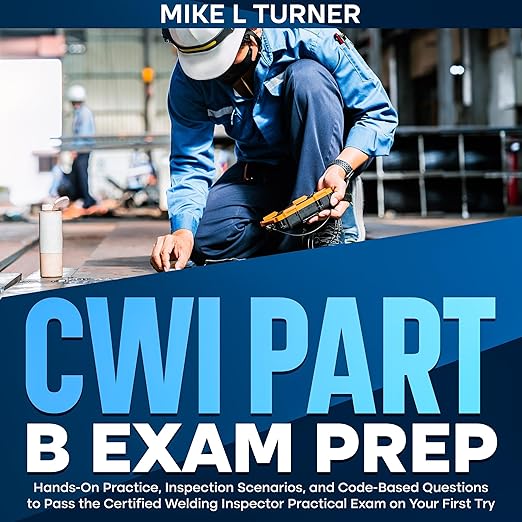
Passing the Certified Welding Inspector Part B exam depends on hands-on judgment under pressure, not memorized definitions, and that distinction shapes everything about this audiobook. Written by a certified welding inspector, CWI Part B Exam Prep runs five hours and fifty minutes and is narrated by Tom Brooks in the same measured, no-dramatization register he has brought to law enforcement and IT certification guides elsewhere, a register that suits technical study material better than a more theatrical reading style would.
Mike L Turner organizes the guide around the actual exam structure: welding symbols and blueprint reading, the specific gauges inspectors use in the field, fillet and groove weld evaluation, discontinuity and defect identification, and the code-based reasoning behind accepting or rejecting a weld. The 250 practice questions with explanations give the material a testable shape rather than leaving listeners to guess whether they've actually absorbed it.
Brooks's pacing is built for note-taking rather than passive listening, unhurried enough that a listener working through gauge specifications, the differences between Hi-Lo gauges, fillet weld gauges, pit gauges, and bridge cam gauges, can actually keep up rather than rewinding constantly.
Certified Welding Inspector status, administered through the American Welding Society's credentialing process, opens doors in construction, shipbuilding, pipeline work, and manufacturing quality control, and candidates typically need to clear multiple distinct exam parts covering general welding knowledge, practical hands-on inspection, and code application. Part B's hands-on format is consistently the one candidates who otherwise test well on paper describe struggling with most, which is exactly the gap this guide is built to close.
Discontinuity and defect identification make up a substantial portion of the guide's real content, walking through the visual and dimensional characteristics that separate an acceptable weld from a rejectable one under code. Even discussed verbally, understanding what specifically makes an undercut, porosity, or incomplete fusion defect count as rejectable under a given code standard is foundational knowledge every other station depends on.
Turner Organizes This Around Actual Inspection Stations
Part B is explicitly the most hands-on and demanding section of the CWI credential, and a guide built around application rather than memorization is the right response to that format. The synopsis promises time-management strategies for completing simulated inspection stations efficiently, which addresses a real, specific anxiety for anyone who has heard how tightly timed this portion of the exam runs.
No written reviews are attached to this listing yet, but twenty-five ratings averaging a perfect five suggest listeners who have used it for actual exam prep came away satisfied, which is the most relevant signal available for a study guide like this one.
Mike L Turner writes as a certified welding inspector himself, and that practitioner's perspective shows in how the guide is organized: around the actual stations and scenarios a candidate will face, rather than around a textbook's theoretical chapter structure. A guide built by someone who has sat for this exact exam carries a different kind of authority than a general test-prep company's generic study material.
The blueprint reading and welding symbol sections cover a skill that trips up plenty of candidates who have years of hands-on welding experience but less formal training in reading engineering drawings, since symbol notation is its own dense visual language separate from the physical welding skill itself. Building fluency there before stepping into an exam station is exactly the kind of foundational work worth doing well before test day.
Working through 250 practice questions with explanations, rather than answer keys alone, means listeners get the reasoning behind each correct and incorrect answer, which matters enormously for a credential exam built around applying code logic to specific scenarios rather than recalling memorized facts.
Photo-Based Judgment Calls Defeat Any Narration
Here is the real limitation: Part B evaluation depends heavily on visual judgment, reading photo-based weld defect scenarios and identifying discontinuities by sight, and no amount of narration can replace looking at an actual image. The synopsis itself promises 'simulated stations and photo-based analysis,' which by definition means some portion of this material needs a visual companion, whether that's the accompanying materials or outside reference photos, rather than audio alone.
Listeners should treat this as reinforcement for concepts they can already visualize or are studying alongside printed diagrams, not a standalone replacement for hands-on inspection practice. The verbal explanations of gauge use and code-based decision-making translate well to audio; the defect-identification visual judgment calls do not.
Because CWI certification directly affects employability and earning potential in fields like structural steel inspection and pipeline welding, the stakes of Part B specifically are real: failing the hands-on portion after passing the written sections means retesting an entire exam cycle later in many cases, which is exactly the kind of costly delay a genuinely useful prep guide is meant to prevent.
The time-management material addressing simulated stations directly responds to one of the exam's most commonly cited stress points: Part B's stations run on a strict clock, and candidates who spend too long second-guessing an early measurement often run out of time before reaching later stations entirely. A guide that treats pacing as its own skill, separate from raw technical knowledge, is addressing a real, specific failure mode rather than a generic study tip.
The four gauge types covered, Hi-Lo, fillet weld, pit, and bridge cam, each measure a different specific weld characteristic, and confusing which gauge answers which question is a common, avoidable way to lose points on stations that are otherwise straightforward. Spending real audio time distinguishing them by name and function, rather than assuming familiarity, is a small design choice that pays off directly on exam day.
Retesting Candidates Target Exactly Their Weak Spots
Welding inspection candidates who have already worked through the visual and hands-on components of their preparation and want a way to review terminology, gauge use, and code reasoning during a commute or gym session will get real value from this format.
Working welders considering a transition into inspection roles, not just inspection candidates already committed to the credential path, may also find value in the terminology and gauge sections as a preview of what the job actually demands day to day.
Candidates retesting after a previous unsuccessful attempt at Part B specifically are also a natural audience, since a focused review of code-based reasoning and gauge use can target exactly the skills a first attempt likely exposed as weak, without requiring a full restart of general welding knowledge review.
Relying on this as sole preparation, without any hands-on practice or visual reference material, calls for caution, since Part B's core skill, judging welds by sight and touch, is not something a purely audio format can teach from scratch.
A Few Questions About CWI Part B Exam Prep
How does narrator Tom Brooks's pacing work for technical study material like this audiobook?
He reads at an unhurried, note-taking-friendly pace consistent with his other certification-exam narration work, which suits a listener trying to absorb gauge specifications and code-based reasoning rather than just hearing it once and moving on.
Is this audiobook useful if you're taking the CWI exam for the first time versus retesting?
The synopsis frames it for both situations, offering foundational coverage for first-time candidates and a focused review structure for anyone strengthening a previous attempt before retesting.