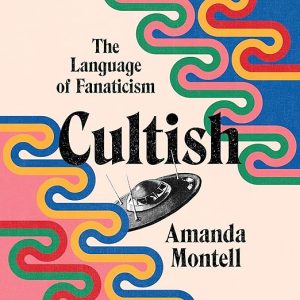
Amanda Montell's Cultish audiobook arrives with a deceptively simple premise: that the most powerful tool any cult, fitness brand, or social media movement has is not charisma or coercion, but language. Montell holds a linguistics degree and grew up as the daughter of a former cult member, which means she brings both personal proximity and scholarly rigor to this investigation. The result is a book that shifts your hearing permanently, in the way that the best language-focused nonfiction tends to do. After eight-plus hours with this audiobook, you will not be able to sit through a SoulCycle orientation or read a multi-level marketing pitch without hearing the linguistic architecture underneath it.
The range here is the first thing that strikes you. Montell moves from Jonestown and Heaven's Gate to SoulCycle and Peloton, from Scientology to QAnon suburban moms, treating each as a data point in the same linguistic spectrum rather than as fundamentally different phenomena. That spectrum is her central argument: cultish language is not the exclusive property of fringe groups operating outside mainstream society. It is something we are all exposed to every single day, and something we are all susceptible to in ways we rarely acknowledge or examine honestly.
Ann Marie Gideon's performance is one of the underappreciated strengths of this audiobook experience. Montell's writing blends first-person storytelling, academic citation, and cultural analysis in a way that could easily become tonally inconsistent in the wrong hands. Gideon navigates these shifts cleanly and confidently, giving the darker case studies a measured gravity without letting the humor sections feel inappropriately light. The pace she sets suits the material: not rushed, not ponderous, but moving with the efficiency of someone who trusts the content to do the heavy work.
Montell's background as a writer rather than a pure academic gives the prose a quality that Gideon can genuinely lean into: it is precise without being dense, and the storytelling instinct that shapes each case study means the listener is always oriented in a narrative rather than a lecture. One reader described the book as offering new tools to approach the world with in a fun and informative manner, and Gideon's narration is a significant part of why that accessibility holds across the full runtime. The cultish language sections, in particular, work better in audio than on the page because hearing Gideon perform the distinctive vocabulary of different groups makes the linguistic analysis visceral rather than merely conceptual.
MLM Vocabulary of Abundance, Mission, Family
The structural cleverness of Cultish is in how Montell keeps expanding the aperture of what counts as cultish language until you can hear it everywhere. The chapter on multilevel marketing companies and their distinctive vocabulary of abundance, mission, and family is one of the most practically useful sections of the book. The analysis of how fitness brands like SoulCycle build identity and belonging through proprietary language and ritualized shared experience is illuminating without being dismissive. By the time Montell reaches social media influencer culture and its own system of in-group signifiers, the framework she has built means the listener can do the analysis themselves in real time.
Montell also gives serious space to the emotional function of cultish language: why it works on people, why the desire to belong to something with its own lexicon and rituals is a genuine human need rather than a weakness, why us-versus-them framing produces genuine comfort as well as genuine danger. This is the balance that keeps the book from being merely skeptical or condescending. It holds the appeal and the risk in the same frame simultaneously, which is a harder and more honest intellectual position than most books about cults manage to sustain.
Casual Tone Draws a Three-Star Caution
The three-star review in the input is worth taking seriously as a warning for certain readers. Reviewer C describes the approach as a casual discussion and notes the book is divided into six parts with varying degrees of analytical depth. Listeners expecting a clinical and systematic dismantling of cult mechanics from a social psychology or linguistic theory perspective may find Montell's tone too conversational in places. The book is built for a general audience rather than scholars, and that design choice means some sections skim across territory that a more specialist text would excavate at greater depth.
The breadth is both the book's greatest asset and its occasional limitation. Jumping from Jonestown to Peloton within the same analytical frame invites the objection that the comparison trivializes genuine harm and catastrophic loss of life. Montell addresses this tension directly and thoughtfully, but readers with a low tolerance for that kind of provocative equivalence may find it grating rather than clarifying regardless of how carefully she handles it.
Eight Hours, Calibrated Without Padding
Cultish works best for listeners who are curious about the mechanics of belief, community, and language, and who want that curiosity met with both intellectual rigor and genuine readability. The eight-hour runtime is calibrated efficiently: Montell does not pad the argument or repeat herself, and each of the six parts of the book adds something distinct to the cumulative framework she is building. True-crime enthusiasts will find enough darkly fascinating material in the Heaven's Gate and Jonestown sections, but should know that this is primarily a linguistics and social science audiobook rather than a narrative investigation of specific tragedies. Those who have already gone deep on cult documentaries will find that Montell offers a genuinely different angle, focusing on the verbal architecture rather than the biographical or criminal narrative. Fans of Montell's other work, including Wordslut and The Age of Magical Overthinking, will recognize the voice and approach immediately and settle in comfortably.
Key Details
- Read by: Ann Marie Gideon brings Montell's conversational academic prose to life with intelligence and dry wit, matching the book's tonal range from genuinely chilling to darkly funny.
- At its heart: Language as social control, cult psychology, everyday ideology
- Vibe: Intellectually sharp with an unsettling undercurrent
- Short version: Cultish rewards listeners who want rigorous linguistics wrapped in cultural storytelling, though those expecting pure true-crime intensity should recalibrate toward something more analytical.
Is the Cultish audiobook narrated by the author Amanda Montell?
No, Amanda Montell does not narrate this audiobook. Ann Marie Gideon performs the narration and brings a strong tonal range to Montell's blend of personal storytelling and linguistic analysis, handling both the chilling and the darkly funny sections with appropriate register.
Does this audiobook cover only traditional cults, or does it include groups like fitness brands and social media movements?
The scope is deliberately wide. Montell moves from Jonestown and Heaven's Gate through Scientology, QAnon, SoulCycle, Peloton, and Instagram influencer culture, treating each as part of the same linguistic spectrum. The argument is that cultish language pervades everyday life, not just extreme fringe groups.
Is the Cultish audiobook appropriate for someone with no academic background in linguistics?
Yes. Montell writes for a general audience and Gideon's narration keeps the tone accessible throughout. Some sections will be lighter than specialist readers prefer, but the core arguments are clear and engaging for anyone with intellectual curiosity about language, belief, and social influence.
How does this audiobook compare to Montell's other work, and should I read her other books first?
No prior reading is required. Cultish stands fully on its own as a complete investigation. Fans of Wordslut or The Age of Magical Overthinking will recognize Montell's voice and approach, but the subject matter and research are entirely self-contained and need no prior context.