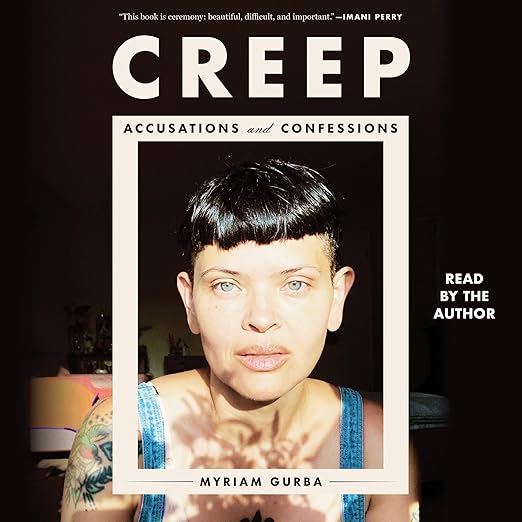
Myriam Gurba's Creep is, at the level of pure prose, one of the most formally ambitious essay collections published in the past decade, which is worth naming plainly before anything else. A National Book Critics Circle finalist and Lambda Literary Award winner, it has attracted the kind of critical attention that is usually reserved for work that genuinely does something new, and the audiobook, narrated by Gurba herself, is the form in which the collection's verbal intelligence is most fully present. Her voice on the page has a quality that critics have described as 'witty, confident, and effortlessly provocative,' and her self-narration confirms that these qualities belong to the speaking voice as much as to the written one.
I listened to the first two essays late on a weeknight with a glass of something and no particular defenses up, and Gurba's prose hit me the way good criticism does at its best: not by explaining things but by forcing you to see them differently. The title itself does its conceptual work on multiple registers. A creep is a person, a villain, an oppressor. Creep is also what fog does, what ideology does, what the tacit rules of oppressive systems do. The book is structured around that double meaning, and the eleven essays that make up Creep move between the personal and the systemic with a control that less skilled essayists rarely achieve.
Gurba's range of subjects is deliberately disconcerting. She moves from William Burroughs to Joan Didion to her own grandfather to her abusive ex-partner. She takes aim at Mexican stereotypes and the carceral state and public school administrations. The principle organizing all of this is not a conventional argumentative through-line but something closer to an anatomy: Gurba is dissecting the mechanisms by which oppression normalizes itself, the creeping processes that make abusers possible and the systems that sustain them. One reviewer called it 'a blistering and slyly informal sociology of creeps,' and that framing is accurate. The essays read like sociology that has been taught to be funny and honest simultaneously.
The Didion essays deserve particular mention. Gurba writes about Didion with the respect and the criticality of someone who has read her carefully and found the limits of her gaze. The treatment of Didion's complicity with certain mythologies of California and whiteness is not a takedown but a genuine intellectual engagement, and Gurba holds both admiration and critique without pretending the tension between them does not exist. That capacity for holding contradictions is one of the collection's defining qualities and one of the reasons the book rewards careful listening rather than skimming.
Gurba Narrates Her Own Spoken Performance
Gurba narrates the audiobook herself, and the effect is significant. Her prose has a quality of spoken performance built into it at the sentence level, a rhythm that suggests someone who thinks out loud in public and has learned to trust that thinking. Her narration does not perform the essays from a remove; she inhabits them, and the result is that the humor, which is genuinely funny in the way that very dark humor can be, lands with the timing of someone who knows exactly where the joke lives. The eleven-hour runtime reflects the length and density of the essays, which are not short-form pieces. Give each one the attention it requires and the audiobook is one of the most intellectually rewarding things you will find in the genre.
One reviewer described the collection as 'challenging but important' and noted that the 'unique and fragmented style' requires the reader to 'engage deeply with the text, navigating jarring shifts in time, language, and perspective.' That warning is accurate and worth passing on. This is not a collection you can half-listen to while driving in traffic. The structural moves are intentional, and the fragmentation is doing argumentative work rather than simply being difficult for its own sake. Listeners who bring their full attention will find the structure rewards them. Those who come in expecting a more conventional essay collection may find the disorientation frustrating.
Called the Mother of Intersectional Latinx Identity
The content of several essays is explicitly about sexual violence, abuse, and systemic oppression, and Gurba does not handle these subjects from behind glass. She is a survivor writing from inside her own experience as well as from a position of critical analysis, and some passages are harrowing in the way that only first-person accounts of violence can be. One reviewer described the experience as 'harrowing but well done,' and that balance, harrowing because real, well done because purposeful, captures what the collection asks of its listener.
The Latinx and intersectional framing of the collection is central rather than incidental. Gurba has been called 'the mother of intersectional Latinx identity' by some critics, and the essays are explicitly concerned with how race, gender, sexuality, and class interact within the systems she is analyzing. Listeners who engage with this material primarily as formal literary criticism rather than cultural criticism may find the political commitment more present than expected, but the two are not separable in this work and should not be treated as if they were.
Formal and Intellectual Limits of the Essay
This audiobook is for readers of cultural criticism and personal essay who want work that operates at the formal and intellectual limits of the genre. Fans of Carmen Maria Machado's In the Dream House or Maggie Nelson's The Argonauts will find Creep a natural companion in its willingness to use the personal as the ground for structural critique. Gurba's self-narration makes the audiobook the definitive format for the collection. Listeners who want conventionally structured argumentative essays or who are sensitive to graphic content about abuse and violence should approach with clear expectations about what the collection contains. For everyone else, Creep is the kind of work that changes what you think essays can do.
- Performance: Myriam Gurba self-narrates with the timing of a performer and the precision of a critic; the spoken voice is as central to this work as the written one.
- What it covers: Intersectional Latinx identity and systemic oppression, the mechanics of how abusers and the systems that enable them persist, humor as critical method.
- Feel: Intellectually combative and formally restless, genuinely funny in the way that very dark essays can be.
- Our call: Gurba's essay collection is among the most formally ambitious cultural criticism of the past decade, and her self-narration makes the audiobook the definitive way to encounter it.
Questions Listeners Ask
Is this audiobook appropriate for listeners who are sensitive to content about sexual violence or abuse?
Several essays deal explicitly with sexual violence and abuse from Gurba's own experience. The content is handled with care and purpose rather than gratuitously, but it is harrowing in the way that authentic first-person accounts of violence are. Listeners with sensitivity to this content should approach with clear expectations.
How does the fragmented structure of this audiobook affect the listening experience?
The fragmentation is intentional and argumentative rather than simply stylistic. The essays shift in time, language, and perspective in ways that require active attention. One reviewer noted it 'demands attention' and requires navigating 'jarring shifts.' This is not a collection for distracted listening; it rewards full engagement.
Does Myriam Gurba's self-narration add something specific to the audiobook, or would a hired narrator serve the essays equally well?
Self-narration is a significant asset here. Gurba's prose has a spoken performance quality built into it at the sentence level, and her delivery places the humor and the critique exactly where they live. A hired narrator would likely produce a more neutral reading; Gurba inhabits the essays rather than performing them from a distance.