Quick Take
- Themes: algorithmic problem-solving, interview communication, AI-assisted preparation, structured study planning
- Mood: Brisk, checklist-driven, exam-week practical
- Verdict: A useful orientation pass for candidates already practicing in an editor, and no substitute for one.
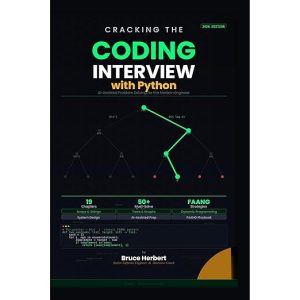
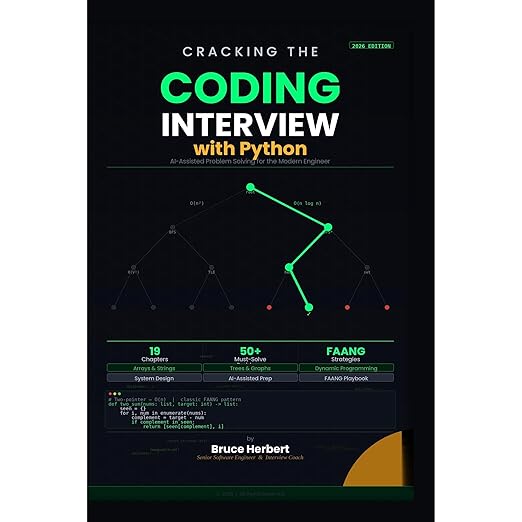
Advertised inside two hours and forty minutes: arrays, strings, linked lists, trees, graphs, dynamic programming, greedy algorithms, recursion, backtracking, binary search, sorting, stacks, Python-specific optimizations, system design fundamentals and behavioral interview preparation. Also practice problem sets across difficulty levels, structured study plans and company-specific insights. Bruce Herbert has written a book with a very long table of contents and recorded a very short audiobook of it, and the gap between those two facts is where a buyer needs to start.
Narrating Your Reasoning Is What Separates Candidates
Behind the long curriculum sits a good pitch, and it is the part I would keep. Herbert's stated objection to the standard interview guide is that it teaches memorization of solutions, and the alternative offered is a way of thinking: break an unfamiliar problem into manageable steps, narrate your reasoning while you work, and write clean, correct code under time pressure. Anybody who has sat on the other side of that table knows the second item is what actually separates candidates. Two people can reach the same solution and only one of them gets the offer, because only one explained the path. Interview panels are scoring a simulation of working together, not a test of recall, and a candidate who thinks aloud gives the panel something to score.
That 2026 in the title is doing real work too. The argument runs that technical interviews have shifted because working engineers now lean on AI coding assistants, and that preparation has to account for both realities at once: knowing how to use the tools efficiently while still owning the algorithmic understanding companies keep testing for. Whether or not the specific strategies land, that is a genuinely current framing, and it is the one thing here that a guide published three years ago could not offer.
The Behavioral Round Rewards Pure Communication
Certain layers of interview preparation transfer to audio cleanly, and they happen to be the layers candidates neglect. Frameworks for approaching a problem you have never seen. Vocabulary for talking through a tradeoff out loud. The behavioral round, which is pure communication and where strong engineers routinely underperform. Study sequencing, so that four weeks of preparation covers the ground in a sensible order rather than whatever the last panic suggested. None of that needs a screen, and all of it benefits from repetition while your hands are busy. Company-specific insight belongs on the same list, since knowing what a particular process values changes how you allocate your remaining preparation time far more than another hour of practice problems would.
Short is also defensible on its own terms. Under three hours makes this something you can run through completely on the days before an interview, when opening another problem set will only raise your heart rate. Used that way, as an orientation pass and a nerve-settler rather than a course, the runtime stops being a defect and starts being the point. Herbert's audience is explicitly broad: engineers preparing for interviews, computer science students entering the market, developers moving into backend roles, and anyone aiming at the big technology employers named in the description.
Twenty Minutes per Subject Is the Arithmetic
Start with the credit line, because it changes what you are buying. Where a narrator's name should sit, this record says Virtual Voice, meaning a synthetic text-to-speech production rather than a person in a booth. No human is credited, so a verdict on the reading would be a verdict on software, and that is worth knowing in advance on technical material specifically. Variable names, symbols, indentation and punctuation-dense syntax are exactly what machine narration handles least gracefully, and this book is made of them.
The description was clearly written for a printed edition and never adapted. It says inside this book you will master the core topics, refers repeatedly to what the book also includes, and lays its curriculum out in a column of check-mark bullets, which is a typographic device with no audible equivalent whatsoever. Practice problem sets and Python implementations are the components least likely to survive the transfer: nobody has ever debugged a nested loop by ear, and nothing on the listing mentions a downloadable file where the code might live.
Arithmetic is the third problem. Eight advertised topic areas, plus problem-solving frameworks, plus practice sets, plus study plans, plus company-specific insight, inside one hundred and sixty minutes, works out to roughly twenty minutes of coverage per major subject. Depth is not on the menu. One smaller inconsistency is worth flagging while you are checking the page: the headline inside the description subtitles the work The Complete Guide for Modern Software Engineers, while the title field calls it the 2026 Edition, so the book carries two different subtitles depending on where you look. The publisher line reads Independently Published, and the record went up in March 2026.
Pair This With an Editor for Real Practice
This suits a candidate who is already grinding problems in an editor and wants the surrounding layer: how to talk, how to structure the hour, how to plan the two weeks before an interview, how to think about AI assistance without letting it hollow out the fundamentals. Used as a supplement to real practice, under three hours of framing is a reasonable purchase, and the behavioral material alone justifies part of it.
Absorbing data structures for the first time from a recording is not a realistic plan; look for a course with a screen attached. Keep an editor open, treat this as the companion that talks while you work, and accept that the actual preparation happens somewhere the audio cannot follow.
Good to Know
Is the audiobook read by a human narrator?
No. The reader field carries Virtual Voice, which means synthetic text-to-speech rather than a credited person. That matters more than usual for technical content, since variable names, operators and indentation are exactly the material machine narration handles least comfortably. Sample before committing if you can.
Does the audiobook deliver the Python code in a usable form?
Not really. Code is meant to be read, and no companion download is mentioned anywhere on the record, which is where the implementations would normally live. Expect the algorithmic reasoning to come through clearly and the actual line-by-line Python to remain something you will need on a screen.
What does the 2026 Edition label actually add?
An argument about AI coding assistants. The book claims interview expectations have adapted to engineers who work with these tools daily, and it folds AI-assisted preparation strategies into the study plan while insisting candidates still own the underlying algorithms. That framing is the freshest thing on offer here.