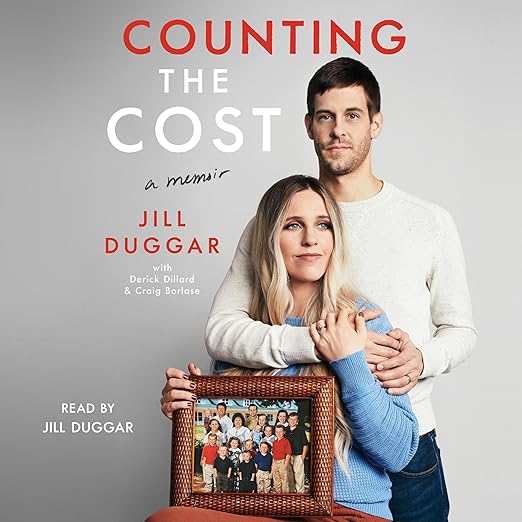
How much does it cost to tell the truth about your family when you still love them? That question sits at the center of this audiobook, Jill Duggar's memoir about growing up as the second daughter in a household of nineteen children under the scrutiny of TLC cameras and Jim Bob Duggar's strict patriarchal model. Jill Duggar narrates her own book, and that choice is not incidental: the voice you hear is the voice of someone who has spent years figuring out what she actually thinks and feels, separate from what she was told to think and feel.
I came to this memoir with a casual viewer's knowledge of the show and a literary critic's skepticism about celebrity memoirs. Both were appropriate tools. What I found was a book that is more careful and more structurally interesting than the headline framing suggests. This is not an expose in the sensationalist sense. It is a reckoning, and the distinction matters.
Specificity Instead of Melodrama or Rebuttal
The memoir's central achievement is its refusal to resolve into a simple narrative of escape and enlightenment. Jill Duggar makes clear repeatedly, almost insistently, that she loves her family. The manipulation she describes, the financial control Jim Bob maintained over adult children's earnings from the show, the intimidation tactics, the weaponization of patriarchal theology, these are presented with documented specificity rather than melodrama. One reviewer called it 'a complicated, remarkably relatable story of faith and family loyalty,' and that framing is accurate. The faith element is genuine and central; Jill's eventual separation from her parents' specific interpretation of Christianity does not read as a rejection of faith itself.
The patriarchy model she grew up inside is described with clarity and without editorializing. Women are expected to be wives and mothers, discouraged from higher education, subject to parental authority well into their adult married lives. Jill explains how she internalized these expectations and how they gradually became impossible to square with her own experience as a married adult. Derick's perspective is woven through the narrative, and the couple's decision to seek therapy is presented as both difficult and transformative.
People magazine's characterization of the book as 'no-holds barred' is slightly misleading. The memoir is measured, not explosive. It is compassionate to people the reader might expect it to condemn, and it is honest about the complexity of breaking from a family system while retaining love for the people within it.
A Restrained Delivery the Narration Earns
Jill Duggar narrating her own memoir is the right call, and it elevates the audiobook significantly. Her voice carries the specific quality of someone choosing their words precisely, aware of their weight. She is not a trained audiobook narrator, and you can hear that: she reads at a slightly formal pace, and her emotional delivery is restrained in ways that occasionally feel practiced rather than spontaneous. But that restraint is also the memoir's voice. This is a woman who grew up performing composure for cameras; the audiobook narration reflects that reality rather than obscuring it.
The seven-hour runtime is well-proportioned to the material. The memoir does not overstay its welcome or repeat itself in the way that celebrity books sometimes do when they are padded to a commercial length. Jill and Derick, and co-author Craig Borlase, have structured the narrative so that each chapter builds on the previous one rather than circling the same emotional territory.
A Gradual Process, Never a Single Turning Point
Listeners who approach this expecting courtroom-level revelations may find the memoir's measured tone frustrating. Jill is explicit about what she is not trying to do: she writes in the afterword that the book was not about shaming her family. That boundary shapes what she will and will not say on certain topics, including specific incidents involving a family member. The deliberate restraint on those subjects is itself meaningful, but readers hoping for full disclosure on every detail will need to manage their expectations.
The theology is present throughout and is not bracketed for secular readers. If you are not interested in the internal distinctions between different models of Christian patriarchy and submission, some sections may feel denser than the narrative requires. For readers who grew up in similar religious structures, those distinctions will likely feel essential rather than excessive.
One reviewer noted that Jill makes many references to how much she loves her family even while describing manipulation and control. This is the book's most interesting formal feature and also its most challenging one for readers who prefer a cleaner emotional throughline. The ambivalence is real, not rhetorical, and it asks something of the listener.
The structural choice to write the book as a first-person memoir narrated in close partnership with Derick, her husband, rather than as a solo account, is worth noting. The book is Jill's voice throughout, but Derick's perspective is integrated in ways that clarify how the couple arrived at their decisions together. This collaborative authorship gives the memoir a texture that solo celebrity memoirs often lack, because the relationship itself becomes part of what the book is documenting. The decision to seek therapy, described with some detail, is presented not as a dramatic turning point but as a gradual and ongoing process, which is a more honest account of how that kind of change actually happens.
More Nuanced Than Casual Fans Expect
This audiobook is particularly valuable for listeners who grew up in high-control religious environments and will recognize the specific dynamics Jill describes: the way love and control are intertwined, the difficulty of criticizing a family system from inside it, the long process of separating internalized beliefs from chosen ones. It is also a strong recommendation for anyone interested in how reality television intersects with private family life and the specific costs of that visibility.
Casual fans of the show who want a quick hit of drama will find the memoir more nuanced and more emotionally demanding than expected. That is not a criticism. It is a measure of what Jill Duggar was actually willing to do here, which is to tell a complicated story without tidying it.
In Brief
- Narration: Jill Duggar reading her own memoir gives the audiobook an authenticity no outside narrator could replicate; the formal delivery is itself a character detail.
- Themes: Religious patriarchy, family loyalty and control, the cost of honesty, faith and autonomy.
- Mood: Measured, honest, and emotionally demanding.
- Verdict: A carefully structured memoir that rewards patient listeners willing to sit with genuine ambivalence rather than a clean narrative of rescue.
Frequently Asked Questions
Does Jill Duggar narrating the audiobook herself enhance the listening experience?
Yes, in a specific way. She is not a trained narrator, and her pacing is occasionally stiff. But hearing her own voice on her own story gives the audiobook a weight and intimacy that an outside narrator could not have achieved. The restraint in her delivery reflects the careful thought that went into the writing.
Is this audiobook an expose of the Duggar family or something more measured?
It is more measured. Jill Duggar is explicit that she wrote the book without the goal of shaming her family. The financial control, manipulation, and intimidation she describes are presented with specificity and documentation, but the tone is compassionate rather than vengeful.
Do I need to have watched 19 Kids and Counting to follow this audiobook?
No. The memoir provides enough context about the show and the family's public image that newcomers can follow it. Some familiarity with the Duggar family makes certain references land more readily, but it is not a prerequisite.