- Performance: Joe Ochman handles the dense technical and geopolitical material with a clear, measured delivery that makes the complexity navigable without dumbing it down. Thirteen hours of cyberwarfare history that never loses the thread.
- What it covers: State-sponsored cyberwarfare, the vulnerability of critical infrastructure, the gap between technical capability and public awareness
- Feel: Investigative and urgent, with the procedural satisfaction of a whodunit carrying genuinely high geopolitical stakes
- Our call: The definitive account of Stuxnet and the age of cyberwarfare it announced, written with journalistic rigor and narrated with the clarity this complex subject demands.
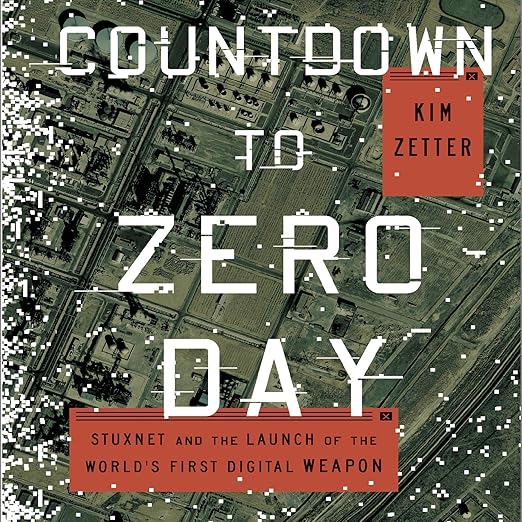
Countdown to Zero Day asks a question that most technology coverage of the early 2010s was not equipped to answer: what does it mean when a piece of software crosses from the digital realm and breaks physical machinery? Kim Zetter, a cybersecurity journalist with years of deep sourcing in the intelligence and security communities, spent years investigating Stuxnet, the malware that sabotaged Iranian uranium enrichment centrifuges, and this audiobook is the most complete account of that investigation available. Joe Ochman's narration carries the material at a measured, authoritative pace across 13 hours that the Washington Post accurately described as an engrossing whodunit.
Stuxnet was different from prior malware in a way that this book makes viscerally clear. Previous cyberweapons stole data, disrupted networks, or compromised systems. Stuxnet caused centrifuges to spin at the wrong speeds while reporting normal readings to the operators monitoring them. It damaged physical equipment in ways that took months to diagnose, creating a weapon that operated in secrecy by design. The discovery and unraveling of this weapon by a small community of security researchers, despite the classified nature of its origins, is the procedural spine of Zetter's reporting.
Ochman Paces the Zero-Day Jargon With Confidence
Zetter's skill as an investigative journalist is most visible in how she handles the technical material. Stuxnet's code is genuinely complex: the malware used four previously unknown zero-day vulnerabilities simultaneously, which no prior piece of malware had done. The risk in covering it is either oversimplifying to the point of inaccuracy or losing general readers in technical specificity. Zetter threads this needle by keeping the human story of discovery central. The security researchers who identified, analyzed, and ultimately attributed Stuxnet are the protagonists of this account, and their work is described with enough detail to be illuminating without requiring the listener to understand how to write exploit code.
Ochman's narration manages the technical vocabulary well. The names, acronyms, and concepts that populate cybersecurity reporting can become an impenetrable wall in audio format, but Ochman delivers them with the confidence of someone who has prepared the material carefully. The pacing is deliberate rather than rushed, which suits a subject where context matters enormously. Listeners who try to skim this book will miss the causal chains that give the story its structure, and the audiobook's measured pace enforces a productive kind of attention.
Beyond Stuxnet, a History of Digital Conflict
The book's range beyond Stuxnet itself is what elevates it from a single-incident account to a genuine history of a new kind of conflict. Zetter covers the development of offensive cyber capability in the United States and Israel, the precedents and ethical frameworks that informed the decision to use Stuxnet, and the implications for critical infrastructure worldwide once the existence of cyberweapons capable of physical destruction became public. The question she poses near the book's conclusion, what happens when this capability proliferates and less scrupulous actors use the same techniques against water systems, power grids, or financial infrastructure, has only become more pressing since publication.
Reviewers with academic backgrounds in security and political science have noted the book's value as a teaching text, particularly for the way it makes the abstract concept of digital-physical convergence concrete through a single, meticulously documented case. But Zetter's journalistic instincts mean the book never becomes a policy paper. The story remains the story of specific people, specific decisions, and a specific piece of code that changed the rules of international conflict for good.
Careful Hedging on Who Actually Built Stuxnet
The attribution question, who built Stuxnet, is addressed by Zetter with the careful hedging of good journalism rather than the confident declaration of popular myth. By the time of the book's writing, US-Israeli authorship was widely accepted but officially unconfirmed, and Zetter respects that distinction. Listeners accustomed to more assertive nonfiction narratives may find this principled uncertainty frustrating; listeners who value evidentiary standards will find it appropriate and will come to appreciate how that discipline distinguishes the book from lesser accounts.
The 13-hour runtime reflects the depth of Zetter's research and the complexity of the subject. This is not a fast listen, and the density of the early chapters, which establish the technical and geopolitical context, requires more concentration than the later investigative narrative. The investment pays off in the depth of understanding the book ultimately delivers, but casual listeners looking for a quick overview should seek a shorter format. This is a book for people who want to genuinely understand what happened, not just know that it happened.
Thirteen Hours That Define the Age of Cyberwarfare
Listeners with an interest in cybersecurity, international relations, intelligence history, or the way technology reshapes geopolitical power will find this audiobook essential. The book rewards anyone who wants to understand how a piece of code became a weapon, why that matters, and what the precedent it set means for infrastructure security going forward.
Listeners who prefer lightly technical nonfiction or need a fast narrative pace may find the middle sections demanding. But for the audience that wants comprehensive, rigorously reported investigative journalism on a subject that has only grown more relevant since publication, this audiobook remains the definitive account of Stuxnet and the age of cyberwarfare it announced. Ochman's narration makes the 13 hours genuinely listenable rather than merely dutiful.
What Zetter achieves that most cybersecurity journalism does not is maintaining the human scale of the story while the geopolitical stakes rise. The security researchers who unraveled Stuxnet were not spies or government officials. They were independent analysts and small-company employees who stumbled onto something they recognized as extraordinary and spent months confirming what they suspected. Zetter documents their process with the granularity of embedded reporting, and Ochman's narration keeps that granularity legible across 13 hours. The book is ultimately as much about how knowledge gets produced in classified environments as it is about the specific weapon it describes.
Before You Listen
How does the Countdown to Zero Day audiobook handle the question of who built Stuxnet?
Zetter approaches attribution with journalistic precision. By the time of publication, US and Israeli authorship was widely accepted but officially unconfirmed, and she reflects that distinction in her language throughout. The book makes a strong evidentiary case without overclaiming, which some listeners find appropriately rigorous and others find frustratingly hedged.
Is this audiobook still relevant given that Stuxnet was discovered over a decade ago?
Yes. Zetter's account of Stuxnet's implications for critical infrastructure, the proliferation of offensive cyber capability, and the legal and ethical frameworks governing digital weapons addresses questions that have become more pressing rather than less since the book's publication. The precedents Stuxnet set continue to shape the current cybersecurity landscape.