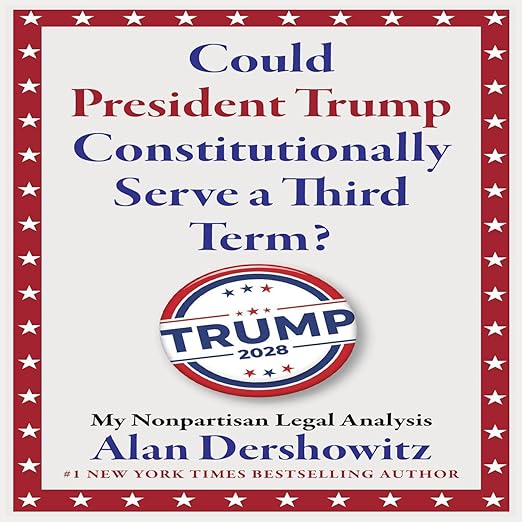
Settled questions are the hardest ones to argue against, and that is the position this audiobook takes up on purpose. Most Americans, the description says, are convinced the 22nd Amendment categorically prohibits a two-term president from serving a third. Alan Dershowitz sets out to challenge that conviction across four hours and twenty minutes, and the copy promises not merely a doubt but a route: exactly how the outcome could come about. Whatever you make of the question, that is a specific promise, and it is the one the recording has to keep.
A Constitutional Argument Has Few Moving Parts
Essay length suits this material better than a full book would. A constitutional argument has a small number of moving parts: the words, the history behind them, and the situations the drafters did or did not anticipate. A short recording forces a writer to make the case rather than surround it with context, and what arrives here is closer to a long lecture than to a survey of the presidency or a history of how the rule came to exist.
Archer's Voice Keeps the Argument at a Remove
The positioning does a great deal of work and deserves reading carefully. The description calls the analysis objective, nonpartisan and astute in the same breath as it calls the question the most partisan and political issue available today. Both statements can hold at once, since a legal argument can be technically neutral about an outcome nobody is neutral about. A listener should still notice that the framing asks for trust before the argument has started.
Dershowitz is identified on this page only as Professor, with no further biography attached, and Rand Archer is credited as the reader rather than the author. That second detail matters more than it appears to on a book of advocacy. An argument delivered in a voice other than its maker's is easier to hear as analysis and harder to hear as testimony. Skyhorse published the recording in March 2026, which places it inside the news cycle it belongs to.
This Argues a Mechanism Rather Than a Mood
The reason to listen is not the conclusion but the pressure applied to a certainty. Most people holding a firm view about the 22nd Amendment are holding a summary of it rather than the text, and a short, structured challenge to a widely shared assumption is a useful thing to hear whichever way it lands with you. Legal arguments are also among the rare nonfiction that improves in audio, since they were built to be spoken aloud to a room.
Specificity is the second reason. The copy does not say the question is open or interesting. It says the book lays out exactly how Trump could become the forty-eighth president. That commits the author to a mechanism rather than to a mood, and a mechanism can be checked, argued with and refuted by anybody who knows the material. Books staking a claim that plainly are more useful than books gesturing at complexity.
Length works in its favor for a second reason. Four hours and twenty minutes can be finished before the subject moves again, which is no small consideration for a title tied this tightly to a live political question. Anyone who wants to be conversant in an argument that is going to be quoted at them can be, in one sitting, without surrendering a weekend. Timeliness is the whole appeal of a book like this one.
Zero Reviews, a Description Written to Sell
Nothing has come back from buyers at all. This listing carries no ratings and no written responses whatsoever, months after a March 2026 release from an established publisher, so nobody has said publicly whether the argument convinces or where it is weakest. On most titles the reception fills the gaps a description leaves. Here the description is the whole of the available evidence, and it was written to sell the book.
That description also runs to a single paragraph. It names no chapters, no structure and no supplementary material, and gives no indication of whether the recording includes the text of the amendment, the case law, or citations a listener could follow up afterward. For a legal argument that is a genuine omission, because this kind of book lives in its footnotes as much as in its thesis, and audio drops footnotes silently unless a publisher decides otherwise.
Then the claim of neutrality. A book arguing that a path exists for one particular person to hold power again will be received as advocacy by roughly half of any audience, however technical the reasoning turns out to be. The description makes no attempt to disguise that tension, which is at least honest. Decide whether you want the argument tested or confirmed before pressing play, because a recording this short will not have room to do both.
Court Watchers Over Partisans of Either Side
Law students, court watchers and anyone who follows constitutional argument for its own sake are the natural audience, along with the reader who wants to know what the strongest version of an unpopular position actually sounds like. Debate goes better when you have heard a case made properly rather than paraphrased by somebody who dislikes it. Journalists who have to write about the question will also gain from having the mechanism stated plainly in one place.
Partisans of either sort should probably pass, though for opposite reasons. Anyone hoping for a demolition of the idea will find a book built to do the reverse, and anyone hoping for a celebration will find constitutional analysis rather than a rally. Listeners who want a broad history of presidential term limits should look elsewhere as well, because the description points at one question and one answer rather than at a survey of how the rule arrived.
Short arguments invite two responses, and the useful one is to check the mechanism rather than the conclusion. This recording promises to state that mechanism plainly, the publisher is established, the author is credentialed on the page, and the reception is a blank space nobody has filled in either direction. Buy it if you want the case put by somebody who believes it, and keep your own reading of the amendment close at hand while you listen.
Quick Take
- Narration: Rand Archer voices the argument instead of its author, which keeps a legal case in a neutral register and makes the reasoning easier to hear as analysis than as testimony.
- Themes: the 22nd Amendment against its common reading, the distance between what is settled and what is written, a mechanism stated rather than implied
- Mood: brisk, adversarial, lecture-hall dry
- Verdict: A short, specific case with no reception at all to check it against, worth the time if you would rather hear an argument made properly than paraphrased.