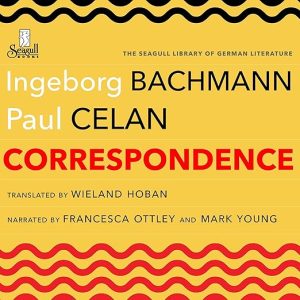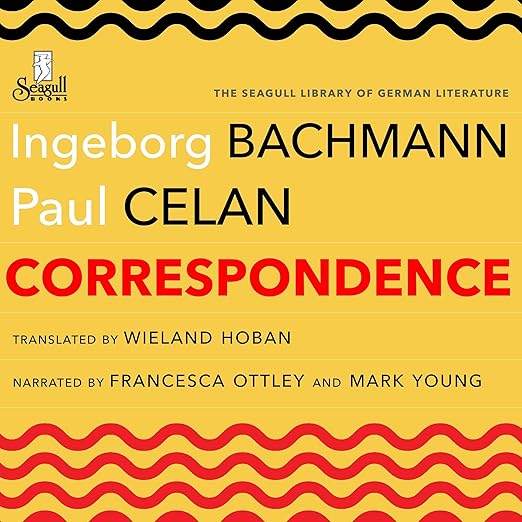
- Read by: Francesca Ottley is credited alone on a book written by two hands, so every switch between one letter-writer and the other has to be made inside a single voice.
- At its heart: literary friendship and love, post-war German letters, memory after the camps, the politics of who gets a byline
- Vibe: Intimate, fragmentary, quietly devastating
- Short version: A primary document rather than a story, and worth four hours if you already care about the two people writing.
Ingeborg Bachmann gets the byline on this audiobook. Paul Celan, whose letters make up the other side of the exchange, does not appear in the author field at all, and neither does whoever carried these pages out of German and into English. What the listing offers is four hours and six minutes covering thirteen years of letters, written between 1948 and 1961 by two of the most consequential writers in post-war German-language literature, and sold under one name.
One Voice Carrying Both Sides of a Correspondence
Structure is the first thing to talk about here, ahead of any judgment about the writing. A correspondence has two hands in it. This edition credits one author and one reader, which means that every move from Bachmann's side of the exchange to Celan's happens inside the same voice. On the page that seam is free: a new letter begins, a salutation announces itself, a signature closes it off, and your eye sorts the speakers without being asked. Listening removes all of that scaffolding at once. You get salutation and signature only if the reading gives them to you, and you are relying on a single performer to keep two very different sensibilities from blurring into one another over four hours.
Seagull Books dates this release to November 2023, and the publisher's own framing is the most useful summary available: a moving testimony of the discourse of love in the age after Auschwitz, with the disturbances and crises caused by conflicting backgrounds and hard-to-reconcile designs for living, as a woman, as a man, as writers. That last clause is the book in miniature. Two people who were briefly lovers and permanently colleagues negotiate, over more than a decade, what each of them is allowed to be.
Four hours also sets an expectation that the material quietly refuses. Letters are not chapters. They arrive at whatever length the day allowed, some of them running for pages and some amounting to a line and a date, and a recording has to absorb that unevenness without the visual cue of white space on a page. Whether you find the effect hypnotic or disorienting will depend almost entirely on how much you already know about the two people involved.
The Headline That Called Her Too Much for Him
Celan is described on this page as one of the best-known German poets of the Holocaust, admired for spare and precise diction, and much of his work addresses that catastrophe head on. Bachmann is placed alongside him as a novelist, poet and playwright of the first rank. Letters between writers of that stature are usually strip-mined by biographers and then quoted back to us in fragments, three lines at a time, with an argument built around them. Hearing them consecutively is a different experience entirely, because the boring letters stay in. Arrangements get made. Trains are missed. The register drops and lifts without warning, and the effect over four hours is closer to overhearing than to reading criticism.
A single written response sits under this listing, filed at four stars, and it is short enough to quote whole in spirit: two important post-war poets exchanging thoughts, and a fascinating record of gender-perceptions of the period. The headline attached to it, that she was too much for him, reads as a verdict on the relationship rather than on the edition, but it points at what genuinely does emerge across the sequence. The asymmetry between what Bachmann wants to say and what Celan is willing to receive becomes legible slowly, the way it would in life, and it is more affecting for never being stated outright.
Something else recommends the format, and it applies to letters more than to almost any other kind of book. Correspondence was written to be received, not published, and reading it silently makes it feel like evidence. Hearing it restores the address. Every sentence was aimed at one specific person who would read it days later in another city, and a voice puts that second person back in the room in a way that print, with its scholarly margins and its footnote numbers, tends to suppress.
Celan Absent From the Byline, Translator Unnamed Too
Credit is the real problem with this listing, and it is worth naming plainly. The other side of this correspondence was written by Paul Celan, and the author field does not mention him. The letters were not composed in English; the publisher's copy says they are collected in English for the first time, which means a translator did substantial work here, and no translator is named anywhere on the page either. Anyone buying this expecting a scholarly apparatus should also note that the listing says nothing about notes, dating conventions or editorial commentary, all of which a letters volume normally carries and none of which is guaranteed to have been recorded.
A Drawer of Paper Being Read to You
Then the practical matter of length. Four hours and six minutes across thirteen years of correspondence means the volume moves briskly, and the page does not indicate whether the selection is complete or edited. Expect gaps you cannot see. Expect, too, that this is not a book with momentum. Nothing builds toward a scene. If you need a narrative spine, this material will feel like a drawer of paper being read to you, which in the most literal sense is exactly what it is.
One more thing about the evidence available to a buyer: a single written account exists for a title carrying twenty-six ratings, and that account was filed in February 2020, more than three years ahead of this release. Whatever it is describing, it is not this audio edition.
Adjust to the Convention, or the Book Stays Shut
Readers with a stake in these two writers will get the most from it, as will anyone drawn to the strange decade in which German-language literature had to work out what could still be said. Primary documents are the appeal, and a love affair reconstructed from its own paperwork suits some temperaments far better than a biographer's summary of the same events. Four hours is a modest commitment for a body of letters this consequential, and the brevity is arguably the format's best argument.
Coming in cold is the wrong way to meet this material. Without some prior sense of who these people were and what the years between 1948 and 1961 cost them, the letters read as private and elliptical, because that is what they were. Anyone who wants the German, or who needs to know exactly which letters were left out, will find neither here. A single unattributed voice moving between two correspondents is the other dividing line: adjust to that convention and the book opens, refuse it and nothing else about this edition will compensate.
A Few Questions About Correspondence
Does the audiobook include Paul Celan's letters as well as Bachmann's?
The description makes clear this is a two-sided exchange collected between 1948 and 1961, so Celan's letters are part of the book. He is simply not credited in the author field, which lists Ingeborg Bachmann alone. Treat the byline as a cataloging shortcut rather than a description of who wrote what you hear.
How long is the Correspondence audiobook and does the length suggest an abridgment?
The listing gives four hours and six minutes for thirteen years of letters. That is brisk, and the page never states whether the selection is complete or edited down. No abridgment is declared anywhere in the metadata, so the honest answer is that a buyer cannot tell from the product page.
Is a translator credited for this English edition?
No. The publisher's copy says these letters appear in English for the first time, which means the text was translated out of German, yet no translator appears in any field on the listing. For a book whose entire appeal is diction and register, that omission matters more than it would elsewhere.
Will this work as an introduction to Bachmann and Celan?
Not really. The letters assume you know who is writing, what each has published and what had just happened in the years before they started. Readers arriving without that context tend to find private correspondence opaque. A biography or a selected poems volume first will make these four hours far richer.