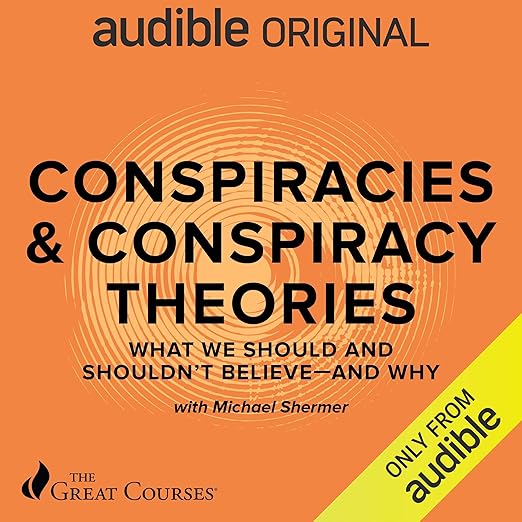
Shermer's voice in Conspiracies & Conspiracy Theories is the voice of a man who has spent decades watching otherwise rational people defend positions that evidence consistently disproves. This audiobook, an Audible Original structured as a course, arrives with a clear purpose: not just to list famous conspiracies but to explain the machinery that makes people susceptible to them in the first place. It is a meaningful distinction, and one that makes this a more durable listen than a simple debunking rundown would be.
The framing is anchored in statistics that remain genuinely striking. Eighty-one percent of Americans believe more than one person was responsible for the assassination of John F. Kennedy. A third of the country at various points accepted that 9/11 was an inside job. Seven percent believed the moon landing was faked. Shermer uses these figures not as punchlines but as evidence of a widespread cognitive pattern worth understanding rather than dismissing. That shift in framing, from mockery to inquiry, is what gives Conspiracies & Conspiracy Theories its intellectual weight.
Where This One Lands
Shermer is the publisher of Skeptic magazine and the host of the Science Salon podcast, and his approach throughout is rigorous without being inaccessible. As one listener summarized, he goes "a little bit deeper inside the conspiracy thinking brain" rather than simply cataloging false claims. The JFK material receives particular attention, and a reviewer specifically singled out that lecture as the strongest in the set, it benefits from Shermer's ability to hold the historical evidence alongside the psychological pull of the alternative narrative, acknowledging why the theory persists without conceding that it is correct.
One honest caveat: listener Gilbert M. Stack noted that the audiobook is not quite the book he expected. Where Stack anticipated each lecture to be dedicated to a specific conspiracy theory, most of the material is devoted to the psychology of belief rather than systematic case-by-case debunking. That is worth knowing in advance. If you want a tour of famous conspiracies with individual takedowns, this is not that. If you want a framework for understanding how conspiratorial thinking operates as a cognitive and social phenomenon, this delivers that with genuine rigor. The two approaches are not in conflict, but the emphasis matters depending on what you are looking for.
The Best Parts of Conspiracies & Conspiracy Theories
The self-narrated format is an asset here. Shermer's delivery is brisk and academic rather than warm or conversational, but that register is appropriate for the content. This is lecture material, and it benefits from the authority of the person who constructed it. His pacing across the 6.5-hour runtime keeps the material moving without sacrificing clarity on the more technical psychological concepts, cognitive dissonance, pattern-matching errors, the proportionality heuristic that leads people to demand large causes for large events.
The course structure, specific to Audible Originals, means each lecture builds on the previous one. The cumulative effect across the full runtime is a coherent model of conspiratorial cognition rather than a loose collection of interesting topics. For listeners who have dabbled in skepticism literature, this will feel like a structured synthesis. For those newer to the subject, the progression from definitions through case studies through cognitive models provides a clear pathway in.
What Gives Us Pause
The 3.9 average rating from only three reviews reflects the small sample size rather than a genuine quality signal, one three-star review accounts for the dip, and that reviewer's specific objection (content skewed toward psychology rather than individual theory coverage) is a matter of expectation rather than execution. With two five-star reviews citing it as both awakening and entertaining, the quality range among those who engaged with it closely is actually quite high.
Listeners should also be aware that the production date matters with this material. Conspiracy theories evolve rapidly, and some of the cultural context around specific theories, particularly those touching on political figures, will feel more or less pointed depending on when you are listening. Shermer's framework is durable, but the specific examples are necessarily anchored in time. The mechanisms he describes are universal; the illustrations are historical snapshots.
The Right Listener for Conspiracies & Conspiracy Theories
This audiobook works best for listeners who want to understand the social and psychological architecture of conspiratorial belief rather than simply have specific theories debunked. Political scientists, educators, journalists, and anyone trying to engage more effectively with people who hold conspiratorial views will find practical frameworks here. The 6.5-hour runtime is dense but manageable across a few sessions.
The course also addresses why conspiracy theories can motivate people toward violence, a question that has become more urgent over the years since this material was produced. Shermer does not sensationalize this dimension, but he does not sidestep it either. Understanding the cognitive pathway from conspiratorial belief to action is one of the more practically important questions in contemporary social psychology, and the fact that this course treats it directly rather than as a footnote elevates the stakes of the material beyond academic curiosity. It is genuinely useful content for anyone trying to understand how radicalization through conspiratorial frameworks occurs.
Listeners who want a case-by-case factual rundown of famous theories, Roswell, 9/11, the moon landing, the Kennedy assassination each treated as extended independent investigations, will find this course more structurally focused on cognition than on individual claims. Both goals are legitimate; Shermer is simply serving the former more fully than the latter. Know which one you are bringing to the audiobook before you begin.
Good to Know
Does this audiobook cover each conspiracy theory in depth, or is it more focused on the psychology behind belief?
Primarily the latter. Michael Shermer devotes most of the content to the cognitive and social mechanisms that make people susceptible to conspiracy thinking. Individual theories, including JFK, 9/11, Roswell, and the moon landing, appear as illustrative examples rather than as extended independent investigations.
Is Conspiracies & Conspiracy Theories a good audiobook for someone new to skepticism?
Yes. Shermer builds the material progressively, starting with definitions and foundational psychology before moving to case studies and cognitive models. The Audible Original course structure supports listeners coming to the subject without prior familiarity.
What does Michael Shermer's narration sound like in this audiobook?
Academic and confident, the voice of someone who has delivered this material in lecture settings before. It is more formal than conversational, which suits the course format, though listeners who prefer a warmer, more intimate narrator style may find it a little dry across 6.5 hours.
How does this audiobook handle politically sensitive conspiracy theories?
Shermer approaches all theories through the same skeptical framework, applying the same evidentiary standards across political examples from different eras. The specific examples are historically grounded, though the mechanisms he describes for why theories persist are treated as non-partisan cognitive phenomena.