- At its heart: The full treatment pathway from source to residuals, chlorine safety and emergency response, asset management and water loss control.
- Vibe: Orderly and unhurried, a walk along the pipe rather than a cram session.
- Short version: A useful portable overview beside a printed manual, and a poor choice as anyone's only preparation.
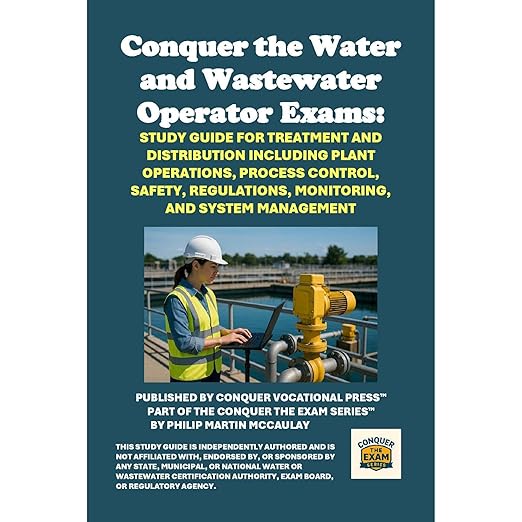
Four hours is not long for a syllabus this wide. Philip Martin McCaulay's guide promises the entire treatment pathway, from raw water sources through clarification, filtration, disinfection, distribution and residuals management, and then adds safety practice, documentation, asset management and infrastructure planning on top. The audiobook runs three hours and fifty-nine minutes, arrived in December 2025 from an independent imprint, and carries a narrator credit reading Virtual Voice. Ahead of any judgment about the content, a prospective buyer needs to know that the page holds a single rating, that rating is one star, and nobody has written a word explaining it.
Water Loss Control Rarely Survives an Editor's Cuts
Water itself is the organizing principle. Chapters follow the sequence a supply actually moves through rather than the order a textbook might impose, which is a sensible choice for a subject where every stage constrains the next. The description is explicit that each chapter is meant to build a foundation of practical understanding, helping an operator see how individual processes support the broader system and how one adjustment changes water quality downstream.
A second block covers what the guide calls the operator's responsibility for safety, documentation, monitoring and system integrity. Chlorine handling, emergency preparedness, abnormal operating conditions and interagency communication are named specifically, which is the part of the job that separates an experienced operator from somebody who only watches the dials. The framing is about composure under pressure rather than procedure lists, and the description backs that up when it names challenges that require informed decision-making.
The third block is the one most study guides skip: long-term stewardship. Asset management, water loss control, distribution monitoring and infrastructure planning are not exam-room glamour, and they are what a system actually needs from the people running it over twenty years. Water loss control in particular is the sort of chapter that rarely survives an editor, and its presence says something about who the guide was written for. Whatever else this guide is, it has been assembled by somebody thinking about the job rather than only about the paper.
Spoken Prose Gives a Listener a Mental Map
Prose style is the strongest argument for the format. McCaulay commits to explaining operational principles in clear language, and the description explicitly rejects technical jargon in favor of steady, structured explanation. Material written that way survives being spoken far better than a dense reference text does, because the sentences carry their own scaffolding and a listener who loses a thread can pick it up at the next paragraph rather than the next page.
Sequencing helps too. A guide built along the path water takes gives a listener a mental map that needs no page numbers: source, clarify, filter, disinfect, distribute, deal with what is left over. Anyone who has walked a plant already has that geography in their head, and a compact recording hanging concepts onto a route you physically know is a genuinely efficient way to revise.
Then the plain practical case. Operators work shifts, drive between sites and spend hours doing rounds where their eyes are occupied and their ears are not. A short guide that can be replayed twice in a week without clearing a single evening is a different proposition from a manual you have to sit down with, and repetition is most of what exam preparation actually is.
One Star, No Text, and a Synthetic Voice
Start with the credit line. It reads Virtual Voice, which names a synthetic reading rather than a person, so nobody is answerable for how a technical vocabulary is pronounced and no performer chose where the emphasis falls in a procedural sentence. That is a fact about the product rather than a verdict on it, and it makes the sample non-optional. Play at least a full minute before buying, ideally from a passage dense with process terms.
Social proof is close to nonexistent, and what exists is bad. One rating, one star, filed by somebody who left no text at all. A single grade tells you nothing statistically, and a one-star with no explanation could mean anything from a technical fault to a buyer who wanted something else entirely. It is still the only signal the page carries, and pretending otherwise would be dishonest.
Audio Gives No Index and No Page to Mark
Gaps in the listing matter for a study purchase. The series line reads Skilled Trades Exams without a number, leaving no clue which other titles exist or in what order they run. The publisher is listed as independently published, which means no editorial house is standing behind the technical accuracy. And the description addresses readers rather than listeners throughout, a small sign that it was written for the printed edition and carried across unchanged.
The deepest problem is structural, and it applies to every exam guide in audio. Preparation means looking things up: the threshold you half remember, the sequence you keep reversing, the definition you need again the night before. Audio gives you no index, no way to flip back, and no page to mark. This recording works as a layer over a printed source or over experience already in your hands. It does not work as the only thing you own.
Portable Overview for Operators Who Already Have a Manual
Working operators are the right buyers here, provided they have a printed manual or a course binder to hand and want a portable overview to run through during a commute in the weeks before a test. It also suits somebody sizing up the trade from outside, since it is a cheap way to find out whether the daily reality of clarification, chlorine and paperwork appeals before enrolling in anything. Anyone chasing a first certification will want a printed syllabus open beside it; anyone renewing one may find this is all the refresher they need.
Nobody should buy this as their sole preparation, and anybody who needs question banks, worked calculations or a specific jurisdiction's requirements should keep looking. Treat it as a companion, which is exactly the word the description itself uses, and it earns its place. Clear explanation is worth something even when the page around it tells a buyer almost nothing.