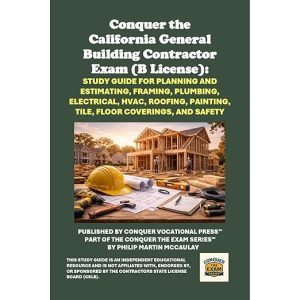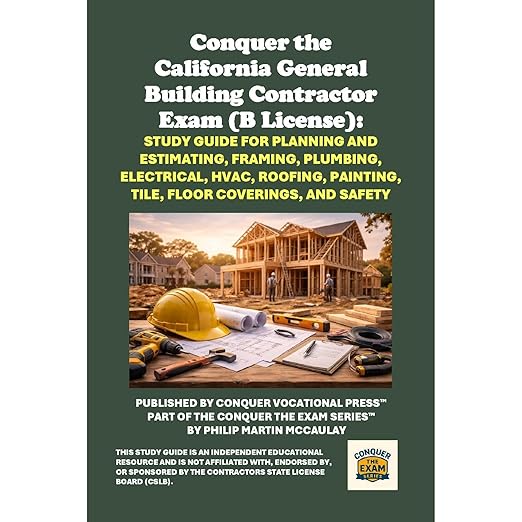
Study guides rarely advertise their own format, and this one does it in the description. Philip Martin McCaulay's California B License guide states that it was written in an audiobook-friendly format, using short, clear paragraphs to support easy listening and focused study. That is a composition claim rather than a marketing flourish, and it changes how you should weigh the runtime on offer. Most exam prep gets recorded because a print edition already exists and somebody decided to read it aloud. This listing says the sequence ran the other way.
The page around that claim is thin. One rating sits on it, that rating is a single star, and no written response explains what went wrong. The series field names a set called California Contractors State License Board (CSLB) Exams but leaves the position blank, so you cannot tell whether this is an opening volume or a later entry. Independently Published released it on December 21, 2025. The narrator credit reads Virtual Voice, which is a synthetic-narration label rather than a person, so no reader has been hired to interpret anything here.
McCaulay Assembles a Spoken Syllabus Here
What McCaulay has assembled is a spoken syllabus. The guide covers planning, estimating, structural systems, building trades, safety and professional responsibilities, then works outward through the building trades themselves. Its organizing idea is stated plainly: each chapter focuses on practical concepts and construction logic rather than memorization, so that a candidate understands how building systems work together on real projects. For a licensing exam that is a genuine bet. Boards test recall, and a guide that deliberately steps away from recall has chosen comprehension over drill.
Virtual Voice deserves a moment of attention, because it interacts with the audio-first claim in a specific way. A synthetic reader does not lean on a definition, does not slow for a list of framing members, and does not signal with the voice that a new topic has begun. The description says the writing handles all of that itself, through short paragraphs and consistent structure. On material this list-heavy, that division of labor is the whole production decision. Put it to the test directly: find a stretch where trades are enumerated and listen for whether the sentences themselves supply the pauses the delivery will not.
Three Hours That Cover the Whole License
Three hours and thirty-eight minutes is the number that makes this worth a look. An entire B License scope in a single sitting is an overview rather than a course, and the guide concedes as much: it is designed to supplement hands-on experience and other study materials. Framed that way, the runtime becomes an argument instead of a shortfall. You can hear the full shape of the exam across one long drive and arrive at your denser materials already knowing which sections you have been quietly avoiding.
Series context is worth a word, since it shapes what this title is for. The listing places the guide inside a set covering California Contractors State License Board examinations, which suggests companion volumes for other license classifications rather than a sequence you work through in order. The position field being blank means you cannot confirm that from the page, and I would treat the set as a shelf of parallel titles rather than a course with a beginning. For a B License candidate that is good news: nothing here waits on a prerequisite volume, and the guide behaves as a self-contained overview throughout.
Plain Vocabulary Matters More Than Depth
Register is the second thing on offer. The description commits to clarity, consistency and technical accuracy while avoiding unnecessary jargon or outdated references, and for a candidate coming off years on job sites rather than out of a classroom, plain vocabulary matters more than depth. Trade knowledge acquired by doing is almost never organized the way a licensing board organizes it. Something that names the categories in order, in words you already use daily, does a job that no additional framing experience will do for you.
One Rating, Zero Explanation of Why
That lone rating is the honest problem. One person graded this title, chose the lowest score available, and wrote nothing at all. A single one-star mark with no accompanying text says very little about the book and quite a lot about the listing, since nobody has yet described what did or did not work, leaving every claim on the page the publisher's own. I would not treat that grade as a verdict on the content. I would treat it as an absence of evidence and price my expectations accordingly.
No Answer Key, No Edition Date
Worth checking too is what the description never promises. It offers structured coverage and construction logic; it does not mention questions, an answer key, or citations to specific code sections anywhere. For a candidate that omission matters, since understanding how a roof assembly works and answering a written item about it are separate skills. Pair this with something that drills. Note also that figures, spans and tolerances spoken by a synthetic reader arrive without emphasis, so a notebook stops being optional the moment numbers matter.
One further caution concerns currency, which matters more in this subject than in most. Construction requirements change, and the description makes a point of avoiding outdated references without stating which edition of any standard it reflects. A December 2025 release is recent, and recency is genuinely useful here. It is still not the same as a dated statement of what the guide is current to, so anything you hear about permissible practice deserves a check against whatever the board publishes now. Treat it as a map of the territory rather than an authority on its boundaries, and the limitation stops mattering.
Locate Your Weak Spots in One Sitting
Reach for this if you already work in the trades and want the shape of the syllabus in your ears before committing to a study schedule, or if you cleared the trade portion years ago and need the sections outside your daily work brought back. A single sitting, spoken plainly, is a cheap way to locate your weak spots. Leave it alone if you want a drill book, if you need code citations, or if synthetic delivery is something you cannot listen past. The audio-first composition claim is the interesting part of this listing, and the empty response page is the reason to sample before you trust it.
A Few Questions About Conquer the California General Building Contractor Exam
Does this audiobook include practice questions or an answer key for the B License exam?
The description mentions neither questions nor an answer key anywhere in its text. What it promises is structured coverage of the trades and of professional responsibilities, plus an explicit statement that the guide supplements other study materials rather than replacing them. Treat it as a scope refresher and pair it with a dedicated question bank before test day.
Who narrates the audiobook edition of this California contractor study guide?
No human reader is credited anywhere. The narrator field reads Virtual Voice, a synthetic-narration label, so the delivery is machine generated rather than performed. That matters most on numbers and enumerated trade lists, where a person would ordinarily supply emphasis, which is why a technical passage is the right thing to sample first.
Is three hours and thirty-eight minutes enough for the whole B License scope?
It is enough for an overview and not for mastery, which is exactly what the guide claims for itself. The runtime buys a single pass across foundations, framing, roofing, plumbing, electrical systems, HVAC, finishes and site work. Used as a map of what to study harder afterward, that compression works in your favor rather than against it.