- Narrator: Virtual Voice provides consistent, accurately pronounced coverage of engine repair terminology across 7 hours, functional for study purposes, though the flat delivery requires listeners to stay actively engaged rather than passively absorbing.
- Subjects: Passenger vehicle engine repair, ASE A1 certification preparation, mechanical diagnosis and rebuild procedures
- Tone: Systematic and precise
- Bottom line: A focused A1 exam preparation audiobook with strong coverage of engine rebuilding sequences and component diagnostics; best used alongside a practice question bank.
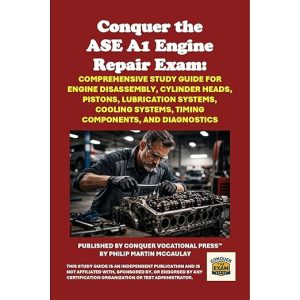
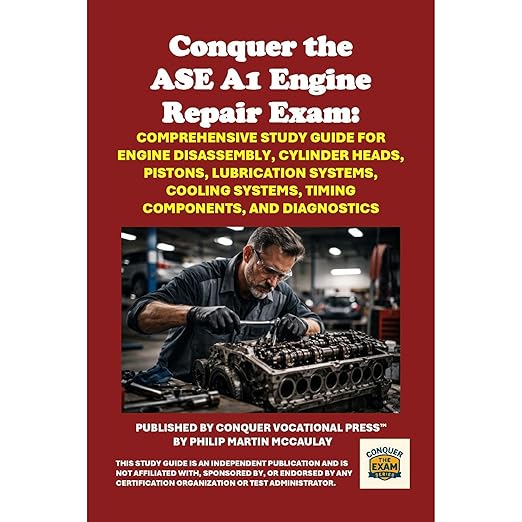
Engine repair certification at the A1 level covers the core mechanical systems of passenger vehicle engines. This audiobook, Philip Martin McCaulay's Conquer the ASE A1 Engine Repair Exam, addresses that foundational knowledge with the kind of depth that supports both exam readiness and practical competence. Philip Martin McCaulay's Conquer the ASE A1 Engine Repair Exam: Comprehensive Study Guide for Engine Disassembly, Cylinder Heads, Pistons, Lubrication Systems, Cooling Systems, Timing Components, and Diagnostics approaches this material from a mechanical systems perspective, building understanding of how each component contributes to overall engine function before addressing what happens when those components fail or wear.
The A1 examination differs from McCaulay's T-series titles in its subject domain. Where the T1 and T3 guides address medium and heavy truck systems, the A1 covers the passenger and light vehicle engine repair systems that form the foundation of general automotive certification. The overlap in study methodology is deliberate, McCaulay applies the same function-before-failure pedagogical approach across the Automotive Exams catalog, but the specific content covers pistons, cylinder heads, crankshafts, valve trains, and the cooling and lubrication systems that keep these components operating within spec.
Cylinder Bore Readings Feed Into Diagnostic Reasoning
Engine disassembly and inspection procedures occupy significant space in this guide, and appropriately so. The A1 exam tests not just knowledge of component function but competency in the diagnostic process that informs whether an engine requires repair, rebuild, or replacement. Understanding how to interpret cylinder bore measurements, crankshaft journal wear, valve seat condition, and timing component stretch requires both procedural knowledge and diagnostic reasoning. McCaulay addresses both, and the integration of measurement procedures with diagnostic interpretation is the strongest aspect of this audiobook.
Lubrication and cooling system coverage is detailed enough to be genuinely useful for exam preparation. These systems are often undertreated in certification prep materials because they are secondary to the "exciting" mechanical components, but they account for a meaningful portion of A1 exam questions precisely because they are commonly misunderstood. The guide explains oil flow paths through a built engine, the relationship between oil pressure and bearing clearances, coolant flow dynamics, and thermostat function in a way that connects system knowledge to diagnostic application.
From Variable Timing to Full Rebuild Verification
The guide's coverage of valve train and timing component systems is particularly relevant for the current exam landscape. Variable valve timing systems have become standard on a wide range of passenger vehicles, and understanding how these systems interact with the base valve train, and how they fail, is increasingly tested material. McCaulay addresses timing component stretch and wear in the context of both traditional fixed-timing and variable-timing configurations, which reflects the actual diagnostic challenges technicians face rather than the idealized engine systems of older certification materials.
The closing section of the guide covers component reassembly, operational testing, and repair verification, the back half of the repair process that is sometimes treated as a brief addendum in other study resources. McCaulay gives it substantive coverage, walking through startup sequence, initial oil pressure confirmation, temperature management on first run, and the verification procedures that confirm a rebuilt engine is operating correctly. For exam candidates who may have practical experience with disassembly but less with full rebuild verification, this section provides a structured framework.
Virtual Voice Narration Holds Steady for 7 Hours
Virtual Voice narration across this audiobook delivers engine repair terminology accurately, component names, measurement units, diagnostic terminology, without significant pronunciation errors. The text-to-speech register is consistent throughout the 7-hour-3-minute runtime. The same limitation that applies to the T1 and T3 titles applies here: there is no vocal emphasis to guide the listener toward the most critical points in a complex sequence. Active engagement is required, particularly during the measurement and diagnostic procedure sections where sequence matters.
The synopsis closes with a pointed note: "If you've already invested time and money into preparing, don't leave success to chance." That framing is accurate. The A1 exam is not particularly forgiving of content gaps, and a comprehensive study resource that covers all the examined systems, rather than one that concentrates on the most commonly tested components, provides better exam readiness. This audiobook earns that description.
Valve Seats and Guide Wear Get Careful Coverage
ASE A1 candidates with practical shop experience who prefer audio study, or who need to fit exam preparation into shop downtime, are the clear primary audience. The guide assumes mechanical familiarity, you should know what a piston ring is before you start listening, and builds from that foundation toward the diagnostic and procedural competency that the exam tests.
Cylinder head work receives some of the most detailed treatment in this audiobook, which reflects the A1 exam's emphasis on that domain. Valve seat condition assessment, guide wear measurement, head surface flatness inspection, and the diagnostic logic that determines whether a head is repairable or needs replacement are covered with the procedural clarity that makes the difference between a technician who works confidently on cylinder heads and one who avoids them. For candidates whose shop experience has been primarily with block-level work and who are less confident with head disassembly and reassembly, this section provides substantial practical value alongside its exam preparation benefit.
Listeners who are new to automotive repair without prior shop experience will find this audiobook inaccessible without additional foundational materials. For the experienced technician who wants a rigorous, systems-organized review of everything the A1 covers, this is a solid 7-hour-3-minute investment in exam preparation. Add practice questions to the mix and you have a complete preparation approach.
Questions Listeners Ask
How does this ASE A1 audiobook differ from the T1 and T3 titles in the Automotive Exams series?
The A1 covers passenger and light vehicle engine repair, disassembly, cylinder heads, pistons, lubrication, cooling, timing, and diagnostics. The T1 and T3 titles address medium and heavy truck systems. All three share the same study methodology, but the A1 content is specific to the automotive (non-commercial truck) certification pathway.
Does this audiobook cover variable valve timing systems relevant to the current ASE A1 exam?
Yes. McCaulay addresses timing component wear and diagnostics in the context of both fixed-timing and variable-timing configurations, reflecting the current exam content rather than older certification materials. Variable valve timing failure modes are covered alongside traditional timing chain and belt systems.
Is 7 hours enough time for complete ASE A1 audiobook preparation?
For conceptual preparation, yes. The audiobook covers the full scope of A1 exam systems with depth appropriate for exam readiness. However, ASE exam performance also requires familiarity with question phrasing and format, which this guide alone cannot provide. Supplementing with practice questions gives the most complete preparation.
What prior knowledge does this audiobook assume for ASE A1 exam candidates?
Practical shop experience with automotive engines is assumed. The guide builds from component functions and diagnostic principles, but it is not an introduction to automotive mechanics from scratch. Candidates with hands-on experience disassembling and repairing engines will find the content immediately relevant; those without that background may need foundational materials first.