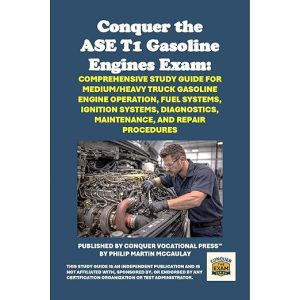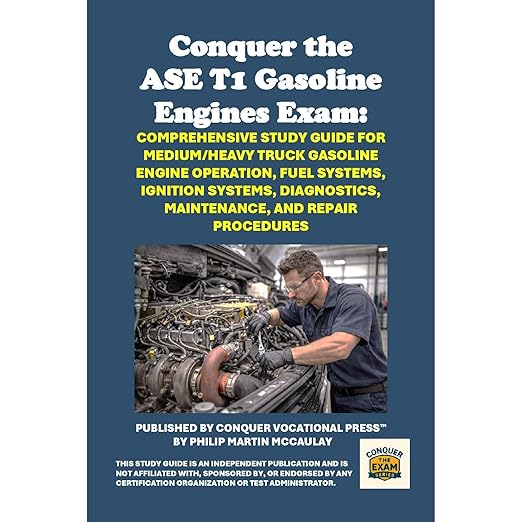
Gasoline engine certification for medium and heavy trucks occupies a specific corner of the ASE examination framework. Conquer the ASE T1 Gasoline Engines Exam is an audiobook built specifically to address that corner in full. The T1 exam tests knowledge of air intake, fuel delivery, ignition principles, electronic engine management, and the diagnostic reasoning that ties them together, a domain that rewards technicians who understand why systems behave the way they do under varying load and temperature conditions, not just how to replace components when they fail. Conquer the ASE T1 Gasoline Engines Exam: Comprehensive Study Guide for Medium/Heavy Truck Gasoline Engine Operation, Fuel Systems, Ignition Systems, Diagnostics, Maintenance, and Repair Procedures takes that diagnostic reasoning framework seriously.
This audiobook is part of Philip Martin McCaulay's Automotive Exams series, and it follows the same structural approach that characterizes the T3 Drive Train and A1 Engine Repair titles. Each system is introduced through its fundamental operating principles before the coverage expands to component-level detail, failure modes, and diagnostic methodology. That sequence is not arbitrary: it mirrors how expert technicians actually think about engine problems, working from principle to symptom to cause rather than from symptom directly to part replacement.
Where Fuel Atomization Meets Ignition Timing Logic
Fuel system coverage is where this guide does its most detailed work. Air intake flow, fuel injector operation, throttle body dynamics, fuel pressure regulation, and the interaction between the fuel system and the engine management computer are all addressed with the specificity that the T1 exam demands. The guide explains how fuel atomization quality affects combustion efficiency and emissions output, the kind of cause-and-effect understanding that allows a technician to interpret a misfiring cylinder correctly rather than defaulting to component swapping.
Ignition system coverage follows the same pattern. Spark plug operation, secondary ignition voltage requirements, timing advance logic in modern electronically controlled systems, and the diagnostic signatures of different ignition failure modes are covered in a way that builds a connected picture of how ignition interacts with fuel delivery and combustion dynamics. Turbocharging and forced induction receive attention as well, which is relevant for the growing percentage of medium and heavy truck gasoline engines operating with boost pressure.
Electronic Engine Management Is the Real T1 Test
The electronic engine management section is the portion of this audiobook most likely to separate candidates who pass the T1 from those who do not. Modern medium and heavy truck gasoline engines are deeply integrated with electronic control systems, throttle-by-wire, electronic fuel injection, variable valve timing, and emissions management all interact in ways that create complex diagnostic scenarios. McCaulay addresses this integration rather than treating it as a secondary topic, and that coverage is what makes the guide genuinely useful for the current exam rather than for the exam of a decade ago.
Virtual Voice narration delivers the content consistently across the 7-hour-19-minute runtime. Technical vocabulary, including injection timing windows, stoichiometric fuel ratios, and knock sensor feedback loops, is handled with correct pronunciation and stable pacing. The limitation of text-to-speech narration for diagnostic sequences is the absence of emphasis: a human narrator can signal "this point is critical" through inflection, while Virtual Voice delivers everything at the same register. Listeners benefit from maintaining active attention rather than passive absorption, particularly during the diagnostic methodology sections.
Maintenance Content Goes Beyond What the Exam Tests
The maintenance and preventive care sections at the end of the guide cover lubrication, cooling system management, fuel filtration, and emissions system maintenance. These sections are useful both for exam preparation and for actual shop practice, but candidates focused purely on the exam's core diagnostic content may find the pace through this material slower than the earlier sections warrant. The guide is comprehensive in a way that occasionally extends beyond what the exam strictly tests, which is a feature for working technicians and a minor inefficiency for candidates with limited study time.
As with all Automotive Exams series titles, this audiobook is best treated as one component of a preparation strategy that also includes practice test questions. The conceptual depth here builds the understanding that underlies correct answers, but familiarity with ASE question phrasing and format requires dedicated practice with actual exam questions.
A 7-Hour-19-Minute Runtime Fits Shop Downtime Study
Medium and heavy truck technicians preparing for the ASE T1 certification who have hands-on gasoline engine experience will find this audiobook a reliable and thorough review resource. The depth of coverage on electronic engine management systems is particularly valuable for technicians whose shop work has been primarily on older mechanical systems and who are updating their diagnostic knowledge for modern truck engines.
One underappreciated strength of this audiobook is its coverage of emissions management systems in the context of fuel and ignition diagnostics. Exhaust gas recirculation, catalytic converter function, and evaporative emissions controls are addressed not as isolated compliance topics but as integrated parts of engine performance and diagnostic logic. Technicians who have struggled to understand why OBD-II emissions codes accompany performance problems will find the explanatory framework here useful for connecting those diagnostic dots. This integration of emissions knowledge with conventional engine diagnostics reflects the reality of the modern T1 exam content rather than the older exam versions that treated emissions as a separate domain.
Listeners new to gasoline engine systems without practical shop background will find the guide challenging, it assumes a foundation of mechanical familiarity and builds from there. For the experienced technician using audio study to cover material during shop downtime, the 7-hour-19-minute runtime deploys efficiently across the full scope of T1 content. Pair it with a practice question bank for optimal exam readiness.
- Read by: Virtual Voice handles the technical terminology of gasoline engine systems adequately, pronunciation is consistent, pacing is stable, though the flat delivery requires active listener engagement during complex diagnostic sequences.
- At its heart: Medium/heavy truck gasoline engine systems, ASE T1 certification preparation, fuel and ignition diagnostics
- Vibe: Methodical and detail-oriented
- Short version: A well-structured ASE T1 preparation audiobook that builds genuine systems understanding; Virtual Voice narration demands an engaged listener but delivers the content accurately.
Before You Listen
Does this audiobook cover electronic engine management systems relevant to the ASE T1 exam?
Yes, and in substantial depth. Modern medium and heavy truck gasoline engines rely heavily on electronic controls for fuel injection, ignition timing, throttle management, and emissions systems. McCaulay addresses this integration throughout the guide rather than treating electronics as a supplementary topic.
Is the Virtual Voice narration clear enough for technical automotive content in this audiobook?
For most of the content, yes. Technical terminology is pronounced consistently and the pacing is stable. The trade-off is the absence of emphasis variation, Virtual Voice does not signal which points are most critical through vocal inflection the way a human narrator would. Active listening is more important here than with a professionally narrated audiobook.
Should I use this audiobook alone for ASE T1 exam preparation?
As a foundation, yes; as a complete strategy, no. McCaulay's guide builds the conceptual understanding that supports exam performance, but ASE questions have specific phrasing and format conventions that require practice with actual test questions. Most candidates benefit from pairing this audiobook with a dedicated ASE practice question bank.