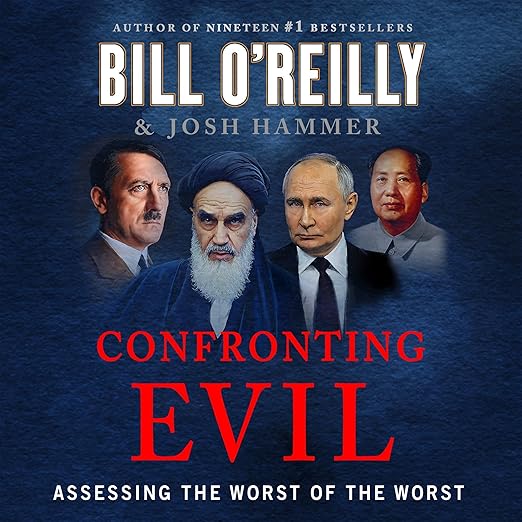
Confronting Evil sets out to explain why cruelty keeps recurring across history, moving through a rotating cast that runs from Genghis Khan and the Roman Emperor Caligula to Stalin, Hitler, Mao, and the Mexican drug cartels operating today. This audiobook, narrated by Robert Petkoff and produced by Macmillan Audio from St. Martin's Press, runs 10 hours and 11 minutes and arrived in September 2025.
One Byline Hiding a Second Author
The byline on this listing reads simply 'Bill O'Reilly,' but the synopsis introduces the book as written 'by Bill O'Reilly and Josh Hammer' and keeps that dual credit throughout its description. One reviewer even signs off thanking both men by name for the research behind it. Whatever the reason for the gap, Hammer's name comes from the description rather than from the author field itself.
The five reviews are uniformly positive on substance. One reader calls the writing 'well researched' and points to the book's side notes as some of its more interesting material. The lone four-star review agrees on the research overall but singles out the closing chapter on drug cartels as feeling rushed, speculating it may have been added to defend the actions of someone the reviewer only describes as 'the author's buddy,' without saying who that is.
AudioFile Praised Petkoff for a Different Book
The description also carries a pull quote from AudioFile praising 'Petkoff's bravura performance, the fine sound quality, and the exceptional direction and editing,' and calling the result 'an impressive audiobook.' That same line credits the praise specifically to a different title, Hitler's Last Days, so it speaks to Petkoff's track record as a narrator rather than to this particular recording.
A pair of the five reviews come from an account simply labeled Amazon Customer, which makes it impossible to tell whether the same person left both or two different listeners happened to share a generic reviewer name. Both are five-star accounts, so the ambiguity doesn't change the overall picture, just the ability to count distinct voices in the column.
Mary Lou's review pushes the book toward the classroom, arguing it should be required reading in high school and college history classes because of how directly it confronts socialistic, communistic, and dictatorial leadership. That review frames the whole project in stark moral terms, the darkness unable to tolerate the light, language that matches the synopsis's own framing of evil as something every listener is ultimately compelled to choose against.
An 1867 Mill Quote Frames the Whole Book
O'Reilly's approach here is breadth over depth: rather than one biography, the book moves through history's worst figures organized around a single question about why evil recurs. Reviewers respond well to that pace, with one finishing the entire book in two days and several others calling the chapter structure easy to stay with despite the heavy subject matter.
The synopsis also frames the whole project around a specific moral challenge rather than pure history for its own sake, closing its introduction with a quote from John Stuart Mill's 1867 inaugural address at the University of St. Andrews about how good men doing nothing is all evil requires to succeed. That framing gives the book a clear thesis to hang its chapter-by-chapter tour of tyrants on, rather than leaving each historical portrait to stand alone.
This also isn't a standalone effort. The series field lists it under Bill O'Reilly's Confronting Series, and the same description references an earlier entry, Hitler's Last Days, giving listeners who respond to this format a specific next title to look for, narrated by the same Robert Petkoff praised in that borrowed AudioFile quote.
A Leftover Production Note Inside One Review
One review carries an odd internal artifact: partway through, it includes what reads like a leftover production note, referencing 'page 1' and a 'book description summary' in parentheses, embedded in the middle of otherwise normal reader commentary. It doesn't undercut the substance of the review, a full five stars with real praise for the research, but it's a strange thing to see left in.
Reviews for this title are also entirely post-release, all five dated after the September 2025 publication, avoiding the earlier-edition confusion that shows up on some other history titles. None of the five reviews comment on Robert Petkoff's actual narration of this specific book either, which is exactly the information the misplaced AudioFile quote fails to provide.
The one dissenting note in an otherwise glowing column is worth taking seriously on its own terms: a reader who otherwise praises the research specifically flags the final chapter on cartels as feeling rushed and possibly motivated by something other than straight history. That kind of narrow, specific pushback is more useful to weigh than a star count alone.
The rating badge itself is also worth a light touch of skepticism rather than a deep dive: 4.6 stars sit atop a vote counter that lags well behind the five written responses actually visible on the page. Treat the number as a general signal of a warm reception rather than a precise, checkable statistic.
Know the Co-Author Credit Gap First
This suits readers of O'Reilly's other history titles and anyone who wants sweeping, chapter-sized portraits of historical cruelty rather than one deep biography. It also works for listeners who appreciate quick, digestible chapters over a single sustained narrative arc, and for classrooms or reading groups drawn to the moral-argument framing Mary Lou's review responds to.
Go in aware that co-author Josh Hammer's contribution is documented only in the text, not the credit line, and that the narration quote in the description is borrowed from a different audiobook entirely. Anyone who picked this specifically for that AudioFile endorsement should know it wasn't written about this recording, and anyone wary of the final chapter's political undertones should read the four-star review closely before committing.
For listeners mainly after a fast-moving survey of historical monsters rather than a rigorously footnoted academic study, the pace and structure reviewers describe should deliver. For anyone who wants a single deeply researched subject instead of several shorter portraits stitched together, a narrower biography would likely serve better than this wide-angle approach.