At a Glance
- Voice: Rachel Story leads instruction while Jorge provides an authentic native-speaker accent, the dual-voice approach is built into the course design and creates a meaningful listening distinction between teaching voice and immersive model.
- Big ideas: Grammar-acquisition fusion, active speaking from day one, progressive comprehension building
- Atmosphere: Structured and energetic, with built-in interactive pauses
- Worth it?: For self-directed learners willing to commit to 59 hours of active participation, Complete Spanish Step-by-Step is among the most thorough audio-first language courses available.
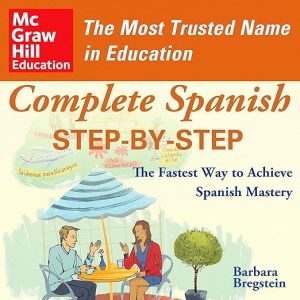
Picture yourself on your first full listening session of Complete Spanish Step-by-Step: within minutes, before you have had time to feel self-conscious, Rachel Story has prompted you to speak a sentence aloud in Spanish. That is the design philosophy of this audiobook course in miniature, immersion before hesitation, production before perfection. Barbara Bregstein's curriculum has accumulated more than a thousand four- and five-star reviews across its print editions, and this audio adaptation attempts something genuinely ambitious: to replicate the interactive quality of classroom instruction in a format you can carry in your earbuds. For anyone who has tried to learn Spanish and stalled on other platforms, this is the structural question the course actually answers: what would it take to keep you not just listening but producing language every session?
The 59-hour runtime signals immediately that this is not a highlights-reel Spanish course. It is a comprehensive curriculum spanning 30 chapters, with the first 15 drawn directly from Easy Spanish Step-by-Step and the subsequent 15 providing significantly deeper grammatical and conversational coverage. The structure is cumulative and sequential, each section builds on the last, which is both the course's greatest strength and its chief limitation. Reviewers consistently note the efficiency of the approach: one learner reported making more progress in a single week with this course than in months with app-based alternatives. Another, already six months into self-study with other materials, described it as providing more immediately applicable knowledge by the fifth chapter than everything that had preceded it. The course's insistence on speaking aloud, not just listening, is the key differentiator. Bregstein's method fuses grammatical understanding with child-like acquisition through listening and production, and the audio format enforces the speaking component in a way that reading the textbook version cannot. Grammar rules are simplified and clearly presented, and new vocabulary is introduced contextually rather than in front-loaded memorization blocks that most learners immediately forget. The progression feels natural precisely because it mirrors how language acquisition actually works in the brain.
Jorge Tunes Your Ear to Real Spanish
The presence of Jorge, a native Spanish speaker who accompanies Rachel Story throughout, is a meaningful design choice rather than a cosmetic one. His role is to tune your ear to authentic, unconstructed Spanish: the kind you encounter in conversation, not in a classroom setting where every syllable is enunciated for maximum clarity. The course builds your listening comprehension alongside your speaking from early on, which addresses one of the most common frustrations in language learning, the gap between being able to produce correct sentences and being able to understand native speakers at natural speed. The interactive structure, filling in missing words, responding to questions, giving your own opinions, prevents the passive drift that tends to undermine long-form audio. At 59 hours, passive listening would be genuinely ineffective anyway. This audiobook demands active engagement, and the course design supports that demand at every chapter. One reviewer specifically praised the pace of study as extremely helpful for self-learning and immediate application, which captures the experience of a course designed around retention rather than coverage.
Fifty-Nine Hours That Demand Real Commitment
The prerequisite structure is real and consequential. This is not a dip-in course where you can jump to the subjunctive chapter without having worked through verb conjugation and pronoun agreement first. The sequential design means that rushing ahead or skipping chapters will undermine the cumulative grammar framework the course builds. For listeners accustomed to non-linear learning, this requires a mental adjustment. The 59-hour commitment also demands realistic time management: this is closer to a semester course than a quick-start guide. Listeners who want conversational fluency in a weekend will need to recalibrate their expectations significantly. What the course delivers is real, verifiable progress along a clearly marked progression, not the impression of progress that shorter and more entertaining language apps can provide. The pacing is described by reviewers as clear and well-managed, but it will feel demanding if you attempt to absorb it passively or in large undivided blocks without engaging in the speaking exercises. The interactive component is not optional; it is the mechanism through which the course actually works, and bypassing it defeats the purpose of the design entirely.
Committed Learners Who Treat This as Class
Self-directed learners who are willing to commit fully to the interactive model will get the most from this audiobook. The ideal listener treats it as a class rather than a commute companion, that means speaking aloud, pausing to complete exercises, and working through chapters in sequence from the beginning. It suits beginners and intermediate learners equally: beginners who lack any foundation, and intermediate learners who want to move beyond app-level proficiency into actual grammatical competence and conversational capability. Listeners who want a casual, low-effort language exposure rather than structured acquisition should look elsewhere. The course rewards those who show up consistently and engage actively, and it will genuinely disappoint those who approach it as background listening. The 59-hour investment is substantial, but reviewers who complete it consistently describe the results as proportional to the commitment required. Unlike language apps that are engineered for daily retention through notifications and gamification, this audiobook places all the responsibility for consistency on the learner, which is exactly the trade-off that produces real fluency rather than the perpetual beginner loop that keeps many language learners engaged but never fully functional in actual conversation with native speakers who do not slow down for classroom clarity.
Can I listen to this audiobook course out of order, or do I need to follow it sequentially?
Sequential listening is essential. The 30-chapter curriculum is explicitly designed so each section builds on what came before. Skipping ahead will leave gaps in the grammar framework that the course relies on as a foundation for later material.
Is this audiobook suitable for total beginners to Spanish, or do I need some prior knowledge?
Total beginners are the primary audience. The course starts from zero and is designed to move you from no Spanish to communicative competence over its full 59-hour span. Reviewers with prior exposure noted they still gained substantial new knowledge from the early chapters.
How does the audiobook handle interactive exercises without a physical workbook?
The course builds interaction into the audio itself, Rachel Story prompts you to fill in words, respond to questions, and speak sentences aloud. This makes active participation possible without a companion textbook, though writing notes alongside listening sessions can reinforce retention.
How does Complete Spanish Step-by-Step compare to app-based language learning as an audiobook course?
Reviewers consistently report faster, more durable progress with this course than with apps. The structured grammar framework and mandatory speaking component create a different kind of retention than gamified app environments, though the trade-off is a much higher time commitment of 59 hours.