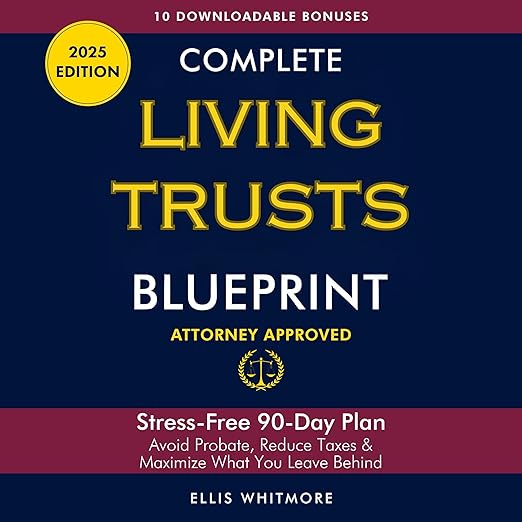
Estate planning content rarely earns a 4.8 rating from 168 listeners, and Complete Living Trusts Blueprint does it by treating a genuinely dry legal subject as a solvable problem rather than an intimidating one. Ellis Whitmore's audiobook walks through the mechanics of living trusts, avoiding probate, minimizing taxes, protecting privacy, over four brisk hours, built around a 90-day action plan that reviewer Precious star calls attorney-approved and genuinely stress-free to follow. Narrator Chris Kiefer, whose clean, professional register has proven well suited to instructional content that needs credibility without stiffness, keeps the material moving at a pace that respects how little most listeners actually want to spend on this topic before getting back to their day.
A 90-Day Timeline Replaces an Information Wall
What separates this from a dry legal reference is the structural decision to build everything around a 90-day timeline rather than presenting estate planning as an undifferentiated wall of information. Whitmore breaks the process into sequenced steps, choosing trustees, handling blended families, addressing special needs dependents, updating plans as laws change, which gives listeners a clear sense of where they are in the process at any given point. Reviewer Daniel Petre specifically credits this structure with making the whole subject feel less overwhelming, and that tracks with how the book is organized: less a comprehensive legal encyclopedia than a guided path through the handful of decisions that actually matter for most families.
The book also does useful work distinguishing wills from trusts, a distinction plenty of listeners will realize, partway through, they did not actually understand going in. Whitmore covers when a will alone is sufficient versus when a trust becomes worth the added complexity, along with DIY software options for straightforward situations and clear guidance on when paying an attorney is worth it. That last point matters more than it might seem: a book selling itself as a shortcut around legal fees could easily oversell DIY solutions, and to its credit, this one does not, flagging complex situations, business ownership, blended families, significant assets, as scenarios genuinely warranting professional help.
Kiefer Avoids Dry Lectures and Sales Pitches
Kiefer's narration suits this material precisely because he does not oversell it. Estate planning content can tip either into dry legal recitation or into anxious, high-pressure sales language, and Kiefer's measured, conversational delivery avoids both traps, treating the listener as someone capable of understanding their own financial decisions rather than someone who needs to be lectured or frightened into action. That professional-without-stiffness quality, already a strength of his on workplace and instructional titles, translates cleanly into legal content where credibility matters more than performance. Over four hours of process explanation, worksheets, and real-world examples, that steadiness keeps the listening experience from feeling like a seminar you are trapped in.
Reader response reinforces the sense that this book delivers on its practical promise rather than just its marketing copy. T.D. calls it a great resource for anyone new to estate planning, specifically praising how simply Whitmore explains why living trusts matter in the first place. Precious star's review describes the 2025 edition specifically and credits its attorney-approved framework for making a genuinely intimidating subject feel manageable within the stated 90-day window. Across all three attached reviews, the consistent thread is not excitement about legal strategy for its own sake, it is relief at finally understanding a topic most people successfully avoid thinking about for years.
Sales Language Fades Once the Mechanics Start
The synopsis leans hard into direct-response marketing language, promises of avoiding probate forever, protecting your legacy, stopping procrastination, and listeners allergic to that register should know it carries into some of the book's framing, even if the substantive legal content underneath is solid. This is standard for the self-published estate-planning and financial-guide category, but it is worth naming plainly rather than pretending the book reads like a neutral legal reference throughout. The good news is that the sales-oriented framing sits mostly in the setup; once Whitmore gets into the actual mechanics of trust structures and the 90-day plan, the content itself is considerably more grounded than the pitch suggests.
At four hours and nine minutes, this is a brisk overview rather than an exhaustive legal treatise, and it cannot substitute for jurisdiction-specific advice, since trust and probate law varies meaningfully by state. Whitmore is upfront that this is a starting framework rather than a replacement for an attorney in complex situations, but listeners with unusually complicated estates, multiple properties across states, contested family situations, significant business assets, should treat this as preparation for a professional consultation rather than a full solution on its own.
For Procrastinators and the Adult Kids Helping Them
This is a strong fit for anyone who has been putting off estate planning because the subject feels overwhelming or the terminology impenetrable, particularly listeners with moderate, relatively straightforward estates who want to understand their options before deciding whether to hire an attorney. It also works well for adult children helping aging parents think through these decisions for the first time, since the 90-day structure gives families a shared framework and timeline to work from rather than an open-ended, easy-to-postpone task.
Skip it if your estate involves significant complexity, multiple business entities, contested family dynamics, assets across several states, since four hours of general framework will not substitute for the specialized legal advice those situations genuinely require. Listeners looking for deep technical detail on tax law specifically, rather than a practical, action-oriented overview, will also want a more specialized resource; this book is built for clarity and momentum over exhaustive legal precision.
- Narrator: Chris Kiefer's clean, conversational delivery treats estate planning like a solvable problem instead of a legal lecture.
- Subjects: Estate planning, avoiding probate, family financial protection
- Tone: Practical and reassuring
- Bottom line: A genuinely clarifying overview for anyone who has been avoiding estate planning out of confusion, though complex estates will still need a specialized attorney.