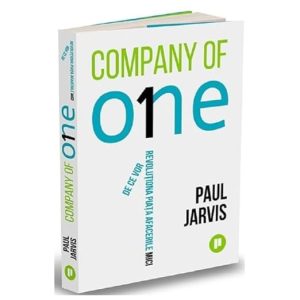
Staying small on purpose is one of the few genuinely contrarian positions left in business writing, and Paul Jarvis has built an entire book on it. The premise of this audiobook, credited to Sam Woolf across eight hours and seventeen minutes, is that the smartest career move available is not founding a startup and scaling it, but building something deliberately modest, sustainable and profitable, then refusing every invitation to make it bigger.
Deciding the Final Size in Advance
Jarvis draws a sharper distinction than any summary of the book conveys. A company of one is not a freelancer paid by the piece, chasing the next contract with no leverage of its own, and it is not a young venture pretending to be small while it waits for funding. It is a business that has decided its final size in advance and built everything around that decision, from pricing to client load to the number of people it will never hire. That distinction does more work than it appears to, because it converts every opportunity into a question with a default answer already attached.
What that buys, in the argument's own terms, is control of the calendar. No employees, no lengthening meetings, no expansion projects that create work whose only purpose is to sustain the expansion. The claim is that a small operation can produce steady cash flow while leaving room for the parts of a life that a scaling company consumes first, and Jarvis treats that trade as the point rather than as a consolation.
An endorsement from the creator of Ruby on Rails, printed on this edition, frames the underlying idea neatly: growth has quietly come to mean more revenue, more clients, more staff, more products, more of everything, and the alternative offered here is a wider definition built on learning, refinement and sufficiency. Whether you find that liberating or evasive is the fault line running through every reaction to this book.
Sapp, Nash, and O'Neal, Then He Stopped
Jarvis argues from his own record rather than from theory, and the record is specific. He worked as a corporate designer in technology and as an internet consultant, spent years building online presences for professional athletes including Warren Sapp, Steve Nash and Shaquille O'Neal, and took contracts with Yahoo, Microsoft, Mercedes-Benz and Warner Music. Then he stopped, on the grounds that a high-pressure world organized around visibility did not match his own definition of success.
What he does now is the actual demonstration. He writes, makes podcasts and runs online courses that have reached more than ten thousand students, working from a house on a small island near Vancouver where he lives with his wife. That is the whole proof offered, and it is more persuasive than a case study precisely because the author has to live inside the conclusion he is recommending. Nobody selling a scaling playbook is obliged to run the company the playbook describes.
Deep Work's Author Calls It a Better Company
The practical chapters are the reason to buy rather than to admire. Preparing for a launch, deciding what income you actually need instead of what income sounds impressive, handling crises without a team to absorb them, keeping a small number of important clients genuinely happy, and doing all of it without staff. Those are the operational questions a solo operator faces in year one and year five alike.
Endorsements tell you the intellectual neighborhood before you start. The author of Deep Work calls it a case for building a better company rather than a larger one, and the remaining blurbs come from writers on side businesses, on brand strategy and from a podcast host who has also written a book about people who change the game. Nobody in that group is a neutral party; all of them have argued adjacent positions elsewhere. Read the list as a map of the tradition, not as evidence.
Woolf's Recording Paired With a Romanian Text
This listing is a mess, and buyers need to know that before anything else. The publisher line names a Romanian house, the language is given as Romanian, the description is printed entirely in Romanian, and the page carries a 296-page count, a print ISBN and an identifier in ISBN form. Those belong to a translated paperback. The duration and the narrator credit belong to an English recording. Nothing on the page reconciles the two, so confirm from the sample which language you are buying.
Ratings offer no help either. Forty-nine ratings support a 4.3 average and not one of them comes with a written response, so the number floats free of any explanation: no listener has said what worked, what did not, or which edition they were grading. Given that the same page appears to be pooling a translation and a recording, even that average should be treated as approximate.
Limits of the argument are worth naming. It suits service businesses, consultancies, writing, design, teaching and software with modest fixed costs, and it suits people whose skills are portable. It does not suit ventures that need capital, inventory or a team to function at all, and the book is honest enough not to pretend otherwise. The path also assumes a client base can be found, which is the step it says least about. Anyone starting from no audience and no professional network will finish the book convinced and still without a first client.
Weighing Whether to Double in Size
Freelancers and solo operators who suspect their next move is supposed to be hiring, and who feel no enthusiasm about it, are the exact audience. So is anyone currently employed and drafting an exit, since the chapters on income targets and launch preparation are aimed squarely at people still holding a salary. Small agency owners weighing whether to double in size will find their doubts argued for at length, and given a vocabulary for defending the decision to somebody who assumes growth is the only measure.
None of it works for someone building a venture that needs scale to function, and none of it works as a marketing manual either; client acquisition is the weakest thread in the book. Listeners who want quantitative case studies rather than a philosophy backed by one person's practice should look at business titles built on research. The tone is calm and personal throughout, which reads as a virtue or as a vagueness depending entirely on what you came for.
The argument deserves the hours it asks for. The page it is being sold from deserves a rewrite, and until somebody gives it one, the sample is the only reliable thing on it.
At a Glance
- Narrator: Sam Woolf holds the audio credit on a listing whose every other line describes a Romanian paperback.
- Subjects: Deliberate smallness, sustainable profit over scale, autonomy, redefining growth
- Tone: Calm, contrarian and quietly persuasive
- Bottom line: A genuinely useful argument for solo operators, sold from a page that cannot decide what it is selling.