Quick Take
- Narration: Marlon Percy delivers a smooth, motivational read that suits the anthology’s inspirational register without adding much interpretive depth.
- Themes: Mindset and wealth, social influence, creative versus competitive thinking
- Mood: Earnest and aspirational, unambiguously self-help in register
- Verdict: A practical anthology for listeners new to these three classics, though the bundling serves convenience more than editorial coherence.
There is a version of this review that is very easy to write, and it is the one that dismisses a bundled self-help compilation as a marketing exercise. I am going to resist that, because the underlying question here is actually interesting: what happens when you put Napoleon Hill, Wallace D. Wattles, and Dale Carnegie in the same room? Do their ideas form a coherent system, or do they merely accumulate?
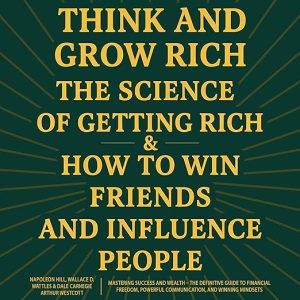
This 2026 compilation from publisher Arthur Westcott presents Think and Grow Rich, The Science of Getting Rich, and How to Win Friends and Influence People in a single 20-hour-plus package narrated by Marlon Percy. The framing in the synopsis is explicit about its ambition: the three books together represent the Why, the How, and the Who of success. Hill’s Master Mind principle addresses goal amplification through collaboration. Wattles offers a metaphysical approach to wealth generation through what he calls the Certain Way. Carnegie’s work handles the social and interpersonal dimension. The synthesis argument is that these three texts are complementary rather than redundant.
Our Take on This Three-Classic Collection
The synthesis argument holds up better than I expected. Hill and Wattles were contemporaries in the New Thought tradition, and their underlying assumptions about the relationship between mindset and material outcome overlap enough that listening to them in sequence has an additive effect. Carnegie’s work is more practical and less metaphysical, which provides useful ballast. The shift in register between Wattles’ somewhat mystical language about creative forces and aligning with universal abundance and Carnegie’s grounded social psychology is noticeable, but that contrast is itself illuminating. The bundle makes the ideological spectrum of early twentieth-century American success literature more visible than any single title would.
Why Listen to This Three-Classic Collection
Marlon Percy’s narration is professional and appropriately warm. He reads all three texts with consistent energy, which is an achievement across nearly 21 hours of material that varies considerably in tone and density. Percy does not attempt to create distinct vocal identities for the three authors, which is the right call. A single narrating voice helps the anthology feel like a unified listening experience rather than three separate audiobooks stitched together. The pacing is well-calibrated for the material, moving through Hill’s more abstract chapters efficiently without rushing Carnegie’s anecdote-heavy sections. Percy’s delivery is best understood as a vehicle rather than an interpretation. He serves the texts efficiently, and for material of this kind, where the listener’s goal is absorption of ideas rather than engagement with literary performance, that serviceable quality is an asset rather than a limitation.
What to Watch For in This Three-Classic Collection
Listeners with any prior familiarity with these texts should know that this compilation does not include editorial commentary, contextual framing, or scholarly annotation. The books are presented as-is. Think and Grow Rich and The Science of Getting Rich in particular contain dated language and cultural assumptions that benefit from some critical distance. The language around gender, race, and social mobility reflects the early twentieth-century contexts in which both Hill and Wattles were writing. New listeners are better served approaching the practical and psychological tools on offer while maintaining awareness of those limitations.
Who Should Listen to This Three-Classic Collection
This works best for listeners encountering these texts for the first time who want a single-purchase introduction to the foundational self-help canon. The 20-plus-hour runtime is substantial, but the value proposition for someone who has not read any of the three originals is clear. Listeners who know one or two of the texts well and want the third may find this format slightly redundant. Those seeking critical or updated perspectives on success psychology should look elsewhere, as the compilation presents these texts without revision or commentary. For new listeners, the sheer span of the material offers an unexpected benefit: you experience how consistent the underlying assumptions are across three writers who did not know each other. That consistency is itself an argument, and listening to all three in sequence makes it legible in a way that reading any one title in isolation does not.
Frequently Asked Questions
Are all three books presented in their complete, unabridged form?
The listing indicates an unabridged 20-hour-54-minute runtime, which is consistent with complete texts for all three titles. No abridgment notice appears in the available metadata.
Is the order of the three books significant, and does it affect comprehension?
The synopsis sequences them as Hill, Wattles, Carnegie, representing mindset, wealth mechanics, and social influence respectively. This order works well thematically, but each book functions independently.
How does Marlon Percy handle the tonal shift between Wattles’ metaphysical language and Carnegie’s practical style?
Percy maintains a consistent warm-motivational register throughout. He does not attempt to dramatize the differences between authors, which keeps the anthology cohesive but means listeners notice the tonal shifts in the writing itself rather than through interpretive narration.
Is this compilation a good choice for listeners skeptical of the self-help genre?
These are foundational texts of the genre rather than critical examinations of it. Listeners approaching with skepticism will find the metaphysical claims of Hill and Wattles particularly demanding. Carnegie’s work tends to cross genre divides more easily given its grounded, anecdotal approach.