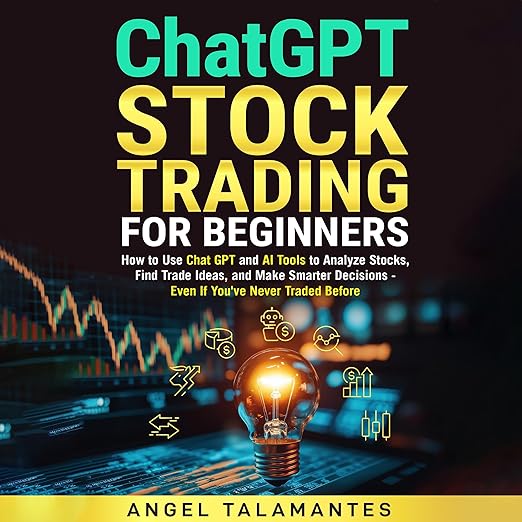
Angel Talamantes builds this whole audiobook on a distinction most trading guides refuse to make. ChatGPT here is a decision assistant, not a signal service, and that gap is the entire argument. The promise is not that a language model will tell you what to buy. It is that a structured conversation with one can force you to say out loud why you want to buy it, before your money is anywhere near the table. As reframes go, that is a sturdier one than the genre usually offers, and it sets a standard the rest of the book has to meet.
Risk Management Lands Eighth on a Ten-Item List
Ten capabilities make up the promised curriculum, and the ordering tells you more than the items do. Managing risk before focusing on profits lands at position eight, after idea generation and after turning analysis into entry and exit plans. An instruction that argues for putting risk first is itself filed behind the fun parts, which is a small tell about where the emphasis really sits. The tenth and last item, a repeatable daily workflow, is the one carrying the weight, because technique without a routine to hang it on produces exactly the beginner described in the opening line.
Volume Sixteen Never Mentions Its Fifteen Predecessors
What I appreciate most is the refusal to sell an edge. The description states flatly that the book does not promise shortcuts or guaranteed profits, which in this corner of the market counts as a position rather than a disclaimer. The formula offered instead is that profits follow preparation rather than predictions. That is not a new thought and it has never needed to be. Hearing it stated before anything else changes what you expect from the next three and a half hours, and it lowers the odds that you finish feeling cheated.
One thing about the page deserves a flag before you spend money. This is filed as the sixteenth entry in a series called Stock Trading, though nothing in the description acknowledges fifteen predecessors, names them, or explains what ground they already covered. The author is also listed as the publisher, so this is an independent production with no house editor sitting between the manuscript and the recording. Neither fact disqualifies it. Both are worth knowing when you are deciding whether a beginner's primer arriving at volume sixteen is a starting point or a fragment of something larger.
Baird Reads Prompts Meant to Be Retyped
Where the approach earns its keep is in what it asks you to do with a chatbot. Rather than requesting a prediction, which is the one job a language model cannot honestly perform, you hand it work it can actually do: restate a bull case in plain terms, summarize a filing, list what would have to be true for a trade to make sense. Talamantes frames this as filtering news, narratives and sentiment through structured prompts, and that phrase is carrying real weight. The model is not the analyst. It is the pressure test.
Nothing in the method requires you to write code, buy expensive software, or spend years in front of charts, and the stated audience is complete beginners on exactly those terms. That constraint gets honored throughout. No API key, no data subscription, no backtesting environment you would have to learn before you learn anything else. If you can type a paragraph into a box and read the answer skeptically, you can run the process, and skeptically is the operative word, since a fluent wrong answer is the specific failure mode this whole approach has to survive.
Thinking in probabilities is the second thread and the harder sell. Beginners want to be right; the method asks them to be calibrated instead, to hold a position because the reasoning survived scrutiny rather than because a chart looked a certain way. Jacob Baird has the reading credit on a text organized around prompts you are meant to pause and retype, which is an awkward shape for any recording to carry, and how well the material lands will depend heavily on whether you treat it as a lecture or as a workbook you happen to be hearing.
Three Five-Star Votes Without a Single Comment
Run your expectations down before you buy, because process books are only ever as good as your willingness to run the process. Talamantes hands you a way to interrogate a stock, but never a way to know whether that interrogation was any good, since the verdict on it only ever arrives from trades you logged, sized and reviewed afterward. Without a journal habit already in place, the method has nowhere to land, and the daily workflow at the end of the list quietly assumes a discipline the book never actually teaches you to build.
Shelf life is the harder problem here. Any book keyed to one named tool inherits that tool's release schedule, and prompts written against one model version behave differently against the next. The structural advice, which amounts to defining your question before you ask it and refusing to outsource the decision, will outlive the software by decades. The specific phrasings may not survive a year. Read the prompt examples as illustrations of a habit rather than as recipes, and the book ages far better than its title suggests it will.
Only three people have rated this so far, all of them at five stars, which is what a clean 5.0 across three votes has to mean. Not one of the three left a written word behind, and a March 2026 release date accounts for that more convincingly than any theory about the book. A perfect score built on three votes is a number without a story attached. Judge this one on the sample and the promised contents, because the star line is not yet carrying enough information to help you.
Buy This if You Can't Explain Your Trades
Buy this if you have opened a brokerage account, placed a few trades on instinct, and recognized the uncomfortable feeling of not being able to explain why. That listener gets the most out of it: enough exposure to see the hole in their own process, not enough habit to resist filling it. It also suits people who already lean on a chatbot for work and have simply never thought to point one at a filing, a sector summary, or their own half-formed reasoning about a position they are about to take.
Experienced traders who already run a documented process, size positions by rule and journal their exits will find nothing here they do not have. Neither will anyone who wants a signal to follow, since removing that crutch is the book's central move rather than an oversight. And if what you were hoping for is code, backtests, or anything resembling a quantitative framework, the no-programming promise that makes this accessible is the same wall that will stop you cold on the first chapter.
Everything finally depends on whether you stop the recording and actually type, which is the one thing no reader on any recording can do on your behalf.
Before You Press Play
- Read by: Jacob Baird is the sole credited voice on a self-published title, cast against instructional prose that asks for a steady pace and a pause button rather than any kind of vocal range.
- At its heart: AI as a decision assistant rather than a signal source, probabilistic thinking, risk management before profit
- Vibe: Brisk, deliberately unglamorous, closer to a checklist than a pep talk
- Short version: A genuinely useful reframe for a beginner who trades on instinct, though a curriculum this broad on a runtime this short buys you a vocabulary rather than a training.
Frequently Asked Questions
Does the audiobook work if you are not sitting in front of ChatGPT?
Partly. You can follow the reasoning anywhere and understand why a structured prompt beats a hunch. But the method is built on text you are meant to adapt and retype, and passive listening quietly converts a workbook into a lecture. Treat a first pass as orientation and a second pass, at a keyboard, as the real course.
Is the audiobook long enough to cover all ten skills it promises?
Three hours and thirty-four minutes divided across ten stated capabilities leaves roughly twenty minutes each, and combining fundamental analysis with technical timing is not a twenty-minute subject. What fits comfortably is a framework, a vocabulary and a daily routine. What does not fit is depth on any single technique, and the description never claims otherwise.
Does the book name specific stocks or hand you trade setups?
No, and refusing to is the point. The stated goal is finding your own trade ideas without leaning on alerts or paid signal groups, using the model to structure your thinking rather than to supply conclusions. Anyone shopping for picks will be disappointed within the first chapter, which is arguably the book working as designed.
Why is this filed under Computer Science rather than investing?
Good question, and the double shelving is a genuine oddity on the page. It carries a Computer Science tag alongside its finance category, which will route it to listeners hunting for a programming text. They will find none. The finance shelf is the accurate one, and the AI content is applied rather than technical.