
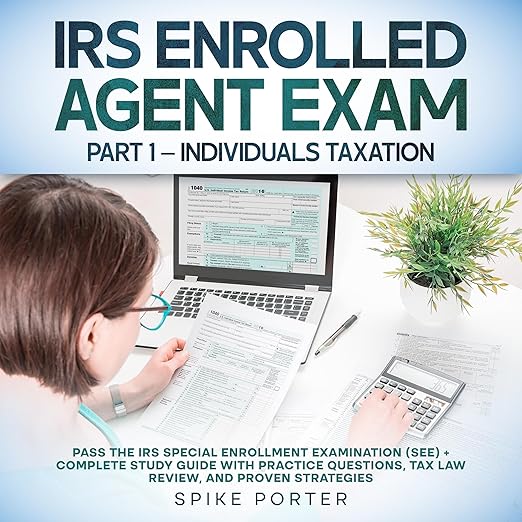
Sitting for the IRS Special Enrollment Examination is not a casual undertaking. The Enrolled Agent credential, the highest level of tax representation authorized by the IRS, requires passing three separate exams covering individual taxation, business taxation, and representation plus ethics, and the Part 1 exam alone spans the full breadth of individual tax law from income and deductions through credits, audits, and special situations. Spike Porter's IRS Enrolled Agent Exam, Part 1: Individuals Taxation, narrated by Tom Brooks over nine hours and four minutes, positions itself as a comprehensive audiobook study guide for that Part 1 exam, designed to give aspiring Enrolled Agents a clear, step-by-step walk through the material they will need to master.
The book organizes its content around the specific topics that appear on the SEE Part 1 exam: income types and their tax treatment, allowable deductions, tax credits, audit procedures, and the mechanics of representing taxpayers before the IRS at the individual level. Porter structures the material to build progressively, with each section designed to establish the conceptual foundation before moving into the more specific applications. For a subject this technical, one where the difference between a deductible and nondeductible expense can hinge on precise statutory language, that organizational discipline is essential, and the audiobook reflects it.
The audiobook's most immediately apparent quality is Tom Brooks's narration. Tax law content read aloud carries a particular risk: the density of the material and the precision required in the language can make even a well-organized guide feel like a reading of the Internal Revenue Code without the right voice. Brooks avoids this by reading with consistent engagement rather than mechanical delivery. His pacing is deliberate, this is content that benefits from not being rushed, and he handles the technical terminology with the confidence of someone who has prepared the material carefully rather than encountering it cold. That matters more than it might seem for a nine-hour study session.
The practice question dimension of the book is worth discussing specifically in the context of the audio format. Porter includes what he describes as detailed practice questions and answers designed to mirror the actual SEE exam format. In print, practice questions function as interactive checkpoints. In audio form, the listener hears both the question and the answer in sequence, which requires a degree of active self-testing discipline that the format does not automatically enforce. Listeners who pause after each question, attempt an answer before continuing, and then compare their response to the recorded explanation will get significantly more from these sections than those who listen passively. The content is strong; the format requires intentional engagement to serve its exam-prep purpose.
Repeated Listening Turns Opaque Concepts Familiar
The 4.9 rating across 51 print reviews suggests the material is resonating with its target audience. The book's appeal as an audiobook specifically lies in its accessibility for candidates who spend significant time commuting, exercising, or in contexts where reading is not practical. Individual taxation is a subject that benefits from repeated exposure, the concepts that feel opaque on a first pass often click on the second or third encounter, and the audiobook format makes that repetition practical in a way that a print textbook does not. Listening to the material on the way to a study session, then reviewing the written notes during the session, creates a reinforcement loop that many exam candidates find effective.
The book covers the full scope of the Part 1 exam content including what Porter frames as real-world applications: how the knowledge translates into actual tax practice rather than just exam success. For candidates who are preparing for the exam while also beginning to build a practice, this dual orientation, credential preparation and practical application, makes the material more immediately relevant than pure exam cram content.
Print Reviews Praise the Book, Brooks Goes Unreviewed
The audiobook is a study companion rather than a complete preparation system. The SEE Part 1 exam is heavily question-based, and developing facility with multiple-choice question strategy requires active practice that an audiobook alone cannot provide. Candidates who use this as one element of a preparation system, alongside written practice tests, flashcard systems, and review of the specific IRS publications the exam references, will be better positioned than those who treat it as sufficient standalone preparation. The test-taking strategies Porter includes are valuable but need to be practiced rather than simply heard.
No audiobook-specific listener reviews are available at this writing, so assessment of Tom Brooks's specific performance draws from the evident care in the narration rather than accumulated listener feedback. The high print ratings suggest the content organization serves candidates well; the audio format adds accessibility at the cost of the interactive engagement that print study tools naturally encourage.
Nine Hours of Transit Study, Still Needs a Plan
Tax professionals pursuing the Enrolled Agent credential who want to supplement a written study program with audio exposure to the material will find this a useful companion. Candidates who spend significant time in transit or in environments where listening is more practical than reading will get particular value from the nine-hour format. Those who are looking for a single self-contained preparation system should note that the audiobook is most effective as one component of a broader study approach rather than the whole of it. Listeners with no background in individual tax law should pair this with some foundational context; the material is clearly presented but assumes the listener is approaching it with exam preparation as the explicit goal.







