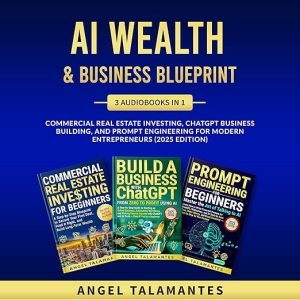
Three separate manuals share one cover here, and the bundle format is always the first thing to interrogate: is this a system, or is it a shelf? Angel Talamantes packages commercial real estate investing, building a business with ChatGPT, and prompt engineering into a single eleven-hour audiobook, records it without an outside narrator, and publishes it under the same name that appears on the cover. The pitch is that the three fit together. Whether they do is the whole question, and the answer turns out to be partial.
Canva and Zapier Never Made the Official Description
Plain naming helps a bundle, and this one gets it right. Book one is Commercial Real Estate Investing for Beginners, book two is Build a Business with ChatGPT: From Zero to Profit, and book three is Using AI Prompt Engineering for Beginners. That order matters: the hardest, slowest and most capital-intensive subject comes first, and the two AI sections that most buyers are actually here for sit behind it. Anyone who bought this for the ChatGPT material has a long approach march.
Digital skills and physical assets belong in one plan: that is the connective argument, with AI-built income funding real-world holdings and the holdings outlasting whichever tool is fashionable this year. It is a sturdier thesis than most bundles bother with, and it explains the odd pairing. What the copy never quite establishes is whether the three parts were written to fit together or written separately and reconciled afterward with a shared introduction.
Earliest of the three responses, filed in mid-February 2026, describes the range accurately and adds two names the description leaves out entirely: alongside the real estate material and using ChatGPT in a specific way to get better results, that reader found instruction on Canva and on Zapier without writing code. Neither tool appears anywhere in the official description, which undersells the practical half of the book to exactly the buyer looking for it.
No Hype, Just Clear Steps Toward One System
A five-star posted on February 17, 2026 makes the case for the packaging better than the marketing does. That listener valued how everything connects into one clear system rather than reading as three random topics thrown together, found the AI sections approachable without a technical background, and specifically noted the absence of hype and quick-win promises in favor of clear steps. Restraint is not the default register in this category, and it is worth something.
Prompt engineering is the most immediately useful section here and the most perishable, which is a familiar trade in this corner of publishing. Techniques for getting better output from a chat model can be applied the afternoon you learn them, and can be obsolete within a year. Taken as a practical starting point rather than as a reference, that section justifies a good share of the running time on its own, particularly for someone who has been typing requests and hoping.
Self-Narration Cuts Both Ways for Real Estate
Self-narration does something specific for a title like this one. The author, the narrator and the publisher are the same person, so nothing sits between the person making the claims and the buyer evaluating them. No hired reader is smoothing over a passage the writer had doubts about, and no outside imprint has vetted the numbers. That cuts both ways, and listeners should hear it as a direct pitch rather than as an edited product.
Real estate is the odd component here, and the one that will age slowest. Analyzing properties, comparing funding routes and structuring a first deal are subjects that will read the same way in five years, and pairing them with automation skills is a genuinely different proposition from the usual AI-money book. Whether you want that pairing is a question about your own plans rather than about the quality of the instruction.
An Etsy Store Review Skips the Real Estate
Format is the sharpest problem. Prompt engineering means text you copy, adjust and reuse; the Canva and Zapier material means clicking through interfaces; the property analysis means arithmetic on paper. All three are page activities, and the listing mentions no accompanying document of any kind. A listener without a notebook will retain the principles and lose every specific, which inverts the value of a book whose selling point is that you can apply it immediately.
Marketing copy has aged before it shipped. The description sells a plan for building wealth in 2025 and beyond on a title released in January 2026, which is a small thing that says something larger about how carefully the page was assembled. The series line names an AI Business Blueprint Series with no number attached, so buyers cannot tell where this sits, and the eleven hours are never broken down across the three constituent books.
Most instructive of the three is the four-star, and it arrives second-hand: a parent describing a daughter who wanted the prompting material for an Etsy store, skipped the real estate section entirely because it did not apply to her, and came away automating tasks that used to eat her afternoons. That is a report on one third of the product from somebody who never touched the rest, and two of the three responses describe reading rather than hearing it.
Beginners at Two Learning Curves Buy on Sample
Someone at the very start of two learning curves at once is the ideal buyer: no AI habits to unlearn, no property experience, and enough patience to treat this as an orientation rather than a manual. It also suits owners of small businesses who suspect automation could take three hours a week off their workload and have no idea where to begin. Anyone whose working week is full of small repeatable tasks will get the most from the middle third.
Avoid it if you already prompt competently or already own property, because a beginners' bundle by definition spends its length on ground you have covered. Avoid it too if you need the exact prompts and the exact click paths, since those are the elements audio cannot hand you. Anyone hoping for advanced automation architecture or serious investment analysis should buy specialist titles in each subject and skip the combined package.
Three responses, all filed within three days of each other a month after release, do not amount to a reception. Buying this means buying on the sample and on the table of contents, which for a beginners' bundle in two fast-moving subjects is a reasonable enough way to decide.
At a Glance
- Read by: Angel Talamantes is author, narrator and publisher on this listing, so the voice selling the system is also the one that built it.
- At its heart: Commercial real estate, AI-built online business, prompt engineering, automation for small operators
- Vibe: Brisk, practical and free of quick-win hype
- Short version: Useful as an orientation for a genuine beginner; anyone already prompting or already investing should buy narrower books.
Common Questions
What exactly are the three books inside this audiobook bundle?
A commercial property primer, a guide to launching a business with ChatGPT, and an introduction to prompt engineering, in that order inside one eleven-hour file. The listing gives no chapter split between the three, so you cannot tell in advance how the length divides among them.
Can you follow the prompt engineering material without a screen?
Only partially. The reasoning behind a good prompt survives being heard; the prompts themselves do not, because their value lies in being copied and edited. Plan on keeping notes, or on treating the section as background before you sit down with the tools it describes. The same applies to the Canva and Zapier walkthroughs.
How much can the rating tell you about this audiobook?
Very little, and it does not add up. The page shows 4.6 from three ratings, while the three written grades are five, four and five stars, which average 4.67. No combination of three whole-star votes produces 4.6 at all. Treat the counter as decoration and judge the book from its contents.