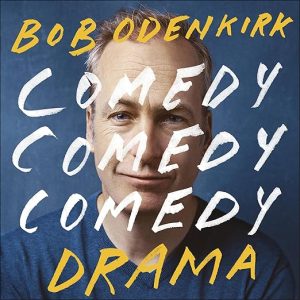
Bob Odenkirk narrating his own memoir Comedy Comedy Comedy Drama is not a neutral casting decision, it is the entire case for the audiobook's existence. Odenkirk's voice is his instrument, the thing that made Mr. Show work, that gave Saul Goodman his motor-mouthed legal armor, that sold the quiet devastation of Jimmy McGill's decline across six seasons of Better Call Saul. Hearing him deliver his own account of how he became these things, in his own cadences and with his own pauses, is a qualitatively different experience from reading the text on a page.
The memoir covers the full arc: Chicago comedy clubs in the early 1980s, the grind toward Saturday Night Live as a writer, the cult success of Mr. Show with David Cross on HBO, years of being visible enough to be known but not successful enough to be celebrated, and then the unexpected late career transformation, Saul Goodman in Breaking Bad, the full flower of Better Call Saul, and finally the action film Nobody, in which Odenkirk reinvented himself physically at age 52 in ways that surprise everyone including him. The subtitle "a classic showbiz tale told by a determined idiot" is not false modesty. Odenkirk applies real analytical pressure to his own limitations.
The Review
Reviewer Katherine Y identifies what makes the memoir structurally unusual: it is the story of a comedian becoming a dramatic actor, a reversal of the more familiar direction. The expectation is that comics play it straight when given the chance; Odenkirk's trajectory did the opposite, and then reversed again with Nobody. That oscillation, comedy to drama to action, with comedy always as the underlying substrate, gives the memoir an arc that is neither the standard rise-and-triumph narrative nor the standard fall-and-redemption one. It is something harder to categorize: a career built on lateral moves and stubborn persistence in unflashy directions.
Reviewer Ramin D. captures the other quality that makes Odenkirk's self-presentation effective: he is "real" in a way that the memoir format sometimes flattens in celebrity hands. The "nimble and straight-forward" quality Ramin identifies comes through more vividly in audio than it would on the page precisely because Odenkirk is not performing a persona here. He is the same person who wrote the material, delivering it with the same instinct for when to play something for laughs and when to let a painful moment land without cushioning.
Reviewer P. Howard, who came to Odenkirk entirely through Breaking Bad and Better Call Saul, notes that reading the memoir made them "almost hear him talking as Saul." The inverse is true in the audiobook: listening to Odenkirk narrate his own story, you hear traces of every character he has been, the comic energy of the sketch writer, the watchful patience of the dramatic actor, the quiet confidence of someone who knows he survived a long period of being underestimated.
Why Comedy Comedy Comedy Drama Works as an Audiobook
The memoir's treatment of Mr. Show is one of its most valuable sections for anyone interested in the history of American sketch comedy. Mr. Show occupies a strange position in the genealogy: too cult to have mainstream recognition at the time, but influential enough that almost every major comedian of the next generation cites it as foundational. Odenkirk writes about the show's creation, its internal politics with David Cross, and its cancellation with the frankness of someone who has had twenty years to process what it meant. That material is genuinely illuminating, not just personal inventory.
The SNL section is equally instructive, though for different reasons. Odenkirk was a writer at SNL at a specific cultural moment (the early 1990s) and his account of the show's internal hierarchy, the gap between what writers create and what performers execute, and the specific way SNL can both launch and constrain a career, adds texture to a show that has been written about extensively. His perspective is sideways to the standard SNL narrative, which makes it fresh.
At 7 hours and 52 minutes, the audiobook is efficient without feeling compressed. Odenkirk does not pad. The humorous tangents the synopsis promises are real, there are digressions that are genuinely funny rather than memoir filler, but they connect back to the main thread rather than floating free as set pieces. The structure is looser than a traditional memoir, which suits Odenkirk's comedy-writer instincts and makes the audio format feel organic rather than repurposed from print.
The Caveats
A note on expectations: this memoir is not primarily about Breaking Bad or Better Call Saul. Both shows receive treatment, but the center of gravity is the long middle period, the years between early SNL success and late-career critical recognition, that preceded the Vince Gilligan collaboration. Listeners who come primarily as fans of Saul Goodman will find the comedy history sections require some patience, and they are more densely referenced (Chicago improv, cult sketch shows, specific comedy club eras) than the TV drama sections. Those sections are the more interesting parts of the book, but they assume some appetite for comedy history as a subject.
The Nobody material, covering Odenkirk's physical transformation for the 2021 action film, is one of the memoir's more surprising threads. Odenkirk writes about training with genuine engagement, not as a health-journalism sidebar but as a late-life investigation into what the body can still do when pushed past its expected parameters. That section has an unexpected emotional register: physical transformation as a form of self-expression for someone who has spent a career performing through voice and facial expression rather than physical action.
Who Should Listen to Comedy Comedy Comedy Drama
Fans of Better Call Saul and Breaking Bad who want to understand the person behind Saul Goodman will find this essential listening. Comedy history enthusiasts, particularly those interested in the 1980s-1990s Chicago and Los Angeles improv-to-sketch pipeline, will find the backstory sections substantive rather than merely personal. Anyone interested in careers that take unexpected shapes, that look like failure from the outside for long stretches before becoming something else, will find Odenkirk's account more honest about the experience than most showbiz memoirs attempt.
Listeners looking for comprehensive Better Call Saul production stories or deep dives into the Breaking Bad collaboration with Vince Gilligan should calibrate expectations, that material is present but not the heart of the book. The heart of the book is the comedy, as the title insists.
Does Bob Odenkirk's self-narration add significantly to the audiobook experience compared to reading the print version?
Yes, substantially. Odenkirk's comic timing, natural delivery of self-deprecating material, and instinct for when to play something straight versus when to lean into the joke make this a qualitatively different experience in audio. Several reviewers who knew his work on screen note how fully his voice inhabits the material. This is one of those audiobooks where the author-narrator combination is a genuine argument for the format.
How much of this audiobook focuses on Better Call Saul versus Odenkirk's earlier comedy career?
The emphasis is on the earlier career, SNL writing, Mr. Show, the long middle years of being known but not celebrated. Better Call Saul and Breaking Bad receive meaningful coverage but are not the center of gravity. Listeners coming primarily as Saul Goodman fans should expect roughly a third or less of the runtime to cover that period directly.
At just under eight hours, does this audiobook feel complete or does it skip over important periods in Odenkirk's career?
The runtime is efficient rather than rushed. Odenkirk covers the major periods with enough specificity to feel substantial, and the memoir's looser structure suits the audio format. The Nobody physical transformation arc and the Larry Sanders Show years could both have supported more detail, but what is present holds together without feeling like a summary.