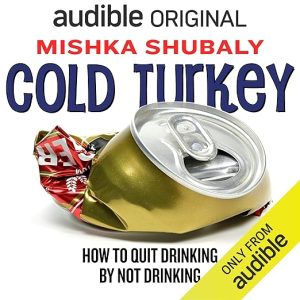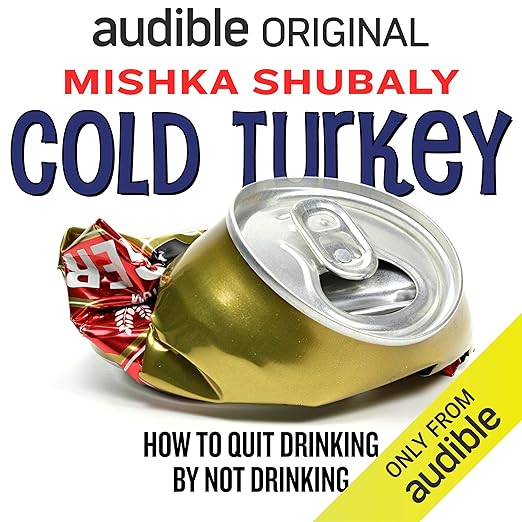
- Performance: Shubaly narrates his own work with the rough, unguarded authenticity of someone who has actually lived it; the self-narration is not a performance but a continuation of the writing.
- What it covers: Sobriety and recovery, DIY approaches to addiction, the gap between early recovery and the rest of your life
- Feel: Raw and darkly funny, like getting good advice from someone who has made every mistake first
- Our call: One of the more honest and practically grounded sobriety guides available in audio, particularly valuable for listeners who have felt alienated by 12-step orthodoxy.
I came to Cold Turkey on a Thursday afternoon while folding laundry, which feels like the wrong context for a book about surviving the first month without alcohol, but turned out to be exactly right. Mishka Shubaly's voice is so matter-of-fact, so bone-dry even when describing things that should not be funny, that it settles into your day without announcing itself. By the time I realized I'd stopped folding and was just standing there listening, he was already deep into what he calls the soul-sucking experience of learning to live a normal life in the early stages of sobriety.
This is an Audible Original, which means it was designed for listening from the ground up, and the format suits Shubaly precisely. He is a Kindle Singles author with a built-in readership, and the audio version adds something the text cannot: the weight of his own voice on his own story. He has been sober for over a decade, and the decade shows, not as distance from the material but as the particular calm of someone who no longer needs to impress anyone with how bad things got.
Where This One Lands
The book's central argument is that there is no one-size-fits-all path to sobriety, and that the dominance of 12-step programs, while beneficial for many people, has left a significant gap for those who need a different approach. Shubaly is not dismissive of AA; he is precise about where his own experience diverges from it and offers a practical, week-by-week roadmap for the first thirty days that is grounded in what actually helped him rather than in what is supposed to help.
What distinguishes this from other recovery narratives is its specificity. He understands, for instance, that for the first three days, the only achievable goal may be eating all the pizza and all the greasy Chinese food. That line lands because it is exactly right, and because most sobriety guides skip the part where the goal is simply not to drink today, then go eat something terrible and feel grateful you did. The tactical granularity of the early chapters is the book's real contribution to the genre.
Why Cold Turkey Works as an Audiobook
Shubaly narrates his own book, and this matters enormously. A professional narrator could reproduce the words without the specific texture of a man who spent years trying to drink himself to death and survived long enough to find it somewhat absurd. The reviewer who described him as "cringe-worthy honest" is right, and that honesty is audiophile-grade when delivered in Shubaly's actual voice. He becomes, as the synopsis suggests, a cheerleader, but not the inspirational-poster kind. More the kind who shows up and says: yes, this is miserable, here is what might help, I will wait.
At four hours and thirty-two minutes, Cold Turkey is a manageable commitment, and the structure rewards listening in short sessions that mirror the day-by-day framework of the content. One reviewer noted that the author sometimes takes detours into personal rants that feel tangential, and that is fair, but Shubaly consistently circles back to practical, usable advice. The rants, when they come, are usually about the cultural myths surrounding addiction, and they are informed enough to be worth sitting through.
What Gives Us Pause
The book is explicitly not for everyone struggling with addiction. Shubaly acknowledges this directly, and listeners looking for a medically supervised framework or a spiritual recovery pathway will find the approach insufficient. It is also worth knowing that this is a personal account, not a clinical guide, and that some of what worked for Shubaly may not translate universally. One reviewer pointed out that the book left them thinking about things they had previously insisted were the only way, and that productive discomfort is worth flagging: Cold Turkey challenges assumptions held by people on both sides of the recovery conversation, including those who think AA is the only answer and those who think they do not have a problem worth addressing.
The absence of a print edition, noted by a reviewer who wanted to annotate it, is a genuine limitation. The content is dense enough with practical advice that many listeners will wish they could mark pages.
Should You Listen to Cold Turkey?
This is most directly useful for people in or approaching early recovery who have found 12-step programs alienating or insufficient. It also works well for family members and friends trying to understand what early sobriety actually feels like from the inside, which no pamphlet or clinical description adequately captures. Listeners who are not personally dealing with alcoholism but are curious about the mechanics of behavioral change will find value in Shubaly's framework even if the specific subject is not their situation. Those looking for a medically rigorous or spiritually grounded program will want to supplement this with other resources.
Before You Listen
Does Cold Turkey require you to follow the 12-step program?
No, and in fact the book explicitly positions itself as an alternative for listeners who have found 12-step programs unsuitable. Shubaly is not hostile to AA but provides a secular, self-directed roadmap for the first thirty days of sobriety based on his own experience.
Is Shubaly's self-narration appropriate for this kind of material?
Yes, and it is probably the book's greatest asset. The self-narration adds authenticity that a professional narrator cannot replicate; hearing the author's own voice tell his own story closes the distance between the text and the experience it describes in a way that serves the material directly.
Does Cold Turkey address the first month only, or does it cover longer-term recovery?
The explicit focus is the harrowing first month of sobriety, but Shubaly's observations about what awaits on the other side of that initial period run throughout the book. Listeners wanting a guide specifically for months two through twelve will need additional resources.