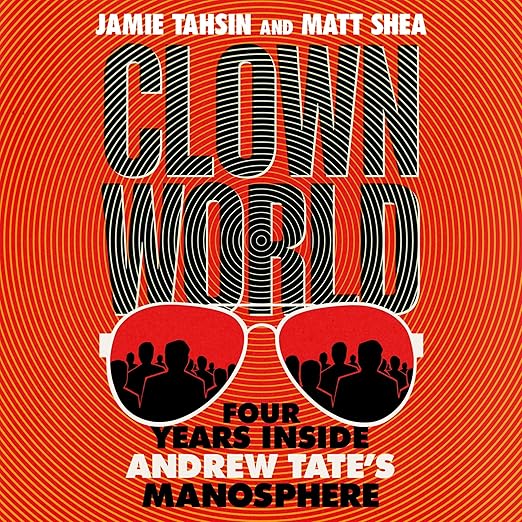
Jamie Tahsin and his documentary partner Matt Shea gained access to Andrew Tate's Bucharest compound and War Room in August 2022, the same month Tate became the most-Googled person on the planet. That access produced the documentary that brought the first women forward to publicly accuse Tate of sexual and physical violence. Clown World, the audiobook expansion narrated by Tahsin himself, takes that investigation into long-form territory: a book-length account of how a failed kickboxer and reality television reject built the most influential misogynist brand of the internet era. Jon Ronson called this "the book about Andrew Tate," and the claim is grounded in what the investigation actually accessed rather than what it assembled from public sources.
Sourcing From Inside Tate's Own War Room
The audiobook's strongest quality is its sourcing. Tahsin is not reconstructing Tate's world from outside; he was inside it, and the account carries the specific texture of that access. The War Room, Tate's network of paid male subscribers organized around his particular ideology of wealth, dominance, and contempt for women, is described through direct observation rather than secondhand reporting. Reviewer Joanna Prestwich described the book as employing "immersive journalism" and offering a "multifaceted narrative" that covers Tate himself, his entourage, and the women who came forward to describe their experiences. That triangulation of the machine, the operator, and the people harmed by it is what distinguishes this from the wave of reactive commentary that followed Tate's viral year.
Ian Hislop described it as "a fascinating and disturbing investigation." Zoe Williams wrote that it "should be required reading for anybody worried about the rise of incel culture and Andrew Tate." These are credible endorsements from people with established standards for this kind of journalism, and they reflect accurately what the book delivers. Reviewer Tardigrade noted going in knowing little beyond the outrageous statements and criminal charges, and finding the investigation genuinely illuminating. That is the experience this audiobook is designed to provide: a structural account of how Tate's influence was built, sustained, and defended, rather than a personality profile or a moral verdict the reader is invited to share without evidence.
Tahsin's First-Person Authority Beats a Rehash
Tahsin narrating his own work is a significant asset here. He was present for the events he describes, and the first-person authority of that experience comes through in the audio. This is investigative memoir as much as journalism, and a third-party narrator would put a layer of distance between the listener and the material that Tahsin's own voice removes. At seven hours and eleven minutes, the audiobook moves with documentary pacing, establishing context, building the case, and introducing testimony in a sequence that feels reconstructed from evidence rather than organized for narrative convenience.
One review in the set calls the book "just a rehash of their video documentary," a critique worth acknowledging because Tahsin and Shea did produce the source documentary before this book existed. Listeners who have watched that documentary will find familiar material here, expanded into longer-form prose with additional context and reported detail. Whether that expansion justifies a separate engagement is a legitimate question. For those who have not seen the documentary, the book stands entirely on its own as an investigative account of considerable ambition and specificity.
Gonzo Journalism Meets an Unfinished Court Case
This audiobook describes an ongoing criminal case. At the time of writing, Tate faced charges of human trafficking, rape, and participation in an organized crime group in Romania. Listeners should be aware that the legal proceedings referenced in the book are part of an evolving situation, and the audiobook represents a snapshot of the investigation as it stood at the time of publication. Tahsin and Shea's documentary work is described as having contributed to women coming forward publicly, and the book documents that specific timeline in detail, but the criminal case has its own trajectory that extends beyond what the audiobook covers.
The genre is part Gonzo journalism and part cultural analysis, and the tone shifts accordingly between chapters that are close-in and observational and chapters that pull back to analyze the ideology Tate has monetized. Those tonal shifts are deliberate and clearly signaled, but listeners who prefer uniform documentary reporting may find the Gonzo sections more personal than expected for a journalistic account. Zing Tsjeng described it as a "sobering, strange and eye-opening look into the toxic manosphere," and the word "strange" is accurate: the material itself is strange, and Tahsin leans into that quality rather than smoothing it out.
Parents of Teenage Boys Need This Framework
This audiobook is for listeners who want to understand the structural mechanics of how a polarizing online figure built an ideological and commercial empire, not as a character study but as an investigation of the systems that made it possible. Parents of teenage boys who have encountered Tate's influence in their children's media consumption will find the book particularly useful as a framework for understanding what is being sold and how. Listeners who have followed the story through news coverage will find the investigative depth here considerably greater than what reactive journalism provided. Those who want a purely neutral account should note that Tahsin is a journalist who investigated Tate specifically because of the harm he documents; the perspective is critical, but the conclusions are grounded in direct reporting rather than assertion. That distinction matters for how one evaluates the audiobook: the analysis is advocacy-adjacent, but the underlying journalism is evidenced, and the difference between the two is visible in how Tahsin handles the sections where the reporting and the conclusion are distinct activities.
A Few Questions About Clown World
Does this audiobook cover Andrew Tate's criminal charges in Romania?
Yes. The charges of human trafficking, rape, and organized crime participation are described in context of the investigation. Listeners should note that the book represents the status of the case as of publication, and the legal proceedings have continued to develop since then.
Is the Clown World audiobook different from the documentary Tahsin and Shea made?
The documentary preceded the book and covered the core investigation. The audiobook expands that material into long-form prose with additional context, reported detail, and cultural analysis of the ideology Tate built. Listeners familiar with the documentary will find the book extends rather than simply repeats it.
Does Jamie Tahsin's self-narration add anything to the audiobook experience?
Substantially, yes. Tahsin was present for the events he describes, including inside Tate's War Room, and narrating his own account gives the investigation a first-person authority that a third-party narrator could not replicate. The insider voice is particularly effective in the compound and War Room sequences.
Is this audiobook appropriate for listeners who want to understand the manosphere and incel culture more broadly?
Yes, though the focus is specifically on Tate as a case study rather than a comprehensive overview of those movements. Zing Tsjeng described it as a sobering look into the toxic manosphere, and that framing is accurate: Tate is the entry point into a broader ideological ecosystem that the book maps through his particular version of it.