Key Details
- Narration: John Telfer delivers Alex Quigley's practical, evidence-grounded prose with clarity and composed authority - he reads like an informed colleague rather than a textbook, which suits the material's accessible tone.
- Themes: vocabulary instruction as equity, academic language in schools, teacher-led cross-curricular intervention
- Mood: Focused and practical, intellectually serious without becoming inaccessible
- Verdict: Alex Quigley makes a compelling case that vocabulary instruction is among the highest-leverage interventions available to classroom teachers, and this audiobook delivers the research and practical tools in under six hours.
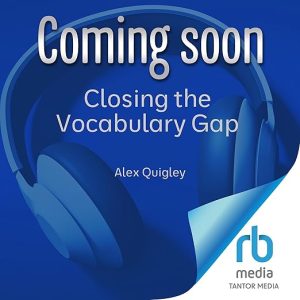
Alex Quigley's central argument in Closing the Vocabulary Gap is precise and somewhat uncomfortable: the distance between students who arrive at school word-rich and those who arrive word-poor is one of the most durable predictors of academic outcome, and most teachers are not doing nearly enough about it because the curriculum rarely makes space for it and the training rarely addresses it. The audiobook, narrated by John Telfer across five hours and forty-four minutes, is Quigley's attempt to change both conditions simultaneously - by making the case for why vocabulary matters as much as it does, and then providing the practical tools to address it within the constraints of a real working classroom.
Quigley Diagnoses a Vocabulary Gap Teachers Miss
Quigley is a practitioner-researcher in the specific sense that makes that compound noun actually meaningful: he has spent years in classrooms, and his observation that the vocabulary demands of an academic curriculum have increased substantially while support for meeting those demands has not is grounded in what he has watched happen rather than derived from a distance. His argument is not that teachers are failing. It is that the problem is structural and underprioritized, and that the fifty thousand words a child needs to access academic text represent fifty thousand potential intervention points that are largely being missed because the professional conversation has not adequately established why they matter.
Reviewer Liam Bellamy, who purchased the book based on the sample alone, described being immediately struck by the density of information, analysis, and practical advice on offer - a quality that holds throughout the full text. Quigley synthesizes research from cognitive science, linguistics, and developmental psychology alongside classroom evidence without condescending to his teacher audience by flattening the research into slogans. He trusts the professionals he is writing for to evaluate evidence and adjust their practice accordingly, which is a more respectful posture than most teacher-directed professional development texts manage.
Tier Two Words Like Infer and Justify
The book's central practical contribution is the framework around what Quigley and others call Tier Two vocabulary - the academic and domain-crossing words that students encounter in text but rarely in speech, words like infer, justify, explicit, or contemporary that appear across subjects and assessment tasks but receive almost no systematic instruction anywhere in the curriculum. Quigley's argument that these words are disproportionately important, and that their instruction is being neglected by default rather than by design, is one of the book's most actionable contributions.
Telfer Reads Like a Well-Considered Colleague
Telfer's narration is a strong match for the material. Quigley's prose is structured clearly - each chapter makes a specific argument and then pivots to practical application - and Telfer reads it with the composed authority that makes complex information feel navigable without oversimplifying it. He does not sound like he is delivering a lecture; he sounds like a knowledgeable colleague presenting a well-considered position. At under six hours, the audiobook moves at a pace that rewards sustained listening rather than episode-by-episode sampling, and Telfer maintains consistent energy across the full runtime without the kind of monotony that can develop in professional development audio.
The argument for vocabulary as a cross-curricular responsibility - not the exclusive territory of English teachers but the shared obligation of every teacher who uses academic language in their classroom - is made with examples drawn from science, history, mathematics, and literature instruction. Quigley is not writing for a specialist audience within English education; he is writing for the full breadth of secondary and primary teachers who encounter vocabulary gaps in their students and currently lack a systematic way to address them. That breadth is the book's practical ambition, and it largely delivers on it within the constraints of a relatively short text.
British Curriculum References Need Translating Elsewhere
The book's structural references - key stages, the national curriculum's specific demands, the assessment context in England - assume a British educational system. Teachers working in the United States, Australia, or other systems will need to translate the structural references to their own context, though the underlying arguments about vocabulary gaps, Tier Two words, and teacher-led intervention are entirely transferable without loss. Reviewer MidwestWriter, an ESL and EFL tutor in the United States, noted planning to purchase specifically because the framework applies across national contexts.
One reviewer identified an error in the Appendix vocabulary list - a mislabeled example - which has been noted since publication. This does not affect the main argument or the practical classroom tools, but it is worth knowing for teachers who plan to use the appendix materials directly. The audiobook format also makes the book's activity frameworks and classroom tools harder to reference than the print version. Listeners who want to use specific exercises with students will benefit from having a print or digital copy alongside the audio rather than relying on the audiobook alone for practical implementation.
Pair the Audio Argument With a Print Toolkit
This audiobook is primarily for classroom teachers across all subject areas who want a research-grounded case for why vocabulary instruction matters and practical tools for beginning to address it. It is also valuable for heads of department grappling with curriculum design, school leaders making decisions about literacy intervention priorities, and teacher educators preparing the next generation of classroom practitioners. The audio format suits commuting teachers who want substantive professional development content rather than motivational filler. Reviewer Amazon Customer's summary - vocabulary is something we all should be teaching - is the book's thesis compressed to eight words. Those who want the classroom activity frameworks in usable reference form should have a print or digital copy as well as the audio; the listening version is the argument, and the print version is the toolkit.
Frequently Asked Questions
Is this audiobook useful for teachers outside the UK curriculum system?
Yes, with some translation required. The structural references - key stages, the national curriculum - are specific to England, but the research base and the practical vocabulary instruction strategies are entirely applicable in other educational contexts. US teachers, ESL and EFL tutors, and international educators have all reported finding the core argument and tools directly usable after minimal contextual adjustment.
Does the audiobook format work well for the practical classroom strategies Quigley recommends?
For understanding the research and the argument, yes. For the specific classroom activities, vocabulary lists, and the appendix materials, the audio format is less practical than the print version. Teachers who want to use the book's frameworks directly with students will benefit from having a physical or digital copy alongside the audiobook rather than relying solely on the listened version.
How does John Telfer's narration handle the academic content of Closing the Vocabulary Gap?
Telfer reads the material with clear authority and appropriate composure - he treats the research sections and the practical sections with equal weight, which matches Quigley's intent in structuring each chapter to move between both. The narration feels like a knowledgeable colleague presenting a case rather than a formal lecture, which keeps the nearly six-hour runtime from becoming taxing.
Does Closing the Vocabulary Gap require a background in linguistics or cognitive science to follow?
No. Quigley writes for classroom practitioners rather than academics. He references the relevant research but explains it accessibly rather than assuming specialist knowledge. The book's accessibility is one of reviewer Liam Bellamy's specific points - Quigley synthesizes complex research findings into practical language without losing the evidence base that gives the recommendations credibility.