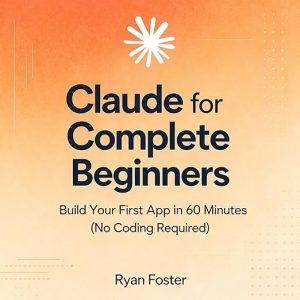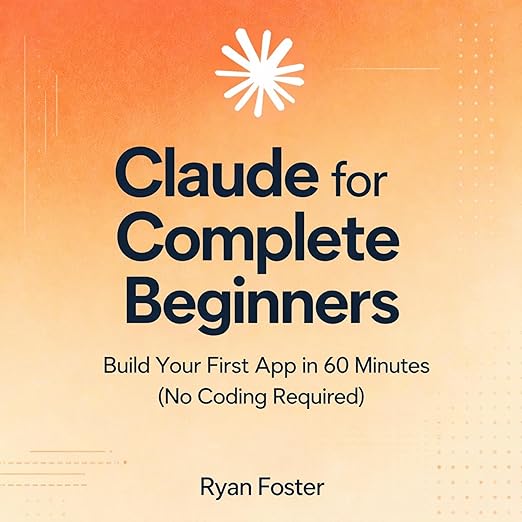
The reader credit here is a sentence, not a name. Where most listings put a narrator, this one puts Douglas Birk's voice replica, which is a disclosure rather than a credit: a human voice was modeled, and the model read the book. That single field tells you more about the audiobook than the paragraphs of content description above it, because it settles what kind of listening you are buying before you reach the question of whether the instruction is any good. Credit where it is due, the disclosure sits in the field a buyer actually reads.
The instruction targets people who have never written a line of code and want a working application by dinner. The record files that under Programming and Software Development, a category whose entire premise the book argues against. Ryan Foster's pitch is that plain-English conversation with an AI assistant, plus a live preview panel, moves a beginner from idea to deployed web app inside a single hour. BGB Learn released it in March 2026, and the rating and response columns on this record are both still empty.
That sixty-minute claim is the hook and it deserves scrutiny. What Foster promises is a four-phase workflow ending in a shareable application, and the examples named are a task manager, a habit tracker, a unit converter, and a custom calculator. Those are all client-side tools: they run in a browser tab, hold their data locally, and need no server behind them. Within that boundary the claim is credible. Outside it, anything requiring accounts, a shared database, or work continuing after you close the tab is a different project, and the description never draws that line.
Most transferable is the prompt structure, which the copy calls the Who-What-See formula: who the app is for, what it does, and what the screen shows. Beginners fail at AI-assisted building for a boring reason, which is that they describe the feeling of the app instead of its behavior. A three-slot template fixes most of that on the first attempt, and it keeps working long after this particular tool version has been replaced by the next one.
Publishing Through GitHub Pages Without Breaking What Works
The chapters that justify the purchase are the last two: publishing to the open web through GitHub Pages, and adding features without breaking what already works. The first build is the easy part, and almost anyone can get something on screen in an afternoon. The wall people hit comes afterward, when the thing exists but nobody else can reach it, or when the sixth change quietly undoes the third. A guide that spends its final third in that territory is spending it in the right place.
The audience list in the description is unusually honest for the genre: complete beginners, small business owners who need an internal tool and cannot justify a developer, professionals who want a dashboard or calculator for their own use, and teachers who want a repeatable exercise. Those four groups are performing the same task in different rooms. A runtime of three hours and ten minutes plus a workflow you can run alongside the audio makes this a reasonable weekend project, provided the browser stays open while you go.
A Replicated Voice Carries Timbre but Not Intent
The synthetic reading is the practical problem, and it matters more here than it would in a novel. Instructional audio depends on emphasis: the difference between a step you can skip and a step that will cost you an hour is carried by how the sentence is said. A replicated voice reproduces timbre well and intention unevenly. Nothing in that makes the content unusable, though it does mean treating this as a spoken outline you follow with your hands, and not as something to absorb while driving somewhere.
The second caution is dating. A book about one feature of one AI product, in a market that revises itself every few months, has a short usable life, and the four-phase workflow will outlast the interface details it was written against. No prompt library is offered alongside the recording either, and a guide built on templates is a guide whose templates you will want to copy and paste instead of transcribing by ear.
Office Managers and Tutors Are the Target
Someone with an idea small enough to describe in two sentences and no route to building it is the target here: the office manager who wants a shift calculator matching how the shifts actually run, the tutor who wants a timer for one classroom routine, the founder who wants a rough quoting tool before paying anyone to make a real one. If that describes you, three hours and ten minutes with a browser open is a fair trade for a deployed thing carrying your name.
Move along if you already build software, since the workflow will be obvious and the pace deliberately slow. Move along too if you cannot work alongside the audio, because passive listening leaves you holding a description of a process instead of the process itself. And move along if synthetic reading is a dealbreaker across three hours of step-by-step instruction, because the text version of this material loses nothing. What the book does have is a narrow, honest scope and a workflow that will survive the tool it was written for, which is more than most guides in this category manage.
A Few Questions About Claude for Complete Beginners
Who or what reads the audiobook, given what the narrator field says?
The field reads Douglas Birk's voice replica, meaning a synthetic model of a human voice performs the text. No live reading session is claimed anywhere. The disclosure sits on the listing instead of being buried, so buyers can decide before purchase whether three hours of synthesized instruction suits them.
What kinds of apps does the sixty-minute workflow actually produce?
Browser-resident tools, in short. The four examples the copy names all run locally in a tab with nothing behind them. Anything needing user accounts, shared data, or processing that continues after the tab closes falls outside the boundary this workflow describes, and the description never draws that line for you.
Is this audiobook useful without a computer in front of you?
Much less so. The four-phase workflow is a sequence of actions, and passive listening yields a summary of a process rather than the ability to run it. Treat the three hours and ten minutes as a guided session with a browser open, not as commute material.
How quickly will the content date?
Faster than most instructional books. It targets one feature of one AI product, and interfaces in that market change within months. The prompt structure and the deployment and iteration habits should outlive the specifics, while screen-by-screen descriptions will age first. The listing says nothing about an update policy.