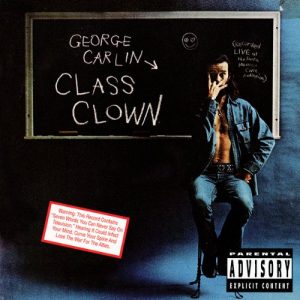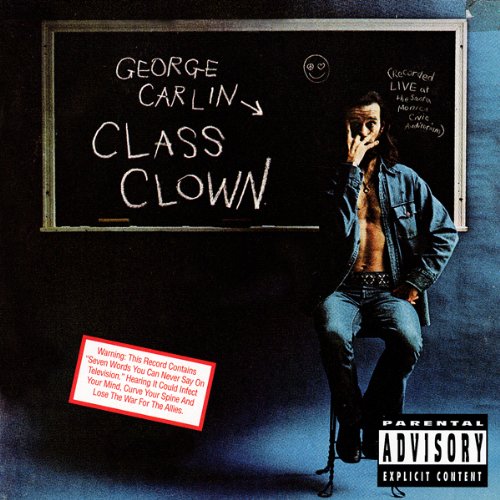
George Carlin's Class Clown is one of the most consequential audiobook recordings in American comedy history, and I do not use that framing loosely. This 1972 album, Carlin's third, contains the monologue that would eventually reach the Supreme Court. The FCC cited "Seven Dirty Words You Can Never Say on Television" as the benchmark for broadcast indecency after a New York radio station played it in 1973, and the resulting legal battle shaped broadcast regulation for decades. Knowing that history does not diminish the comedy. If anything, it sharpens it: Carlin understood, precisely and early, that language policing was institutional control wearing a prudish mask.
At 48 minutes, this is a short but dense listening experience. The album is structured as a live performance across nine tracks, moving from autobiographical Catholic school material through a meditation on wasting time, into the climactic "Seven Words" routine. Carlin's narration of his own work is the only delivery that has ever existed for this material. He is the author, the performer, and the recording itself: a document of a specific voice at the specific moment it became something that the government felt it needed to regulate.
Seven Words as the Punchline to an Argument
The Catholic school material that opens the album is where Carlin establishes the thematic logic that runs through the whole performance. "I Used to Be Irish Catholic" and "The Confessional" are not just funny anecdotes about parochial education. They are a comedian interrogating the institutions that shaped his language before he knew language was something that could be interrogated. The confessional bit in particular works because Carlin plays the absurdity straight: the ritual, the penance, the transactional structure of Catholic guilt all observed with the precision of someone who was genuinely inside the system and genuinely baffled by it.
The transition into the "Seven Words" routine at the album's end arrives with the weight of everything that preceded it. Carlin has spent the previous tracks demonstrating that language is arbitrary, culturally constructed, and weaponized by whoever holds authority at a given moment. The seven words are the punchline to an argument he has been building for forty minutes. That structural coherence is what separates this album from shock comedy. Carlin was never interested in transgression for its own sake. He was interested in the machinery that made certain words transgressive, and he wanted his audience to see the machinery clearly.
None of This Existed on the Page
The case for listening rather than reading a transcript is straightforward: this is a performance, not a text. Carlin's timing, his vocal shifts between the child's perspective and the adult's retrospection, the precise modulation of his rhythm as the "Seven Words" routine builds toward its conclusion: none of that exists on a page. The album format also preserves the live audience, which is important context. You are not simply hearing Carlin's material; you are hearing an audience in 1972 encountering this material for what was, for many of them, the first time. Their laughter is part of the document.
The nine tracks cover substantial autobiographical territory alongside the more famous linguistic material. The Muhammad Ali and "America the Beautiful" track near the album's end is notably ambitious: Carlin pivots from cultural commentary to something closer to political poetry, and it lands better in performance than it reads in summary. "Heavy Mysteries" is the album's most purely playful section, a riff on existential questions with the lightness of a comedian who has already done the harder philosophical work elsewhere in the set.
Carlin Never Lets the Listener Get Lost
The note that this material contains explicit language and is intended for adults over eighteen years old is accurate and understated. The album is explicit by design and by argument. Carlin is not being gratuitously offensive; he is being specifically offensive to demonstrate that the concept of offensive language is itself a social construction. That is a meaningful distinction, but it does not change the fact that the language is present and frequent in the final track.
The autobiographical material in the opening half of the album dates itself in ways worth noting. Carlin's Catholic school memories are specific to a mid-century Irish-American New York experience that has largely passed from the culture. Some listeners may find the period detail charmingly specific; others may find it requires a minor act of historical imagination. Either way, Carlin contextualizes his world with enough precision that the listener is never lost. The comedy is not dependent on shared cultural memory, only on recognizing the human tendency to invent rules and then take the rules seriously.
Essential Listening for American Comedy History
This audiobook is essential listening for anyone interested in American comedy history, the history of First Amendment law and broadcast regulation, or the work of one of the twentieth century's most intellectually rigorous stand-up performers. It documents a specific cultural moment with the clarity that only a live performance can provide.
Listeners who want gentle humor or who are sensitive to repeated explicit language should approach this one with clear expectations: the back half of the album is not incidentally crude, but deliberately and argumentatively so. Anyone who finds that premise interesting rather than objectionable will find fifty years have not aged this performance significantly. The argument Carlin was making about language and power in 1972 is still being made, and is still being resisted, which may be the most dispiriting thing this comedy album has to tell you.
Is this audiobook a studio recording or a live performance?
This is a live performance recording from the original 1972 album. Carlin performs to an audience, and the crowd reactions are part of the recording. It preserves the energy and timing of the original show rather than presenting a studio-produced reading.
Is the complete 'Seven Dirty Words' routine included in this audiobook?
Yes. The full 'Seven Words You Can Never Say on TV' routine is Track 9, the final track on the album. This is the complete performance as originally released in 1972, including the material that was later at the center of the FCC broadcast indecency case.