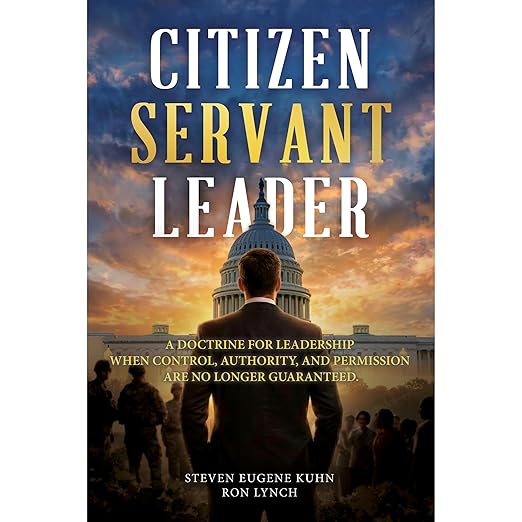
Citizen Servant Leader packs its leadership doctrine into a two-hour, two-minute audiobook, narrated by Amazon's Virtual Voice AI system rather than a credited human reader, for a field manual built on one uncompromising principle stated directly in its synopsis: responsibility always comes before authority.
Positioned deliberately against the usual leadership-book playbook, the synopsis promises no influence tactics, no motivation theory, no personal branding advice. Instead it focuses on behaviors that stabilize systems under pressure, drawing, per the synopsis, on combat experience, high-stakes international business, and decades of organizational leadership across ten countries. Each chapter reportedly combines real-world stories with clear standards and recognizable failure patterns, designed to be practiced under real pressure rather than simply admired from a distance, and the book explicitly frames itself as a practical guide, not a motivational one, stating as much directly and repeatedly in its own description. The synopsis also promises the book examines how silence and passivity quietly erode trust, and frames truth as a structural requirement rather than a moral preference, language that positions the book closer to organizational doctrine than to a typical inspirational business read.
Worth flagging directly: the synopsis repeatedly refers to "the authors" in the plural, discussing what "the authors show" from their combined experience, even though Steven Kuhn is the only credited author on this listing. One review adds a middle name, Steven Eugene Kuhn, but nothing on the listing names a co-author. That is a mismatch between the synopsis language and the byline worth knowing about rather than assuming away as a typo. It does not undermine the content itself, but it is exactly the kind of detail worth checking against the actual product page before you buy, since a listing described in the plural sometimes indicates a co-writer left off the credits.
From the Battlefields of Iraq to the Boardroom
Every one of the five reviews here rates it five stars, and the credentials behind them are unusually specific. One reviewer signs their review as a colonel, USAF, retired, and a former senior director at the U.S. Department of Veterans Affairs, describing Kuhn opening the book not in a boardroom but in the dust of Iraq, watching a Command Sergeant Major stabilize a chaotic situation with a single well-placed question. Another reviewer identifies themselves as an active political candidate, calling the book indispensable and noting Kuhn's military service directly informed the leadership lessons on offer for anyone running for public office. That reviewer specifically calls the book indispensable for a candidate weighing how to talk about leadership on the campaign trail, a fairly specific and unusual use case for what markets itself broadly as a leadership manual.
A third simply calls it a rare gem, a lived-in guide moving from a power mindset to a service mindset, while a fourth describes Kuhn teaching the same lessons across the battlefields of Iraq and the boardrooms of publicly traded companies, framing the book as proof those two settings share more in common than most leadership writing admits. None of the five reviews mention the audiobook's narration at all, focused entirely on the leadership content and Kuhn's credibility as its source, which is worth noting given the book is read by Virtual Voice's synthetic narration rather than a human performer bringing the combat stories to life. Given how many of the five reviews lean on the emotional weight of Kuhn's own lived experience, the gap between that expectation and a synthetic reading voice is one of the more notable trade-offs on this particular listing.
Two Hours for a Doctrine Spanning Ten Countries
Sit with the runtime for a second: two hours and two minutes is short for a book its synopsis calls a doctrine-based field manual drawing on decades of leadership across ten countries. That is a compressed format for material this dense, closer to an extended briefing than an exhaustive manual, despite the framing. Combined with the synopsis's use of "the authors" when only one person is credited, and reviews that add a middle name not present in the byline, this listing carries a few loose threads worth a second look before you buy expecting a definitive multi-author treatment.
Because the narration comes from Virtual Voice rather than a human reader, a book this dependent on vivid combat and boardroom anecdotes, per the reviews, is being delivered by a synthetic voice rather than someone trained to shape those stories vocally. That is a real trade-off for a title whose selling point, according to its reviewers, is lived experience translated into practical guidance rather than abstract theory.
Built to Revisit Before a High-Stakes Decision
Military veterans, business operators, and anyone stepping into leadership without a formal title are the audience the synopsis names directly, and the reviews, several from credentialed military and civic readers, back that framing up. Political candidates and community organizers get a direct nod too, per one reviewer's own experience applying it to a campaign for public office.
A longer, more exhaustive treatment of leadership theory exists elsewhere for readers who want it, and the synthetic narration itself may not suit anyone who wants a human voice carrying these particular combat and boardroom stories. Given the five-star, credentialed reception so far, readers already working in high-pressure institutional settings, military, government, or corporate, seem to be finding the most direct value in it. Its short runtime also makes it easy to revisit specific chapters before a high-stakes decision rather than treating it as a single, one-time listen.
- At its heart: responsibility before authority, leadership under pressure, service over personal branding
- Vibe: Direct and doctrine-focused, closer to a briefing than a memoir
- Short version: A short, credibly-reviewed leadership manual, though the synopsis crediting the authors in the plural against a single byline and the synthetic narration are both worth checking before buying.
Frequently Asked Questions
Is the Citizen Servant Leader audiobook narrated by a real person?
No. This one is read by Amazon's Virtual Voice AI system rather than a named human narrator. The leadership content draws every comment across all five reviews here; not one addresses the audio production itself, so how the synthetic voice handles the book's combat and boardroom stories remains untested by listener feedback.
How long is the Citizen Servant Leader audiobook?
It runs just two hours and two minutes, a compact runtime for a book its own synopsis calls a doctrine-based field manual built on decades of leadership experience across ten countries. Expect a briefing-style pace covering core principles rather than an exhaustive, chapter-by-chapter deep dive into each one.
Does the Citizen Servant Leader audiobook have one author or several?
The listing credits a single author, Steven Kuhn, though the synopsis itself repeatedly refers to the authors in the plural when describing the combined military, business, and leadership experience behind the book. No co-author is named anywhere else on the listing, so that is a mismatch worth noting rather than resolving on your own.